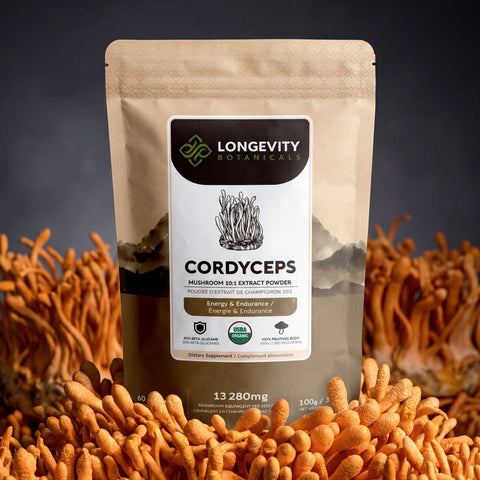
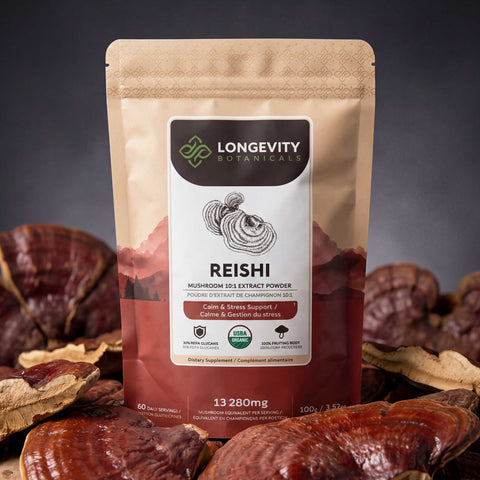
El Cordyceps cuenta con el mayor volumen de estudios renales de todos los hongos que vendemos. Una revisión Cochrane evaluó 22 ensayos aleatorizados en 1746 personas con enfermedad renal crónica, donde los preparados de Cordyceps sinensis tomados junto con el tratamiento convencional se asociaron con niveles más bajos de creatinina sérica. El Cordyceps militaris, la especie que comercializamos, cuenta con un estudio menor en el mismo contexto. El Reishi es el compañero para la noche. Ambos son extractos de agua caliente 10:1, probados para contener al menos un 30 % de beta-D-glucanos.
Cordyceps: the most researched kidney mushroom there is
Cordyceps militaris
Start here. No other mushroom comes close on this: a Cochrane review of 22 randomised trials, plus a trial on the exact species we sell.
Cordyceps has been the kidney tonic of Chinese medicine for centuries, and it is one of the very few traditional remedies anywhere that went on to be tested at scale. It is used in Chinese hospitals as an adjuvant treatment, which is how the trial evidence accumulated.
The wild species is Cordyceps sinensis, which grows on the Tibetan plateau and carries most of the clinical literature. What we sell is Cordyceps militaris, the farmed species, harvested as a bright orange fruiting body, and it now has a human kidney trial of its own.
Ours is a 10:1 hot water extract tested to 30% beta-D glucans. Take it in the morning, daily. It is also the mildest tasting extract we make, so it disappears into coffee.
Extracción
Agua caliente 10:1
Beta-D-glucanos
≥30%
Mejor para
Kidney and stamina support
Lo que dice la investigación
Cochrane reviewed 22 randomised trials covering 1,746 people, which is the most rigorous standard in evidence review and more human data than any other mushroom has on any outcome. In people with chronic kidney disease taking Cordyceps alongside conventional treatment, it was associated with lower serum creatinine across 14 studies, better creatinine clearance across 6, and reduced 24-hour proteinuria across 4, with higher haemoglobin and serum albumin. The reviewers called it potential promise and asked for better-designed trials to confirm it.
And there is now a trial on Cordyceps militaris itself, the species in our pouch. Patients took 100 mg daily of a cordycepin preparation for three months alongside usual care: urinary protein fell 36.7%, blood urea nitrogen 12.5% and creatinine 18.3% (Sun 2019). A second Cochrane review covers its use in kidney transplant recipients, and a 2024 meta-analysis adds more. All of these studied people already under medical care, so read them as research rather than as a promise, and every one is linked below.
The other half of the day. Reishi is the most-studied mushroom we sell and the traditional evening partner to a morning Cordyceps.
Reishi is lingzhi, catalogued in the Chinese materia medica two thousand years ago and reserved then for people who could afford rare things. It sits in the same tonic tradition as Cordyceps and is taken at the opposite end of the day.
It is genuinely bitter, which is the triterpene fraction, so most people take the capsules. Ours is a 10:1 hot water extract from fruiting bodies tested to 30% beta-D glucans, prepared by decoction, which is the method behind nearly all of its human research.
Take it an hour or two before bed. Recovery happens overnight, which is exactly where this tradition places it.
Extracción
Agua caliente 10:1
Beta-D-glucanos
≥30%
Mejor para
Evening restoration
Lo que dice la investigación
Reishi carries the deepest clinical record of any mushroom we sell. A 2025 systematic review pooled 17 clinical trials across 971 participants and found significant improvements in BMI, serum creatinine, glutathione peroxidase and resting heart rate, with the reviewers calling for larger trials to build on it.
It is here as the evening companion to Cordyceps rather than as a second kidney answer. If you are buying one thing from this page, buy the Cordyceps.
Is there really human research on mushrooms and kidney function?
More than on almost anything else in this category. Cochrane, the most rigorous standard in evidence review, assessed 22 randomised trials covering 1,746 people and found Cordyceps associated with lower serum creatinine, better creatinine clearance and reduced proteinuria when taken alongside conventional treatment. There is a second Cochrane review on transplant recipients and a 2024 meta-analysis on top. All of it is linked at the foot of the page.
Was that research on the species you sell?
The bulk of it is on Cordyceps sinensis, the wild Tibetan species, which is what Chinese hospitals use. There is also a trial on Cordyceps militaris, the farmed species we sell: patients took 100 mg daily for three months and urinary protein fell 36.7%, blood urea nitrogen 12.5% and creatinine 18.3%. We tell you which is which because most sellers will not.
I have a kidney condition. Should I take this?
Talk to your doctor first. Every trial above studied people who were already under medical care, taking Cordyceps alongside conventional treatment rather than instead of it, and that is the right model. The kidneys also clear most of what you swallow, so anything you add is worth checking rather than assuming.
Which one should I take, and when?
Cordyceps, in the morning, daily. That is the one with the kidney research behind it. Add Reishi in the evening if you want both ends of the day covered, though it is a companion here rather than a second answer.
How long before I judge it?
The militaris trial ran three months and the pooled trials run over weeks to months. Give it eight weeks minimum. These were studied as daily adjuvants over a sustained period, not as something taken occasionally.
What does Cordyceps taste like?
Mild, faintly savoury and slightly sweet. It is the easiest extract we sell to hide in a drink and it goes into coffee more cleanly than anything else in the range.
The largest body of kidney research on any mushroom, assessed by Cochrane, the most rigorous standard in evidence review. Twenty-two randomised trials covering 1,746 participants. In people with chronic kidney disease not on dialysis, Cordyceps preparations taken alongside conventional treatment were associated with lower serum creatinine across 14 studies, improved creatinine clearance across 6, and reduced 24-hour proteinuria across 4, plus higher haemoglobin and serum albumin. The reviewers called it potential promise and asked for better-designed trials to confirm it.
The trial that puts Cordyceps militaris, the species we sell, into this literature directly. Patients with chronic kidney disease took 100 mg daily of a cordycepin preparation from C. militaris or placebo for three months, alongside their usual care. Urinary protein fell by 36.7%, blood urea nitrogen by 12.5% and creatinine by 18.3%, and the lipid profile improved. Run by the nephrology department of a Chinese general hospital, and it carries a 2020 correction notice.
A second Cochrane review, this one on Cordyceps used as an adjuvant alongside standard immunosuppression in kidney transplant recipients, where it has been part of routine practice in China for years. Evidence that this is an established clinical use with real institutional history behind it, not a wellness trend.
The most recent pooled analysis, on a fermented Cordyceps preparation widely prescribed in China. Combined with conventional treatment it outperformed conventional treatment alone on kidney function measures, and the network pharmacology section maps the pathways involved. Evidence that this field is still active and still producing results a decade after the Cochrane review.
Three weeks of daily supplementation was associated with a longer time to exhaustion, a higher ventilatory threshold and a higher VO2max; after one week, only time to exhaustion had improved. Read it for what it tested: the supplement was PeakO2, a six-species blend of mycelial biomass grown on oats, so nothing here is attributable to Cordyceps alone, and the three-week result comes from the 10 of 28 participants who continued that far. An encouraging early signal in a field that deserves a bigger trial.