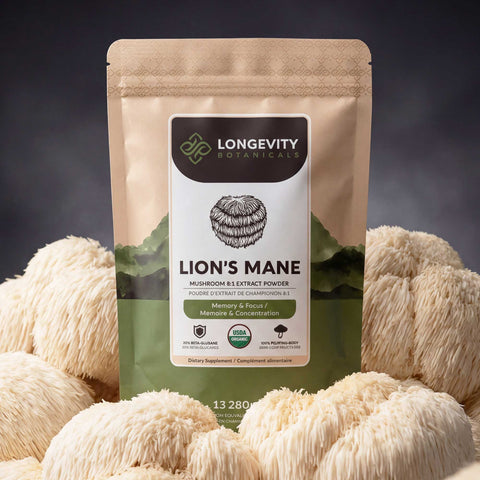
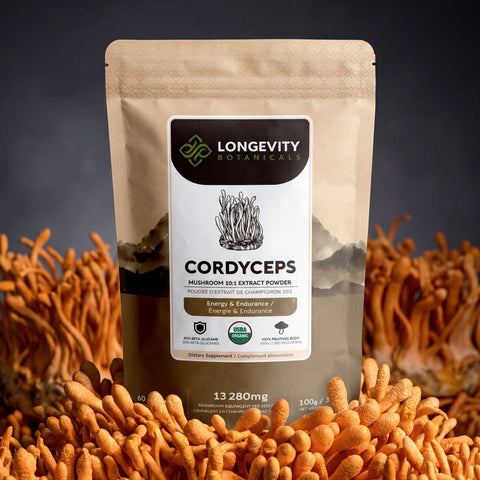
Which one you want depends on the problem. Lion's Mane is the pick if you lose the thread: it is the mushroom with human trials on memory and attention. Cordyceps is the pick if the fog is really tiredness, and it has been studied for exercise capacity. Both go in the morning. Lion's Mane is an 8:1 extract tested to 20% beta-glucans and Cordyceps a 10:1 extract at 30%, both from fruiting bodies.
Start here if the problem is holding a train of thought. Lion's Mane is the only mushroom we sell with human trials aimed at cognition rather than at energy or stress.
The pick when concentration is fine but fuel is not. A good deal of what gets called brain fog is ordinary tiredness under another name, and this is the one taken for that.
Start here if the problem is holding a train of thought. Lion's Mane is the only mushroom we sell with human trials aimed at cognition rather than at energy or stress.
Lion's Mane is the white, shaggy mushroom that grows on hardwood. It is a real culinary species, mild and faintly seafood-like cooked. The compounds it is taken for, hericenones, form in the fruiting body. Erinacines, the family usually named alongside them, form in cultured mycelium rather than in the mushroom, and the human trials were run on fruiting body. That is why what a brand puts in the jar matters more here than anywhere else in the range.
Ours is fruiting body only, hot water extracted at 8:1, and every batch is tested to a minimum of 20% beta-glucans. That is a different product from ground mycelium grown on grain and sold with the grain still in it.
Take it daily rather than when you need it. In the trial most often cited, scores improved over sixteen weeks of continuous use and drifted back down after people stopped.
Extraction
Hot Water 8:1
Beta-D glucans
≥20%
Best for
Memory and attention
USDA Organic
What the research says
This is the one with human trials behind it. In a double-blind study, adults with mild cognitive impairment improved over sixteen weeks of daily use, and the gain receded once they stopped, which is the clearest sign we have that the mushroom was doing the work rather than the calendar (Mori 2009).
A later pilot in healthy young adults reported faster performance on a processing-speed task and lower self-reported stress after four weeks (Docherty 2023). A further trial in cognitively healthy adults over 50 found the same direction at 3.2 g a day of powdered fruiting body (Saitsu 2019). Every paper is linked at the foot of the page.
The pick when concentration is fine but fuel is not. A good deal of what gets called brain fog is ordinary tiredness under another name, and this is the one taken for that.
Cordyceps militaris is farmed and orange. It is nothing like the wild caterpillar fungus it gets pictured beside, which sells for more per gram than gold and is not what anyone puts in a pouch. Ours is a 10:1 hot water extract from fruiting bodies, tested to 30% beta-glucans.
This is the morning one. Most people find it useless late in the day, which is exactly what you would expect of something taken for daytime energy. Nothing about it is sedating.
Its human research is on exercise tolerance and stamina, which makes it the one to reach for when the problem is fuel rather than focus. Lion's Mane is the other half of that answer.
Extraction
Hot Water 10:1
Beta-D glucans
≥30%
Best for
Daytime energy
USDA Organic
What the research says
The relevant research is on Cordyceps militaris, the species we sell. Three weeks of daily supplementation was associated with a longer time to exhaustion and a higher ventilatory threshold, though a single dose did nothing (Hirsch 2017). It tested a six-mushroom blend, so it points at a direction rather than at one species.
A 2025 review of the human work asks for larger studies on better-characterised preparations, which is a fair ask of any supplement. The trial usually quoted against Cordyceps tested Cs-4, a different species, and is listed at the foot of the page with that noted.
Lion's Mane if you can find the energy but lose the thread, because it is the one with human trials aimed at cognition. Cordyceps if you can concentrate but run out of fuel, because its research line is fatigue and exercise tolerance. If you genuinely cannot tell, start with Lion's Mane: it is the more direct answer to the question the page asks.
Can I take both?
Yes, and it is a common pairing. Both are morning extracts and they are taken for different things, so there is no reason to alternate them. Reishi is the one that belongs at the other end of the day.
How fast do they work?
Neither works this afternoon. In the trials that found anything, the effects built over weeks of daily use: sixteen weeks in the Lion's Mane cognition study, three weeks in the Cordyceps exercise study. Give either one a month before you judge it.
Do they contain caffeine?
Neither contains caffeine, and that is the appeal. These build over weeks of daily use instead of spiking and crashing, which is why people stay on them long after they would have abandoned a pre-workout.
When should I take them?
Both in the morning. Cordyceps in particular is wasted late in the day. If you want something for the evening, that is Reishi, and it is on the sleep page rather than this one.
Will they help if I am just not sleeping enough?
Not really, and that is worth saying plainly. If the underlying problem is sleep, the honest answer is on our sleep page and it is Reishi. Neither of these two will substitute for rest, and taking Cordyceps to paper over a sleep debt tends to work about as well as another coffee.
Thirty adults aged 50 to 80 took 3 g a day of powdered Hericium erinaceus or placebo for sixteen weeks. Cognitive scores climbed steadily in the mushroom group and not in the placebo group. Four weeks after they stopped, the gain drifted back, which is the clearest possible sign that the mushroom itself was driving the change.
A double-blind trial in healthy young adults. A single dose produced faster performance on a processing-speed task, and after 28 days of daily use participants reported feeling less stressed. An encouraging early result, and the reason larger trials are now being called for.
Three weeks of daily supplementation was associated with a longer time to exhaustion, a higher ventilatory threshold and a higher VO2max; after one week, only time to exhaustion had improved. Read it for what it tested: the supplement was PeakO2, a six-species blend of mycelial biomass grown on oats, so nothing here is attributable to Cordyceps alone, and the three-week result comes from the 10 of 28 participants who continued that far. An encouraging early signal in a field that deserves a bigger trial.
A survey of the human research on Cordyceps militaris in exercise and recovery. It gathers the positive findings so far and calls for larger trials on consistently characterised preparations, which is the natural next step for an area attracting this much interest.