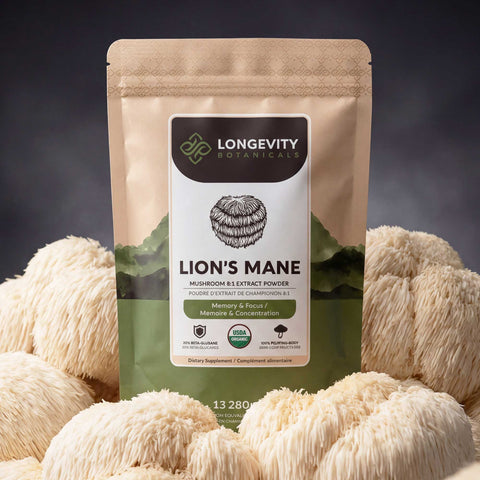
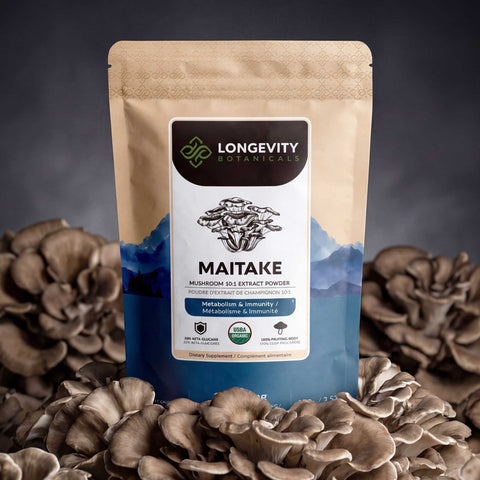
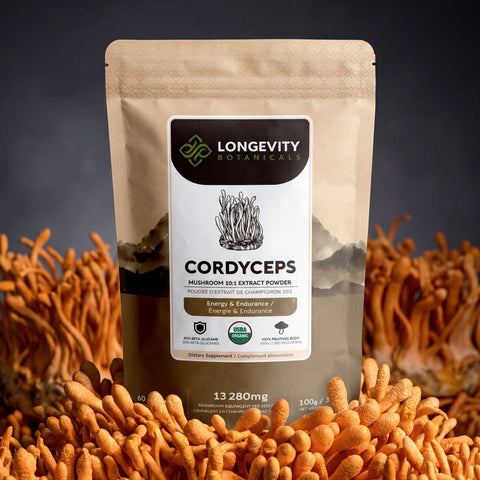
Lion's Mane comes first: in a small twelve-week double-blind trial, adults over 50 taking its powdered fruiting body improved on the Mini-Mental State Examination against placebo. Maitake is second, studied for cognition in healthy older adults. Cordyceps is third, for the fog that is really tiredness, and Reishi fourth, for the sleep behind a clear head. All four are hot water extracts at 8:1 or 10:1. A serving is 1,660 mg of powder or 900 mg in capsules.
Start here. Its trial is the only one on this page run in people who already had a cognitive complaint, and the only one that dosed the mushroom as a supplement rather than as food.
The surprise on this page. Maitake has a randomised, double-blind, placebo-controlled trial of cognition in healthy older adults, and two caveats that keep it second rather than first.
The pick when the problem is not memory but energy. A good deal of what gets called brain fog is ordinary tiredness wearing a different name, and this is the one taken for that.
Start here. Its trial is the only one on this page run in people who already had a cognitive complaint, and the only one that dosed the mushroom as a supplement rather than as food.
Lion's Mane is the white, shaggy mushroom that grows on hardwood. It is a real culinary species, mild and faintly seafood-like when you cook it. The compounds it is taken for, hericenones, form in the fruiting body. Erinacines, the family usually named alongside them, form in cultured mycelium rather than in the mushroom, and the human trials were run on fruiting body. That is why what a brand puts in the jar matters so much here.
Ours is fruiting body only, hot water extracted at 8:1. Eight kilos of dried mushroom go into one kilo of extract, and every batch is tested to a minimum of 20% beta-glucans. That is a different product from ground mycelium grown on grain and sold with the grain still in it, whatever the front of the pack says.
Take it daily rather than occasionally. In the trial most often cited, scores improved over sixteen weeks of continuous use and drifted back down once people stopped.
Extraction
Hot Water 8:1
Beta-D glucans
≥20%
Best for
Memory and focus
USDA Organic
What the research says
This is the one with human trials behind it. In a double-blind study, adults with mild cognitive impairment improved over sixteen weeks of daily use, and the gain receded once they stopped, which is the clearest sign we have that the mushroom was doing the work rather than the calendar (Mori 2009). A later pilot in healthy young adults reported faster processing speed and lower self-reported stress after four weeks (Docherty 2023). Both studies are small and the nerve growth factor research is still preclinical, which is why we point you at the papers rather than at a headline.
The surprise on this page. Maitake has a randomised, double-blind, placebo-controlled trial of cognition in healthy older adults, and two caveats that keep it second rather than first.
Maitake is hen of the woods, the big clustered polypore that grows at the base of old oaks. It is one of the few genuinely good culinary mushrooms in this range, savoury and faintly peppery, and it is sold fresh in good greengrocers.
Ours is a 10:1 hot water extract from fruiting bodies, tested to 30% beta-D glucans. The fraction the research concerns is usually called the D-fraction, which describes its beta-glucan rather than naming a separate ingredient.
Time of day does not matter, unlike Reishi in the evening or Cordyceps in the morning. If you cook, the powder is the more interesting buy: it goes into stock, a pan sauce or scrambled eggs as easily as into a drink.
Extraction
Hot Water 10:1
Beta-D glucans
≥30%
Best for
Cognition and immune support
USDA Organic
What the research says
The trial behind Maitake's place on this page is a randomised, double-blind, placebo-controlled one. Forty-seven healthy Japanese adults aged 60 and over ate bread containing 50 g of maitake daily for eighteen weeks, in three arms. One group improved significantly on the Japanese Montreal Cognitive Assessment against placebo, and natural killer cell activity rose in that same group and tracked the cognitive score (Jogi 2026).
Two things keep it second rather than first, and both belong with the result. It used 50 g of whole mushroom baked into food, not a 10:1 extract. And it was strain-dependent: the trial ran two maitake strains and only one of them produced the effect. That is a genuinely interesting finding and it is not yet a claim about this pouch.
The pick when the problem is not memory but energy. A good deal of what gets called brain fog is ordinary tiredness wearing a different name, and this is the one taken for that.
Cordyceps militaris is farmed and orange. It is nothing like the wild caterpillar fungus it usually gets pictured beside, which is rare enough to be priced like saffron and is not what anyone is selling you in a pouch. Ours is a 10:1 hot water extract from fruiting bodies.
This is the daytime one. Most people take it in the morning and find it useless late. Nothing about it is sedating, which is exactly why it does not belong in an evening routine.
The research line here is exercise tolerance and fatigue, not cognition. That is a different claim from the one Lion's Mane makes, and if your focus problem is really a sleep problem then Reishi is the more honest answer.
Extraction
Hot Water 10:1
Beta-D glucans
≥30%
Best for
Daytime energy
USDA Organic
What the research says
The relevant research is on Cordyceps militaris, the species we use. Three weeks of daily supplementation was associated with better time to exhaustion and a higher ventilatory threshold, though a single dose did nothing (Hirsch 2017). The trial usually cited against Cordyceps tested Cs-4, a different species, and found no endurance benefit (Parcell 2004). A 2025 review of the human work asks for larger studies on better-characterised preparations, which is a fair ask of any supplement.
Sleep and stress cost more focus than most people credit, and Reishi is the one that works on those. It is also the only one of the four taken at night.
Reishi is a hard, woody bracket fungus and it is genuinely bitter, which is why most people take it in capsules rather than stirring it into a drink. If you do use the powder, it sits better in cocoa or something spiced than in coffee.
Hot water extraction is the traditional preparation for Reishi and the method behind nearly all the human research. The decoction is how it has been taken for centuries, and it is what pulls the beta-glucans out. Ours is a 10:1 hot water extract from fruiting bodies.
The case for Reishi on a brain health page runs through sleep and stress rather than through cognition. That is a longer chain of reasoning than the other three need, and we would rather say so than imply a direct effect on memory.
Extraction
Hot Water 10:1
Beta-D glucans
≥30%
Best for
Sleep and stress
USDA Organic
What the research says
Reishi is the most-studied of the four. A 2025 meta-analysis pooled 17 randomised trials across 971 people and found measurable changes, while rating the certainty of that evidence low and calling for better-designed studies. A separate pilot reported improved fatigue and physical wellbeing scores in patients undergoing endocrine therapy (Zhao 2012). Centuries of traditional use, a real body of modern trials, and still room for stronger ones.
Week 1–2Usually nothing, and that is the normal pattern. In the trials the effect built over months. Anyone promising a first-week change is selling something else.
Week 3–4Reported: staying with a task through a long block of work without drifting, and picking it back up more easily after an interruption.
Week 6–8Reported: steadier recall for names and detail. The afternoon dip flattening out is the change people mention most.
OngoingReported effects hold while the daily serving continues. In the Mori trial, scores fell back over the four weeks after people stopped.
What customers report. Individual experience varies; none of this is a clinical claim.
Lion's Mane. Its trial is the one run in people who already had a cognitive complaint, and it dosed the mushroom as a supplement rather than as food. Maitake is the other one here with a cognition trial. Add Cordyceps if the real problem is daytime energy, and Reishi if it is sleep.
Can I take all three together?
Yes. Most people who stack them split the day: Lion's Mane and Cordyceps in the morning, Reishi in the evening. There is no need to start all three at once. One at a time makes it obvious which is doing what.
How long before I notice anything?
Weeks, not days. In the most-cited trial, improvement was measured at sixteen weeks of continuous daily use and faded within four weeks of stopping. Anything faster is pleasant but unexplained.
Does it matter that these are extracts?
It is the thing that matters most. An 8:1 or 10:1 hot water extract concentrates the compounds the research is about, and hot water is what frees them from the chitin cell wall that would otherwise pass straight through you. Ground whole mushroom does neither. Nor does mycelium grown on grain and milled with the grain still in it, whatever the milligram number on the front says.
How strong is the research really?
Early, and you should hear that from us rather than from a comment section. There are real human trials on Lion's Mane and Reishi, and the Cordyceps work is on exercise capacity rather than cognition. All of them are small, and we say so on this page instead of rounding up. Every paper is listed at the foot of the page with a link, so you can read them and decide for yourself.
Will these interact with my medication?
Possibly, and it is not a question to settle from a product page. Reishi in particular has been discussed in relation to anticoagulants. Talk to your doctor or pharmacist before starting, especially if you take blood thinners, immunosuppressants or diabetes medication, or if you are pregnant or breastfeeding.
Thirty adults aged 50 to 80 took 3 g a day of powdered Hericium erinaceus or placebo for sixteen weeks. Cognitive scores climbed steadily in the mushroom group and not in the placebo group. Four weeks after they stopped, the gain drifted back, which is the clearest possible sign that the mushroom itself was driving the change.
A double-blind trial in healthy young adults. A single dose produced faster performance on a processing-speed task, and after 28 days of daily use participants reported feeling less stressed. An encouraging early result, and the reason larger trials are now being called for.
A review of the mechanism research, and one of the more interesting stories in mycology. It separates the two compound families by where they form: hericenones in the fruiting body, erinacines in cultured mycelium. This review states that erinacine A is absent from fruiting bodies altogether. Both families are associated with nerve growth factor activity in cell and animal models, and that work is preclinical; the human cognition trials used fruiting-body preparations. Laboratory work has mapped a plausible route, which is exactly why the human trials are worth running.
International Journal of Molecular Sciences · 2023
Forty-seven healthy Japanese adults aged 60 and over ate bread containing 50 g of maitake daily for eighteen weeks, in three arms. One of the two strains tested, Y10M, improved scores on the Japanese version of the Montreal Cognitive Assessment against placebo; the other, C5304, did not. Natural killer cell activity rose in the Y10M group and tracked the cognitive score. Read it for what it tested: 50 g of whole mushroom baked into food, not a 10:1 extract, and a result that held for one strain out of two.
Journal of Nutritional Science and Vitaminology · 2026
Trained cyclists took Cs-4 for five weeks with no change to VO2peak or time-trial performance. Worth reading for the species: Cs-4 is Cordyceps sinensis, the wild caterpillar fungus, which is a different mushroom from the farmed Cordyceps militaris sold here and the one the positive exercise research was run on.
International Journal of Sport Nutrition and Exercise Metabolism · 2004
Three weeks of daily supplementation was associated with a longer time to exhaustion, a higher ventilatory threshold and a higher VO2max; after one week, only time to exhaustion had improved. Read it for what it tested: the supplement was PeakO2, a six-species blend of mycelial biomass grown on oats, so nothing here is attributable to Cordyceps alone, and the three-week result comes from the 10 of 28 participants who continued that far. An encouraging early signal in a field that deserves a bigger trial.
A survey of the human research on Cordyceps militaris in exercise and recovery. It gathers the positive findings so far and calls for larger trials on consistently characterised preparations, which is the natural next step for an area attracting this much interest.
The widest survey of the Reishi literature: 17 clinical trials covering 971 participants, at doses from 200 to 11,200 mg a day. Pooled analysis found significant improvements in BMI, serum creatinine, glutathione peroxidase and resting heart rate. Many other markers did not move, and the reviewers rate the certainty of the underlying trials as low and call for better-designed studies, which is the usual state of a field this active and this young.
A pilot trial in 48 patients undergoing endocrine therapy reported improved fatigue and physical wellbeing scores using Reishi spore powder. A different preparation from a fruiting body extract and a clinical setting, and an encouraging signal from a mushroom taken for exactly this reason for centuries.
Evidence-Based Complementary and Alternative Medicine · 2012
The trial that matches a fruiting body product most closely. Thirty-one cognitively healthy adults over 50 took 3.2 g a day of powdered Hericium erinaceus fruiting body or placebo for twelve weeks, with compliance above 98%. Scores on the Mini Mental State Examination rose significantly against placebo. Two other cognitive tests were unchanged, which is a fair description of an early and promising field.
Seventy-five adults with subjective memory complaints took Tremella fuciformis at 600 or 1200 mg a day, or placebo, for eight weeks in a double-blind trial. Memory complaint scores improved against placebo, with significant gains in short-term memory and executive function, and exploratory brain scans showed changes in several regions. Side effects were no different from placebo.