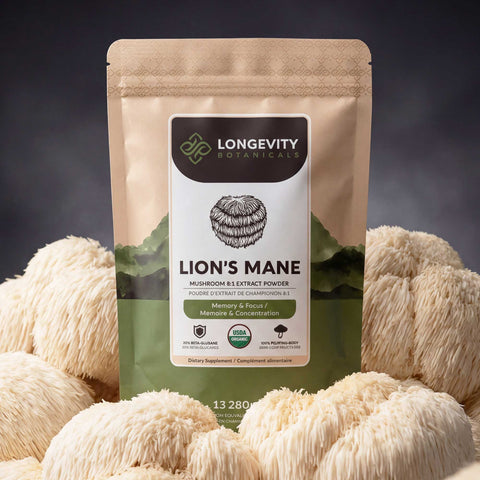
Lion's Mane is the mushroom taken for nerve support, and the laboratory research behind it is one of the most interesting stories in mycology: its compounds are associated with nerve growth factor activity in cell and animal studies. Hericenones form in the fruiting body, which is what we extract, with hot water at 8:1, tested to at least 20% beta-glucans. A serving is 1,660 mg of powder or 900 mg in capsules.
The answer to this page. Lion's Mane is the only mushroom we sell with research pointed at nerve tissue, and the only one with human cognition trials.
Lion's Mane is the white, shaggy mushroom that grows on hardwood, and a real culinary species, mild and faintly seafood-like cooked.
The compound family it is taken for, hericenones, forms in the fruiting body. Erinacines, the family usually named alongside them, form in cultured mycelium rather than in the mushroom, and the human trials were run on fruiting body. That is why what a brand actually puts in the jar matters more here than anywhere else in our range.
Ours is fruiting body only, hot water extracted at 8:1, tested to a minimum of 20% beta-glucans. Take it daily: in the trials the effect built over weeks and receded after stopping.
Extraction
Hot Water 8:1
Beta-D glucans
≥20%
Best for
Memory and nerve support
USDA Organic
What the research says
The human trial measured cognition, not nerves. Adults with mild cognitive impairment improved over sixteen weeks of daily use and the gain receded once they stopped, which is the clearest sign we have that the mushroom did the work rather than the calendar (Mori 2009).
The nerve growth factor research is one of the most interesting stories in mycology. A 2023 review in the International Journal of Molecular Sciences gathers it: hericenones form in the fruiting body and erinacines in cultured mycelium, and both are associated with NGF activity in cell and animal models. Laboratory work has mapped a plausible route, which is exactly why the human trials are worth running.
The mechanism research is genuinely exciting. Hericenones and erinacines are associated with nerve growth factor activity in cell and animal models, and the human trials so far have measured cognition, where adults improved over sixteen weeks of daily use. It is an area moving quickly and we follow it closely.
What is NGF?
Nerve growth factor, a protein involved in the growth and maintenance of nerve cells. It is the mechanism most often invoked for Lion's Mane, on the strength of cell and animal studies. It is a plausible route rather than a demonstrated human effect.
Why does fruiting body matter so much for this one?
Because hericenones form in the fruiting body, and because the human trials were run on fruiting-body preparations. Erinacines, the other family usually quoted, form in cultured mycelium. Cheap Lion's Mane is usually mycelium grown on a grain substrate and milled with the grain still in it, which is a different composition. If you are buying for this reason, check the fruiting body claim and the extract ratio.
How long before I judge it?
Sixteen weeks is the length of the trial most often cited, and the effect built across it. Four weeks is the minimum before there is anything to assess.
Can it help with nerve pain or numbness?
That is a conversation for a doctor. What we can tell you is that Lion's Mane is the mushroom with the deepest nerve research behind it, and ours is fruiting body only, which is where the hericenones form and what the human trials used.
Why does fruiting body matter so much for Lion's Mane?
Because hericenones, the compound family that forms in the fruiting body, are what a fruiting-body extract actually delivers, and because the human trials used fruiting body. Erinacines form in cultured mycelium, not in the mushroom. Ours is fruiting body only, with no grain substrate, which is the single most important thing to check on any Lion's Mane pack.
Thirty adults aged 50 to 80 took 3 g a day of powdered Hericium erinaceus or placebo for sixteen weeks. Cognitive scores climbed steadily in the mushroom group and not in the placebo group. Four weeks after they stopped, the gain drifted back, which is the clearest possible sign that the mushroom itself was driving the change.
A review of the mechanism research, and one of the more interesting stories in mycology. It separates the two compound families by where they form: hericenones in the fruiting body, erinacines in cultured mycelium. This review states that erinacine A is absent from fruiting bodies altogether. Both families are associated with nerve growth factor activity in cell and animal models, and that work is preclinical; the human cognition trials used fruiting-body preparations. Laboratory work has mapped a plausible route, which is exactly why the human trials are worth running.
International Journal of Molecular Sciences · 2023
A double-blind trial in healthy young adults. A single dose produced faster performance on a processing-speed task, and after 28 days of daily use participants reported feeling less stressed. An encouraging early result, and the reason larger trials are now being called for.
The widest survey of the Reishi literature: 17 clinical trials covering 971 participants, at doses from 200 to 11,200 mg a day. Pooled analysis found significant improvements in BMI, serum creatinine, glutathione peroxidase and resting heart rate. Many other markers did not move, and the reviewers rate the certainty of the underlying trials as low and call for better-designed studies, which is the usual state of a field this active and this young.