

Mushroom Farming Explained: a Beginner's Practical Guide
TL;DR:
- Mushroom farming is a controlled process centered on preparing organic substrates, inoculating with spawn, and managing phase-specific environmental conditions. Understanding the biology of mycelium growth and proper regulation of temperature, humidity, CO₂, and airflow is essential for success, especially when starting with forgiving species like oyster mushrooms. Reusing spent substrate as compost completes a sustainable cycle, making mushroom cultivation both productive and environmentally advantageous.
Mushroom farming is not what most people picture. It is not digging in soil, waiting for rain, or scattering spores and hoping for the best. To explain mushroom farming accurately, you need to understand one fundamental difference from growing plants: mushrooms are fungi, not crops. They do not photosynthesize. They grow by breaking down organic matter through a network of thread-like cells called mycelium. That biology drives every decision in cultivation, from what you use as a growing medium to how you control the air in your grow space. Get those decisions right, and mushrooms are one of the most productive, space-efficient crops available to small-scale growers.
Table of Contents
- Key takeaways
- What mushroom farming actually involves
- Biology and environment: what mushrooms need
- From substrate to harvest: step-by-step mushroom farming
- Small-scale and home setups
- Scaling up to commercial mushroom farming
- Sustainability and the circular farm logic
- My perspective on starting and refining mushroom cultivation
- Explore mushroom supplements from Longevitybotanicals
- FAQ
Key takeaways
| Point | Details |
|---|---|
| Biology drives every decision | Mushrooms grow from mycelium colonizing organic substrate, not soil or sunlight. |
| Phases require different conditions | Colonization and fruiting need separate temperature, humidity, and CO₂ settings to succeed. |
| Substrate preparation is foundational | Matching pasteurization or sterilization to your species prevents contamination and supports yield. |
| Beginners start with oyster mushrooms | Oyster species tolerate minor errors and show visible progress fast, making them ideal for new growers. |
| Spent substrate closes the loop | Used growing medium converts to compost, feeding your soil and reducing farm waste. |
What mushroom farming actually involves
Mushroom farming is a controlled cultivation process that moves through four repeating stages: substrate preparation, mycelium colonization, fruiting, and harvest. Each stage demands specific conditions. Missing a single variable at the wrong phase can halt growth entirely or cause contamination that ruins a whole batch.
The organism doing the work is mycelium. Think of it as the plant equivalent of roots, except mycelium is the main body of the fungus. It spreads through a prepared growing medium, consuming cellulose and lignin for energy. Once mycelium fully colonizes the substrate, it signals readiness to reproduce. At that point, environmental shifts such as lower temperature, increased fresh air, and maintained humidity trigger the formation of fruiting bodies. Those fruiting bodies are the mushrooms you harvest.
This process differs from plant farming in one critical way. Plants convert sunlight into energy. Mushrooms extract energy from organic matter. That is why substrate selection and preparation carry so much weight in any mushroom cultivation guide.
The two phases growers must manage separately
Every mushroom species has two distinct phases with different environmental needs. During colonization, the mycelium grows through substrate in a relatively warm, high-CO₂ environment. During fruiting, conditions shift. CO₂ levels must drop, humidity stays high, and fresh air exchange increases. Confusing these phases or applying the same conditions throughout is the most common reason home growers get disappointing results.
Biology and environment: what mushrooms need
Understanding mushroom growth starts with knowing what each species requires at each phase. There is no universal setting. Button mushrooms colonize well at around 20 to 25 degrees Celsius but need fruiting temperatures as low as 16 to 17 degrees Celsius. Oyster mushrooms tolerate a broader range but still need clear phase separation.
Here are the four environmental factors that govern every cultivation decision:
- Temperature: Species-specific ranges must stay stable. Temperature fluctuations during colonization or fruiting cause developmental problems, malformed caps, and reduced yields. A fluctuation of even a few degrees at the wrong time can stall growth.
- Humidity: Most species fruit best at 85 to 95% relative humidity. Low humidity causes cracked or dry caps. Too much with poor airflow creates conditions for bacterial contamination.
- CO₂ levels: Incubation tolerates higher CO₂ around 5,000 to 6,000 ppm, while fruiting requires levels below 1,200 to 1,800 ppm. Elevated CO₂ during fruiting causes elongated stems and small, deformed caps.
- Fresh air exchange: Fruiting rooms need air exchanged three to five times per hour. This removes CO₂, prevents pathogen buildup, and supports normal cap development.
Substrate selection is equally specific. Oyster mushrooms thrive on straw, cardboard, or wood chips. Shiitake prefers hardwood sawdust or logs. Lion’s Mane does well on supplemented hardwood. Using a substrate that does not match the species’ natural diet slows colonization and invites competing molds.
Pro Tip: Separate your colonization and fruiting spaces if possible. Even a simple shelf with a curtain dividing two temperature zones improves results significantly for home growers.
From substrate to harvest: step-by-step mushroom farming
This is where theory meets practice. Mushroom farming basics follow a consistent sequence regardless of scale.
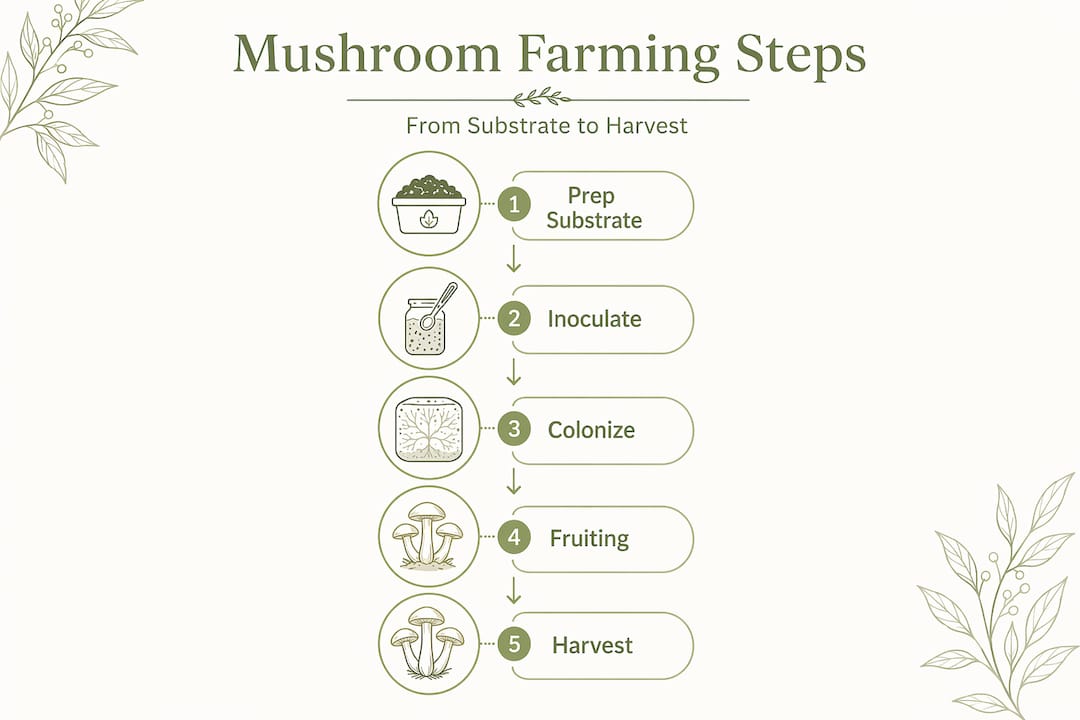
Substrate preparation: pasteurization vs. sterilization
Choosing between pasteurization and sterilization is one of the first decisions in any step-by-step mushroom farming process.
| Factor | Pasteurization | Sterilization |
|---|---|---|
| Heat applied | 65 to 80°C for several hours | 121°C under pressure |
| Best for | Oyster mushrooms, straw substrates | Grain spawn, supplemented hardwood |
| Contamination risk | Lower with aggressive species | Higher if inoculation area is not sterile |
| Equipment needed | Hot water bath or steam | Pressure cooker or autoclave |
| Scalability | Higher, used in tunnel systems | Lower, requires sterile workflow |
Sterilized substrates are more nutrient-rich, which sounds like an advantage. The problem is that sterilized substrate demands a sterile inoculation environment to prevent rapid Trichoderma mold infections. Without a still-air box or clean room, contamination rates on sterilized bags run high. Pasteurization leaves behind beneficial bacteria that compete with common molds, making it more forgiving for most growers.
Inoculation, colonization, and fruiting
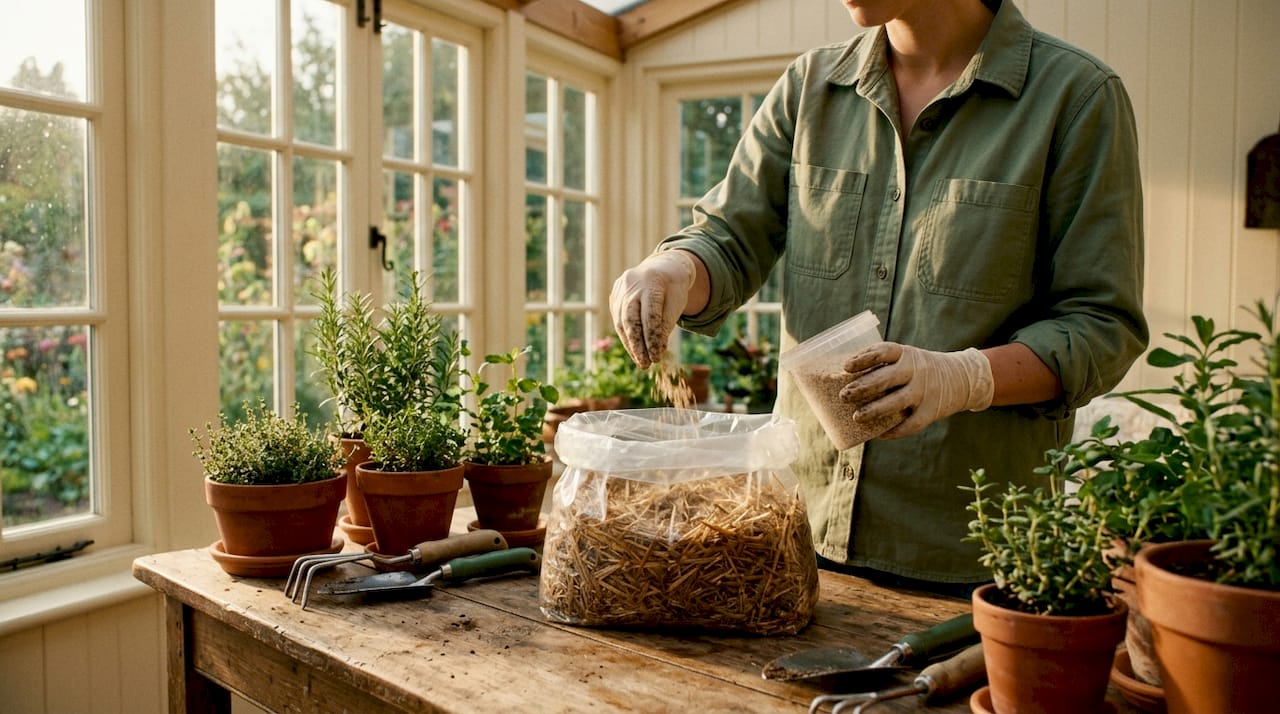
After preparation, substrate is cooled and inoculated with spawn. Spawn is mycelium already growing on a carrier material such as grain, sawdust, or wooden dowels. Higher spawn rates speed up colonization and reduce contamination risk, but balancing spawn rate with substrate quality keeps costs manageable.
Colonized substrate then incubates in warm, dark conditions. Once mycelium fully covers the substrate (white, fuzzy, and even coverage), the fruiting trigger kicks in. Move the block or bag to cooler conditions, introduce fresh air exchanges, and maintain humidity. Pins appear within days on fast species like oyster mushrooms.
Harvest timing matters. Pick mushrooms just before the caps fully flatten or the edges start to wave. Waiting too long reduces shelf life and encourages spore release, which can complicate breathing in enclosed grow rooms.
Pro Tip: After your first flush, mist the substrate and maintain humidity. Most species produce two to three additional flushes from the same block before the substrate is spent.
Small-scale and home setups
For home growers, the recommendation is consistent. Oyster mushrooms are the best starter species due to their fast growth, visible progress, and tolerance for minor environmental errors. They fruit on straw, cardboard, or pasteurized coffee grounds. That means low startup costs and easy sourcing.
Here are practical small-scale setup options, ordered from least to most infrastructure:
- Grow kits: Pre-inoculated, ready-to-fruit blocks. Require no substrate preparation. Ideal for first-timers learning fruiting phase management before tackling full cultivation.
- Mushroom buckets: Drill holes in a five-gallon bucket, fill with pasteurized straw, mix in oyster spawn, and wait. Inexpensive, forgiving, and produces real yields.
- Log inoculation: Drill holes in fresh hardwood logs, hammer in wooden dowel spawn, seal with wax, and place in a shaded outdoor area. Slower to produce (six to eighteen months) but requires minimal ongoing labor and suits shiitake and wine cap species.
- Grow tents with humidity control: A small growing tent with a humidity controller and ultrasonic humidifier creates a reliable fruiting chamber for $100 to $200. Suitable for oyster, lion’s mane, or king oyster varieties.
- Dedicated grow room: A spare bathroom or garden shed with a programmable controller managing temperature, humidity, and fresh air exchange. Requires more setup but supports multiple species year-round.
Managing humidity without expensive equipment comes down to frequency. A handheld mister applied two to three times daily keeps relative humidity above 80% in a small enclosed space. Adding a humidity tent from a clear plastic storage bin over your fruiting blocks costs almost nothing and significantly improves results.
Pro Tip: Fresh air exchange is the most undermanaged variable in home growing. A small USB fan set to run for ten minutes every two hours in a grow tent prevents CO₂ buildup and dramatically reduces deformed or elongated mushrooms.
Scaling up to commercial mushroom farming
Commercial mushroom farms use climate-controlled growing rooms with integrated HVAC systems, automated CO₂ sensors, and HEPA-filtered air intake. The principles are identical to home growing. The difference is precision. Automated microclimate control at tight tolerances, around ±1% for temperature and humidity, improves biological efficiency and produces consistent yields at scale.
| Factor | Home setup | Commercial farm |
|---|---|---|
| Temperature control | Manual adjustment or basic thermostat | Automated HVAC with zone separation |
| Humidity management | Handheld mister or small humidifier | Fogging systems with humidity sensors |
| CO₂ control | Passive fan ventilation | CO₂ monitors with automated air handling |
| Substrate volume | Kilograms per batch | Tons per week via pasteurization tunnels |
| Contamination control | Sanitation protocols by hand | Clean rooms, HEPA filtration, drainage systems |
The economic tradeoff at commercial scale centers on spawn rate and substrate quality. More spawn costs more per batch but reduces colonization time and contamination risk. Commercial operations also run dedicated colonization and fruiting rooms to keep conditions precise for each phase.
Key infrastructure considerations for scaling up:
- Smooth, cleanable wall and floor surfaces to reduce pathogen harboring
- Proper drainage to manage daily humidity and cleaning runoff
- Separate air handling for colonization vs. fruiting zones
- Shelving systems to maximize vertical space and airflow between blocks
Sustainability and the circular farm logic
Mushrooms are natural decomposers. They break down agricultural and food waste into food, and then the leftover growing medium cycles back into the soil. That closed-loop logic is why mushroom farming fits naturally into sustainable agriculture systems.
Spent mushroom substrate converts directly to compost, improving soil organic matter and fertility. Growers using straw-based systems can redirect post-harvest blocks to garden beds as mulch, where they continue to break down and feed soil microbes.
Practical sustainability benefits of mushroom farming in integrated systems:
- Converts farm waste (straw, corn cobs, wood chips, coffee grounds) into food
- Produces edible protein with minimal land, water, and energy inputs relative to animal agriculture
- Spent substrate adds organic matter that improves water retention in sandy soils
- Integrates with crop rotation by conditioning beds before planting vegetables
The limitations deserve acknowledgment. High-humidity grow environments increase energy use for temperature control. Contamination events mean substrate goes to waste. And consistent yields at home scale require ongoing attention that not every grower can maintain.
The most sustainable mushroom farm is the one that runs reliable cycles. Experimentation and documentation build the pattern recognition that turns a failed batch into a better next one.
My perspective on starting and refining mushroom cultivation
I have seen the same mistake repeated by growers at every level: they optimize for inputs and ignore phase-specific conditions. They spend money on premium spawn, source good substrate, and then run colonization and fruiting in the same tent at the same temperature and wonder why yields are low or caps are strange.
The biology does not negotiate. Environmental control is more critical than most beginner guides suggest. Starting with forgiving species like oyster mushrooms is not dumbing it down. It is building the environmental intuition you need before you tackle more demanding species.
What repeated cycles actually teach is patience with contamination. Every green or black spot is information. It tells you where airflow failed, where surfaces did not get sanitized, or where the substrate cooled too slowly before inoculation. That feedback loop, observed and documented, is what separates growers who scale from those who give up after two batches.
Mushroom farming can also shift how a small farm functions ecologically. Once you close the loop between waste, growing medium, and compost, the farm starts working more efficiently as a system. That shift is real and measurable. Start simple, run consistent cycles, and adjust based on what the mycelium shows you.
— Longevitybotanicals
Explore mushroom supplements from Longevitybotanicals
Cultivating your own mushrooms builds a direct connection to one of nature’s most functional food groups. For those interested in the health side of mushrooms alongside growing them, Longevitybotanicals offers a range of organic mushroom capsules and mushroom powders sourced from high-quality fruiting bodies. Species covered include Reishi, Lion’s Mane, Turkey Tail, Chaga, and Cordyceps, each selected for documented health benefits including immune support and cognitive function. For growers who want to understand how cultivated mushrooms translate into daily wellness support, the Longevitybotanicals product catalog offers a straightforward next step from farm to supplement.
FAQ
What is mushroom farming, simply explained?
Mushroom farming is the controlled process of growing fungi by preparing an organic substrate, introducing mycelium, managing environmental conditions, and harvesting fruiting bodies. It differs from plant farming because mushrooms require no sunlight and feed on organic matter.
What is the best mushroom species for beginners?
Oyster mushrooms are the top recommendation for new growers. They are forgiving, fast, and grow well on straw or other low-cost substrates with minimal equipment.
Why does CO₂ management matter in mushroom cultivation?
CO₂ levels must match the growth phase. High CO₂ is acceptable during incubation but must drop below 1,200 to 1,800 ppm during fruiting to prevent elongated stems and deformed caps, according to growing room research.
What is the difference between pasteurization and sterilization for substrate?
Pasteurization uses moderate heat and suits oyster mushrooms on straw. Sterilization uses high-pressure heat, supports more nutrient-rich substrates, but requires a sterile inoculation environment to prevent mold contamination.
Can spent mushroom substrate be reused?
Yes. After harvests are complete, spent substrate is composted and applied to garden beds, returning nutrients to the soil and supporting sustainable farming cycles.
Recommended
- Build a daily mushroom supplement workflow: 5 steps – LongevityBotanicals
- Mushroom supplement dos and don’ts: safe guide for wellness – LongevityBotanicals
- Master the Mushroom Blending Process for Optimal Wellness – LongevityBotanicals
- Mushroom extraction explained: unlock wellness from nature – LongevityBotanicals
Related Posts

Why Water-Soluble Mushroom Compounds Drive Real Results

What Is Mushroom Sustainability? Benefits and Practices

The Role of Organic Farming in Mushrooms Explained

What Is a Fruiting Body? Mushroom Science Explained

Mushroom Allergenicity Explained: Symptoms and Safe Use

Top 5 naturesrise.com Mushroom Supplement Alternatives 2026


