

What Is a Fruiting Body? Mushroom Science Explained
TL;DR:
- Fruiting bodies are the visible reproductive structures of fungi that contain high concentrations of beneficial compounds like beta-glucans and triterpenes. They are distinct from mycelium, which is the underground vegetative network responsible for nutrient absorption and long-term survival. Choosing high-quality, verified fruiting body extracts ensures better potency, bioavailability, and alignment with clinical research, unlike often grain-filled mycelium products.
A fruiting body is defined as the visible, spore-producing reproductive structure of a fungus. It is what most people recognize as a mushroom: the cap, stem, and gills that appear above ground or on a host substrate. In mycology, the fruiting body is also the part of the fungus that concentrates the highest levels of beneficial compounds, including beta-glucans and triterpenes. This distinction matters enormously for anyone evaluating mushroom supplements, because not all products are made from the same part of the fungus. Understanding what a fruiting body is, how it differs from mycelium, and why it matters for supplement quality gives you a clear framework for making informed choices.
What is a fruiting body in fungi?
The fruiting body is the reproductive organ of a fungus, equivalent in function to a flower on a plant. Its primary biological job is to produce and release spores so the fungus can reproduce. Structures like the cap, gills, pores, and stem all serve this single reproductive purpose. The fruiting body is temporary by design: it lasts only days to weeks, while the mycelium network living underground can survive for decades. That short lifespan is why fruiting bodies invest so much metabolic energy into producing concentrated bioactive compounds quickly.

From a chemistry standpoint, the fruiting body is where the fungus accumulates its most complex secondary metabolites. Beta-glucans, the polysaccharides most studied for immune support, are densely packed in the cell walls of the fruiting body. Triterpenes, which are responsible for the bitter taste of mushrooms like Reishi and for many of their documented biological effects, are also synthesized primarily in the fruiting body. Ergosterol, a precursor to vitamin D2, is another compound found in meaningful concentrations here. These compounds are not evenly distributed across the whole fungus.
The definition of fruiting body also has direct relevance to supplement labeling. When a product states “fruiting body extract,” it means the extract was made from this reproductive structure, not from the root-like mycelium. This distinction is the single most important factor in evaluating mushroom supplement potency.
How is the fruiting body different from mycelium?
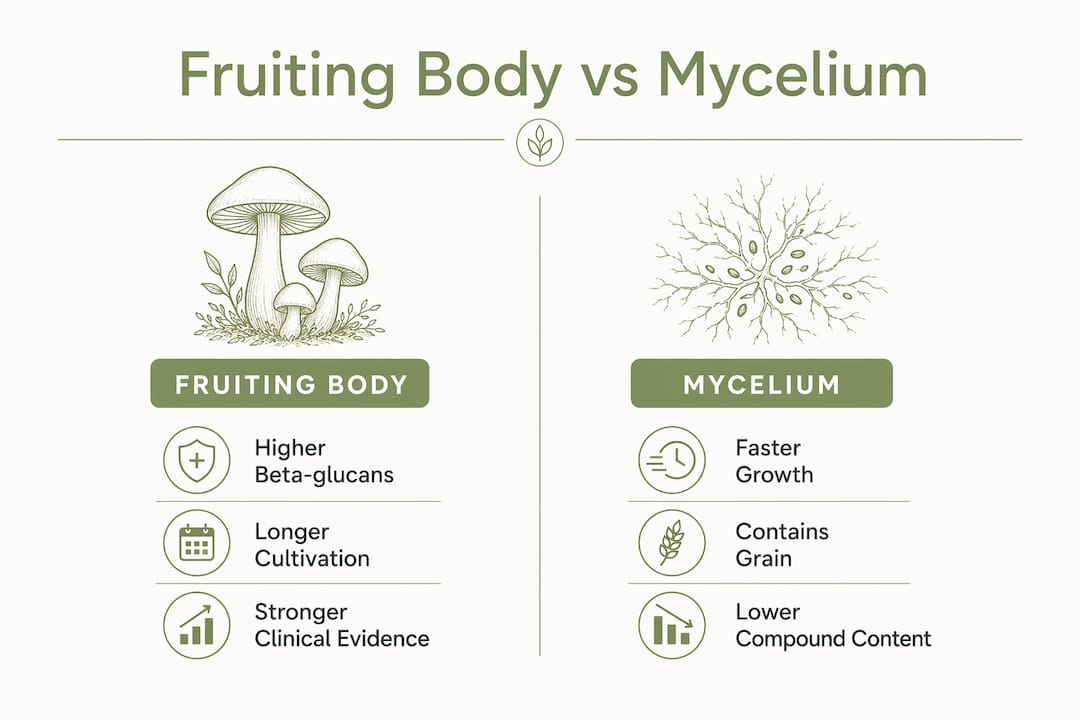
Mycelium is the vegetative body of the fungus. It consists of a dense network of thread-like filaments called hyphae that spread through soil, wood, or other substrates. Mycelium is responsible for nutrient absorption and long-term survival. The fruiting body, by contrast, is a temporary structure that the mycelium produces under the right environmental conditions, including specific temperature, humidity, and light cues.
The biological roles of these two structures lead to very different chemical profiles:
- Fruiting body: High beta-glucan content, rich in triterpenes, ergosterol, and other secondary metabolites. Short-lived and metabolically concentrated.
- Mycelium: Lower beta-glucan density, fewer secondary metabolites in most species. Long-lived and focused on nutrient absorption rather than compound synthesis.
- Grain substrate: Not part of the fungus at all, but often present in commercial mycelium products because mycelium is grown on rice or oats and not fully separated before processing.
The last point is where consumer confusion becomes a real problem. Many commercial mycelium products include the grain substrate remaining after cultivation. This leads to inflated polysaccharide counts that reflect grain starch rather than fungal beta-glucans. A product can legally list a high polysaccharide percentage on its label while delivering very little actual fungal activity.
Pro Tip: When reading a mushroom supplement label, look for the words “fruiting body” specifically. “Whole mushroom,” “full spectrum,” or “mycelium” without further clarification are signals that the product may contain grain filler or a lower concentration of active compounds.
The lifecycle context helps here. Mycelium is the foundation; the fruiting body is the culmination. Both are part of the same organism, but they serve different functions and contain different compounds. Knowing this prevents you from treating them as interchangeable in a supplement context.
Why choose fruiting body extracts for supplement use?
The case for fruiting body extracts rests on three pillars: compound concentration, extraction efficiency, and clinical relevance.
On compound concentration, quality fruiting body extracts contain 20% to 40% beta-glucans by dry weight. Mycelium-on-grain products typically deliver 1% to 15% beta-glucans, with 40% to 80% of the product being starch filler. That gap is not marginal. It means a 500 mg capsule of fruiting body extract may deliver 100 to 200 mg of beta-glucans, while a comparable mycelium-on-grain capsule may deliver 5 to 75 mg, with the rest being grain starch. The difference in effective dose is significant.
| Feature | Fruiting body extract | Mycelium-on-grain |
|---|---|---|
| Beta-glucan content | 20% to 40% by dry weight | 1% to 15% by dry weight |
| Starch filler | None (grain-free) | 40% to 80% of product |
| Triterpenes and ergosterol | Present in meaningful amounts | Largely absent |
| Traditional use heritage | Centuries of documented use | Limited traditional precedent |
| Bioavailability | High with proper extraction | Variable, often reduced by starch |
On extraction efficiency, the cell walls of fruiting bodies are made of chitin, a tough polysaccharide that humans cannot digest. Raw mushroom powder delivers limited benefit because chitin blocks access to the compounds inside. Hot water and dual extraction break down chitin and make beta-glucans, triterpenes, and other metabolites bioavailable. This is why a well-made extract outperforms raw powder even when the raw powder comes from a fruiting body. The extraction step is not optional for efficacy.
On clinical relevance, the majority of published research on medicinal mushrooms uses fruiting body material. Reishi studies use the fruiting body. Turkey Tail clinical trials, including those examining beta-glucan effects on immune markers, use fruiting body extracts. When you choose a fruiting body product, you are choosing the form of the mushroom that the existing evidence base actually studied.
Pro Tip: Request a Certificate of Analysis (COA) from any mushroom supplement brand before purchasing. A reliable COA will list beta-glucan content as a separate line item. If the COA only lists “total polysaccharides,” the number may include grain starch and is not a trustworthy potency indicator.
Fruiting body extracts also contain a broader spectrum of secondary metabolites, including triterpenoids responsible for both the bitter taste and many of the documented biological effects of mushrooms like Reishi and Chaga. These compounds are largely absent from mycelium-on-grain products. For anyone using mushroom supplements for immune support, cognitive health, or stress adaptation, the fruiting body is the more evidence-aligned choice.
Fruiting body vs. mycelium supplements: a practical comparison
The supplement market contains products made from fruiting bodies, mycelium, or a combination of both. Each has a distinct profile worth understanding before you buy.
Fruiting body supplements tend to be more expensive. This reflects the longer cultivation time required to grow a full mushroom, the lower yield compared to mycelium, and the cost of proper extraction. They are also more bitter and less water-soluble than mycelium products, which affects taste in powders and formulation complexity in capsules. However, fruiting body extracts offer higher potency and a richer bioactive profile than mycelium-on-grain alternatives.
Mycelium supplements are faster and cheaper to produce because mycelium grows in weeks on grain substrates. The challenge is that most commercial producers do not separate the mycelium from the grain before drying and milling. The result is a product that is partly fungal and partly grain. Some producers do offer pure mycelium extracts without grain, but these are uncommon and expensive.
There is one nuanced exception worth noting. In Lion’s Mane, the mycelium contains erinacines that may cross the blood-brain barrier, while the fruiting body contains hericenones with similar but distinct neuroactive properties. Both compound classes are studied for nerve growth factor support. A product combining pure mycelium extract with fruiting body extract could theoretically deliver a broader range of neuroactive compounds. However, pure mycelium extracts without grain are rare, and most products labeled “mycelium” on the market are mycelium-on-grain.
Key factors to compare when selecting a supplement:
- Beta-glucan percentage: Look for 20% or higher in fruiting body products.
- Grain-free certification: Confirms no starch filler is present.
- Extraction method: Hot water, alcohol, or dual extraction indicates proper processing.
- COA availability: Third-party lab testing with beta-glucan specifics is the gold standard.
- Species and part used: The label should clearly state “fruiting body” for the mushroom species listed.
How to identify authentic fruiting body products
Reading a mushroom supplement label accurately takes practice. The terms used in the industry are not always consistent, and some are deliberately vague.
- Look for “fruiting body” explicitly. The label should state the part of the mushroom used. “Whole mushroom” and “full spectrum” do not guarantee fruiting body content.
- Check the beta-glucan percentage. A COA showing beta-glucan content is the most reliable potency indicator. Total polysaccharides alone is not sufficient.
- Verify grain-free status. Ask the brand directly or look for a grain-free or starch-free claim backed by lab data.
- Confirm third-party testing. Brands that submit products to independent labs and publish results are demonstrating transparency. This is the minimum standard for a quality product.
- Assess the extraction ratio. A 1:1 extract means one gram of extract came from one gram of fruiting body. Higher ratios like 8:1 or 10:1 indicate greater concentration, though the beta-glucan percentage on the COA remains the most reliable measure.
For deeper guidance on evaluating mushroom supplement quality, the mushroom supplement certification guide from Longevitybotanicals covers what COA data actually means and which certifications carry weight. The potency and purity breakdown for standardized extracts is also worth reviewing before making a purchase decision.
Key takeaways
The fruiting body is the gold standard for mushroom supplement potency because it concentrates beta-glucans, triterpenes, and other bioactive compounds at levels that mycelium-on-grain products cannot match.
| Point | Details |
|---|---|
| Definition of fruiting body | The visible, spore-producing reproductive structure of a fungus, distinct from mycelium. |
| Bioactive concentration | Fruiting bodies contain 20% to 40% beta-glucans; mycelium-on-grain products contain 1% to 15%. |
| Extraction is necessary | Chitin in cell walls blocks absorption; hot water or dual extraction is required for bioavailability. |
| Grain filler problem | Many mycelium products contain 40% to 80% grain starch, inflating polysaccharide counts. |
| Quality verification | Request a COA listing beta-glucan content specifically, not just total polysaccharides. |
Why fruiting body supplements deserve more scrutiny, not just more hype
The fruiting body has a documented track record spanning centuries of traditional use in Chinese, Japanese, and Korean medicine. Reishi, Chaga, Turkey Tail, and Lion’s Mane were all used as fruiting body preparations long before modern extraction technology existed. That history is not proof of efficacy on its own, but it aligns with what the biochemistry shows: these structures contain the compounds that researchers are now studying in clinical settings.
What concerns me about the current supplement market is not the fruiting body itself. It is the lack of transparency around what is actually in most products. The polysaccharide labeling issue is not a minor technicality. It is a structural problem that allows grain starch to masquerade as fungal potency. Consumers who do not know to ask for beta-glucan-specific COA data are routinely buying products that deliver a fraction of the active compounds they expect.
That said, the fruiting body versus mycelium debate is sometimes oversimplified. For Lion’s Mane specifically, the erinacine content of pure mycelium extracts is worth considering if neurological support is the goal. The honest answer is that combining a high-quality fruiting body extract with a grain-free mycelium extract may offer the broadest compound profile. But that combination is only meaningful if both components are properly extracted and verified. Most products on the market do not meet that standard.
The practical takeaway is straightforward. Prioritize fruiting body extracts with verified beta-glucan content. Treat total polysaccharide claims without COA backup as unverified. And consult a healthcare provider before using mushroom supplements to address specific health conditions, since the evidence base, while growing, is still developing for many applications.
— Recontour,
Explore fruiting body mushroom supplements at Longevitybotanicals
Longevitybotanicals sources 100% fruiting body material for its mushroom supplement range, with no grain fillers and no mycelium-on-grain blends. Products are available as organic mushroom capsules and powders, covering species including Reishi, Lion’s Mane, Turkey Tail, Chaga, and Cordyceps. Each product is backed by third-party lab testing with COA data available on request, specifying beta-glucan content rather than total polysaccharides. For those focused on immune support, brain health, or stress adaptation, the range offers verified potency in formats suited to daily use. Explore the full selection at Longevitybotanicals to find a product matched to your health goals.
FAQ
What is a fruiting body in simple terms?
A fruiting body is the visible part of a mushroom, including the cap and stem, that produces and releases spores for reproduction. It is distinct from the underground mycelium and contains the highest concentration of beneficial compounds like beta-glucans and triterpenes.
What does fruiting body mean on a supplement label?
On a supplement label, “fruiting body” means the extract was made from the reproductive structure of the mushroom, not from the root-like mycelium. This distinction matters because fruiting bodies contain significantly higher levels of bioactive compounds than most mycelium-on-grain products.
Why use fruiting body extracts instead of whole mushroom powder?
Fruiting bodies contain chitin in their cell walls, which humans cannot digest. Extraction processes like hot water or dual extraction break down chitin and make beta-glucans and triterpenes bioavailable. Raw powder, even from a fruiting body, delivers limited benefit without this processing step.
How do I know if a fruiting body product is high quality?
Request a Certificate of Analysis that lists beta-glucan content as a specific percentage, not just total polysaccharides. High-quality fruiting body extracts contain 20% to 40% beta-glucans by dry weight and carry a grain-free verification.
Are there any compounds found only in mycelium and not in the fruiting body?
Yes. In Lion’s Mane, erinacines are found primarily in the mycelium and may cross the blood-brain barrier, while hericenones are found in the fruiting body. Both compound classes are studied for nerve growth factor support, which is why some researchers suggest that combining pure mycelium extract with fruiting body extract may offer a broader neuroactive profile.
Recommended
- Fruiting Body Supplements: Immunity and Brain Benefits – LongevityBotanicals
- Mushroom Fruiting Body vs Mycelium: The Clear Potency Gap Explained – LongevityBotanicals
- Standardized Mushroom Extract: Potency, Purity, Explained – LongevityBotanicals
- Why Choose Pure Mushroom Sources for Better Health – LongevityBotanicals
Related Posts

Mushroom Allergenicity Explained: Symptoms and Safe Use

How to read mushroom supplement labels effectively

What is an anti-inflammatory mushroom? Benefits and uses

Standardized Mushroom Extract: Potency, Purity, Explained

Mushroom supplement dos and don'ts: safe guide for wellness

Top 6 Best Mushroom Supplements 2026

Mushroom extract dosage guide for immune and brain support


