

Fruiting Body Supplements: Immunity and Brain Benefits
TL;DR:
- Fruiting body extracts contain higher concentrations of bioactive compounds like beta-glucans and hericenones.
- Clinical research supports the immune and cognitive benefits of fruiting body mushroom supplements.
- Check labels to ensure products specify “fruiting body” and have third-party testing for purity.
Not all mushroom supplements are created equal, and the difference often comes down to one critical factor: whether the product contains actual fruiting body extract or a mycelium-based alternative. Many labels say “whole mushroom” or “mushroom complex” without specifying which part of the fungus is inside. That distinction shapes how potent the supplement actually is. Fruiting body extracts carry the highest concentration of bioactive compounds, including the beta-glucans and hericenones that researchers link to measurable immune and cognitive outcomes. This guide breaks down what fruiting body supplements are, what the science says, and how to use them effectively.
Table of Contents
- What are fruiting body supplements?
- Science-backed immune benefits
- Cognitive and neurological advantages
- Safe use, results timeline, and what to watch for
- Why fruiting body purity matters more than hype
- Explore high-quality fruiting body supplements
- Frequently asked questions
Key Takeaways
| Point | Details |
|---|---|
| Prioritize fruiting body extracts | Supplements made from mushroom fruiting bodies provide the highest levels of immune and cognitive-supporting compounds. |
| Look for clinical validation | Choose products and mushrooms that are backed by real research for proven benefits. |
| Expect gradual results | Improvements in immunity and cognition usually appear after several weeks of consistent use. |
| Check for label transparency | Only buy from brands that clearly state the part of mushroom used and test for purity. |
| Consult before starting | If you have health conditions or take medications, consult a provider before using mushroom supplements. |
What are fruiting body supplements?
When most people picture a mushroom, they see the cap and stem sitting above the soil. That visible structure is the fruiting body. It is the reproductive organ of the fungus, equivalent to the “fruit” of a plant, and it contains the densest concentration of health-relevant compounds found in any part of the organism.
Supplements can be made from three different parts of the fungus:
- Fruiting body: The cap and stem. High in beta-glucans, triterpenes, and other active compounds.
- Mycelium: The underground root-like network. Often grown on grain substrates, which dilutes the final product with starch.
- Blends: A combination of fruiting body and mycelium. Quality varies significantly by brand.
The concern with mycelium-based products is not the mycelium itself. It is that commercial mycelium is typically grown on grain (usually rice or oats), and the grain is not fully separated before processing. This means the final powder may contain more starch than actual fungal material, which reduces the concentration of the compounds you are paying for.
| Type | Main compounds | Typical label | Potency |
|---|---|---|---|
| Fruiting body | Beta-glucans, triterpenes, polysaccharides | “Fruiting body extract” | High |
| Mycelium on grain | Lower beta-glucans, higher starch | “Mycelium biomass” | Low to moderate |
| Blend | Variable | “Full spectrum” or “whole mushroom” | Variable |
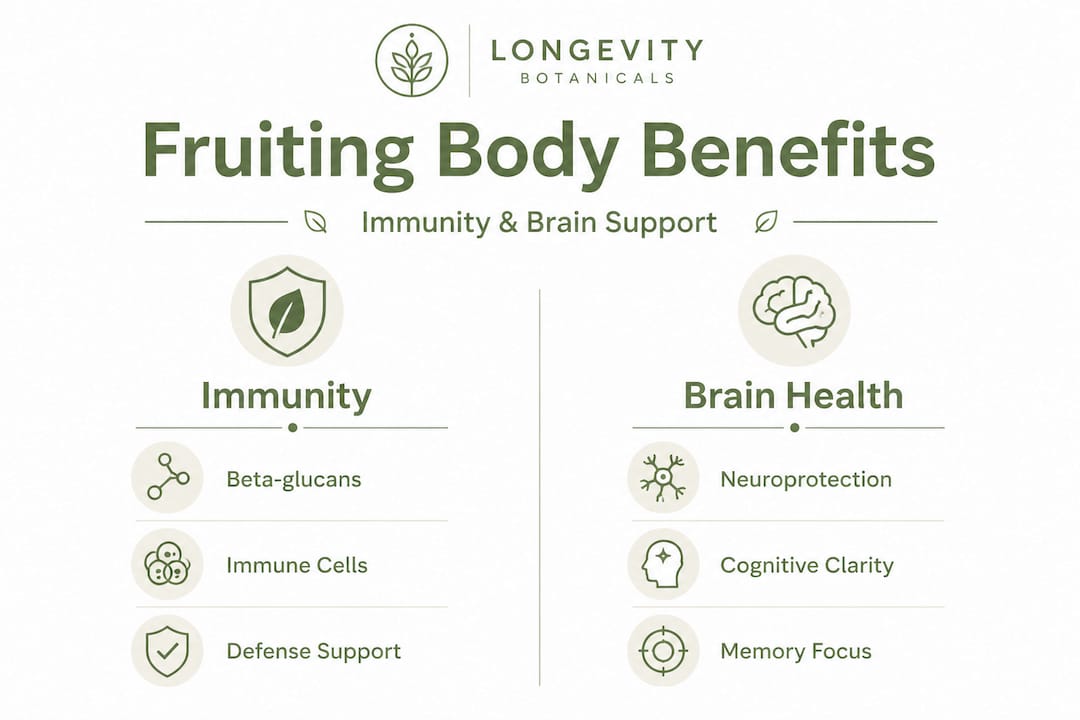
The most clinically relevant immune compounds in mushrooms are beta-glucans, a class of polysaccharides. Beta-glucans modulate immunity by stimulating macrophages, natural killer (NK) cells, and T-cells, and they appear in the highest concentrations in the fruiting body rather than the mycelium fraction.
For more detail on how mushroom compounds support immune health, the mushroom immune support guide from Longevity Botanicals covers the full breakdown.
Pro Tip: Flip the supplement bottle over and look for “fruiting body” listed as the actual ingredient, not just the mushroom name. If it says “mycelium biomass” or “full spectrum” without specifying ratios, the beta-glucan content is likely lower than advertised.
Science-backed immune benefits
Fruiting body extracts have a solid foundation in clinical research, particularly for immune support. The most studied mushroom in this category is Reishi, known scientifically as Ganoderma lucidum. Its fruiting body is dense with polysaccharides, specifically beta-glucans and glycoproteins, that interact directly with the immune system.
Reishi fruiting body polysaccharides enhance immune function and antioxidant status across multiple randomized controlled trials (RCTs), showing benefits in both cancer patients and healthy volunteers. In healthy participants, Reishi supplementation consistently elevated markers of immune activity, including increased NK cell counts and improved antioxidant enzyme levels.
The mechanism is well understood. When beta-glucans from fruiting bodies enter the digestive system, they bind to receptors on immune cells, particularly macrophages (the first responders of the immune system). This binding triggers a signaling cascade that activates NK cells and T-cells, the cells responsible for identifying and destroying infected or abnormal cells.
“Polysaccharides derived from mushroom fruiting bodies interact with pattern recognition receptors on immune cells, triggering downstream activation of innate and adaptive immune responses.” Research published in peer-reviewed immunology journals consistently links this activity to improved immune surveillance and antioxidant defense.
| Mushroom | Compound | Observed immune effect | Study type |
|---|---|---|---|
| Reishi (G. lucidum) | Beta-glucans, polysaccharides | Elevated NK cells, improved antioxidant status | Multiple RCTs |
| Turkey Tail (T. versicolor) | PSK, PSP polysaccharides | Enhanced immune response in cancer adjunct therapy | Clinical trials |
| Shiitake (L. edodes) | Lentinan, eritadenine | Increased immune cell proliferation | Human pilot trials |
Top fruiting body mushrooms for immune support:
- Reishi: Most researched for immune modulation and antioxidant defense
- Turkey Tail: Strong evidence for polysaccharide-driven immune activation, particularly in oncology support settings
- Shiitake: Lentinan is one of the most studied beta-glucan fractions in clinical immunology
You can find a detailed breakdown of how Reishi supports immune cells and what dosages appear in the published literature on the Longevity Botanicals blog.
Cognitive and neurological advantages
The immune benefits of fruiting body supplements are well established, but the cognitive effects have gained significant research attention in recent years. Lion’s Mane (Hericium erinaceus) stands out as the primary mushroom studied for brain health, and the specific compounds responsible for its effects are found almost exclusively in the fruiting body.

Those compounds are called hericenones. Found in the fruiting body cap, hericenones stimulate nerve growth factor (NGF), a protein essential for the growth, maintenance, and survival of neurons. NGF supports the connections between brain cells, which underlies learning, memory, and general cognitive sharpness.
Research has observed cognitive improvements at different timescales:
- Acute effects (within hours): A single dose of Lion’s Mane fruiting body extract has been shown to improve psychomotor speed and reaction time in healthy adults, suggesting a rapid NGF-adjacent response.
- Short-term effects (4 to 8 weeks): Participants in several trials showed measurable improvements in memory recall, focus, and processing speed compared to placebo groups.
- Longer-term effects (12+ weeks): In patients with mild cognitive impairment (MCI), chronic Lion’s Mane supplementation produced significant cognitive improvements on standardized assessments, with effects diminishing after discontinuation.
These findings point to consistent, cumulative benefits rather than a one-time spike. The neuroprotective angle is equally important: Lion’s Mane fruiting body appears to reduce neuroinflammation, support neuroplasticity (the brain’s ability to form new connections), and improve resilience under cognitive stress.
For anyone interested in the full evidence base, the Lion’s Mane science on brain health article covers the clinical studies in detail. A deeper look at the biological pathway is also available through the Lion’s Mane NGF explained resource.
Pro Tip: Cognitive benefits from Lion’s Mane do not appear overnight. Most studies showing statistically significant improvements run for at least 4 weeks. Daily consistency matters more than dose size for brain-related outcomes.
Safe use, results timeline, and what to watch for
Understanding the safety profile and realistic timeline for fruiting body supplements is essential for setting accurate expectations and getting the most out of your investment.
According to published research, benefits build over 3 to 6 weeks of consistent daily use, with immune and cognitive effects being cumulative rather than immediate. This is not a supplement category that produces the kind of overnight results you might associate with caffeine or melatonin. The mechanisms involve cellular signaling and gradual shifts in immune and neurological activity, which means patience and consistency are the core requirements.
Statistic callout: In clinical trials examining Lion’s Mane and Reishi fruiting body extracts, the majority of participants reported noticeable effects between week 3 and week 6. Studies extending beyond 12 weeks consistently showed stronger and more sustained outcomes.
The safety record for fruiting body supplements is strong. Most studies report no serious adverse events in healthy adults. However, some specific populations should consult a healthcare provider before starting any mushroom supplement regimen:
- People taking blood thinners (e.g., warfarin): Reishi has anticoagulant properties that may amplify medication effects
- People with autoimmune conditions: Immune-stimulating compounds could theoretically interfere with immunosuppressive therapies
- Pregnant or breastfeeding individuals: Limited safety data exists for these populations
- Anyone with a known mushroom allergy: Reaction risk exists even with extracts
- People scheduled for surgery: Immune and platelet effects could complicate recovery
Practical steps to maximize safety and results:
- Start with a standard dose as listed on the product label and stay consistent daily
- Take capsules or powders with food to minimize the risk of mild digestive discomfort
- Allow a minimum of 4 weeks before evaluating whether the supplement is working
- Store products away from heat and moisture to preserve compound integrity
- Choose supplements that provide a certificate of analysis (COA) from third-party lab testing
For more on why the current research supports Lion’s Mane as a safe and effective option, the why Lion’s Mane works in 2026 article includes updated clinical context.
Why fruiting body purity matters more than hype
The supplement industry moves fast, and mushroom products are no exception. Over the past several years, dozens of brands have entered the market with products labeled as “mushroom complex,” “full spectrum mushroom,” or “adaptogenic mushroom blend.” These terms sound premium, but they do not guarantee that the product contains meaningful amounts of fruiting body material.
From a clinical standpoint, the distinction matters enormously. The studies showing immune activation and cognitive improvement all used fruiting body extracts, standardized to specific beta-glucan or polysaccharide percentages. When a product replaces fruiting body with mycelium on grain, the beta-glucan content can drop dramatically, sometimes below 5% of total weight. At that level, the biological activity documented in research simply does not apply.
The trend toward trendy branding over transparent sourcing is a real problem in this space. A product with a sleek label and a celebrity endorsement is not automatically a better product than one with clear ingredient sourcing and third-party testing. Consumers who know what to look for are far better positioned to find supplements that deliver real results.
What to look for when reading a mushroom supplement label:
- “Fruiting body” listed as the ingredient source, not “mycelium” or “full spectrum”
- A stated beta-glucan percentage (ideally 20% or higher for quality extracts)
- A third-party COA confirming the beta-glucan content matches the label
- Clear extraction ratio (e.g., 10:1 extract) indicating concentration
For a practical guide to the mushrooms with the strongest cognitive evidence, the top mushroom picks for cognition resource is a useful next reference point.
The bottom line: purity, transparency, and correct sourcing are more predictive of a supplement’s effectiveness than any marketing language on the front of the package.
Explore high-quality fruiting body supplements
Applying this knowledge starts with choosing products that meet the standards described above. Longevity Botanicals offers a range of organic mushroom extracts made from real fruiting body material, clearly labeled with the mushroom part used and extraction method. For those focused specifically on neurological health, the mushrooms for brain health collection includes Lion’s Mane and other cognitive-support options backed by current research. For broader wellness goals that combine immune and brain support in a single daily formula, the mushroom blend supplements collection offers transparently sourced multi-mushroom options with third-party testing documentation available.
Frequently asked questions
What is the difference between fruiting body and mycelium supplements?
Fruiting body supplements use the cap and stem of the mushroom, which are rich in beta-glucans and immune-active compounds, while mycelium products often contain significant amounts of grain substrate that dilutes the active ingredient content.
How long does it take to notice benefits from fruiting body supplements?
Most users begin noticing effects after 3 to 6 weeks of consistent daily use, based on published clinical studies examining both immune and cognitive outcomes.
Are fruiting body supplements safe?
Fruiting body supplements are generally well-tolerated in healthy adults according to clinical studies, but those taking blood thinners or immunosuppressive medications should consult a healthcare provider before starting.
Which mushrooms are best for immunity and cognitive support?
Reishi is the most clinically validated option for immune function and antioxidant defense, while Lion’s Mane fruiting body is the leading choice for cognitive support due to its NGF-stimulating hericenones.
Recommended
Related Posts

Why Water-Soluble Mushroom Compounds Drive Real Results

What Is Mushroom Sustainability? Benefits and Practices

The Role of Organic Farming in Mushrooms Explained

What Is a Fruiting Body? Mushroom Science Explained

Mushroom Allergenicity Explained: Symptoms and Safe Use

Top 5 naturesrise.com Mushroom Supplement Alternatives 2026

Top 6 Hemplucid.com Alternatives for 2026


