

Why Choose Pure Mushroom Sources for Better Health
TL;DR:
- Many mushroom supplements contain little actual fruiting body material and rely heavily on grain-grown mycelium, which offers lower medicinal compounds. Choosing products with explicitly labeled “fruiting body,” disclosed beta-glucan percentages, and third-party testing ensures higher potency and purity. Consistent intake for 8-12 weeks, aligned with clinical doses, is essential to experience genuine health benefits.
Not all mushroom supplements deliver what they promise. The market is full of products labeled with impressive mushroom names, but many contain little actual mushroom at all. Understanding why choose pure mushroom sources requires looking past the label and into what’s actually in the capsule. This article breaks down the science of mushroom sourcing, explains what separates effective supplements from ineffective ones, and gives you a clear framework for making smarter purchasing decisions backed by peer-reviewed research.
Table of Contents
- Key takeaways
- Why pure mushroom sources start with the fruiting body
- Beta-glucans, extraction, and why potency is not automatic
- Reading labels and navigating the regulatory gap
- How dosage and sourcing affect real-world results
- How to choose mushroom sources that actually deliver
- My perspective on transparency in this market
- Longevitybotanicals pure mushroom supplements
- FAQ
Key takeaways
| Point | Details |
|---|---|
| Fruiting body beats mycelium | Fruiting bodies contain 25-40% beta-glucans; mycelium-on-grain products contain only 1-5%. |
| Extraction method matters | Hot water or dual extraction increases bioavailability of key active compounds in mushroom supplements. |
| Labels can mislead | Milligram counts on labels include filler starch, not just active mushroom compounds. |
| Third-party testing is the standard | Look for certificates of analysis showing beta-glucan percentage, batch number, and lab name. |
| Consistency is required | Benefits from pure mushroom supplements typically appear after 8-12 weeks of consistent daily use. |
Why pure mushroom sources start with the fruiting body
Most people assume a mushroom supplement contains mushroom. That assumption is often wrong. To understand the advantages of pure mushroom sources, you need to know basic mushroom anatomy.
A mushroom has two main structures: the fruiting body and the mycelium. The fruiting body is what most people recognize as the actual mushroom cap and stem. The mycelium is the root-like network that grows underground or through a substrate like grain. Both are biologically part of the fungus, but they are not equivalent in medicinal value.
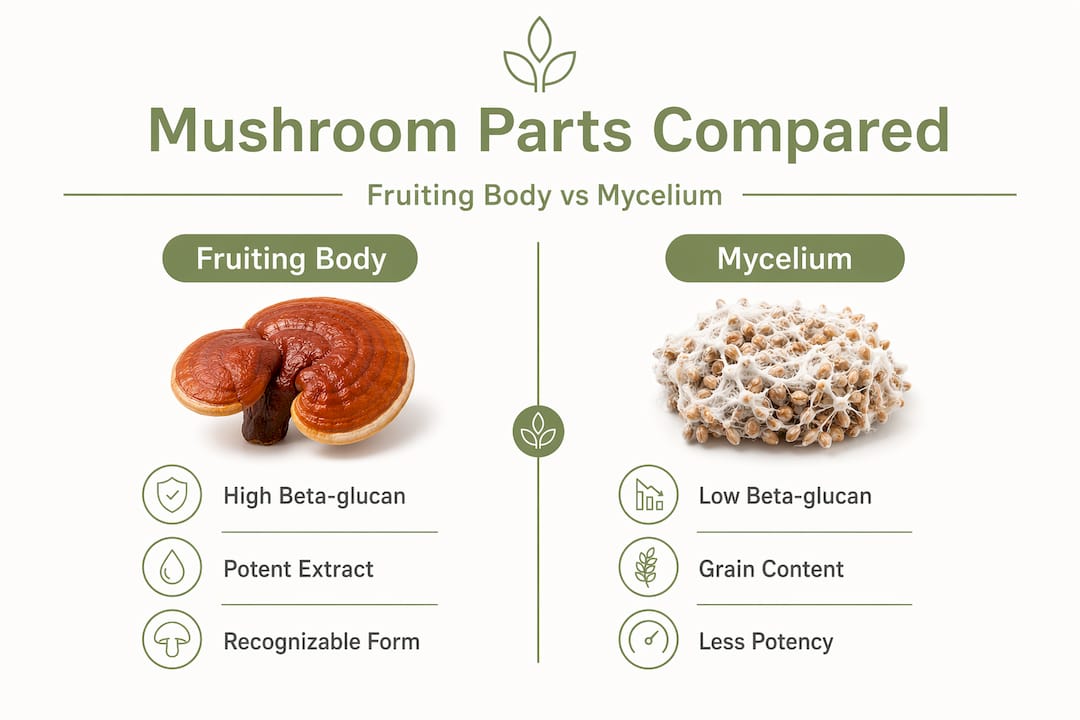
The compounds that drive immune support, cognitive function, and adaptogenic effects are concentrated in the fruiting body. Beta-glucans, triterpenes, and polysaccharides accumulate there in meaningful amounts. The mycelium, while not worthless, contains far fewer of these compounds on its own. The problem is compounded when manufacturers grow mycelium on grain substrate and then dry and powder the entire mixture without separating the mycelium from the grain.
Here is what that means in practice:
- Beta-glucan content in fruiting body extracts: 25-40%
- Beta-glucan content in mycelium-on-grain products: 1-5% beta-glucans with 40-60% starch
- Starch in mycelium-on-grain products: 40-60%, contributing zero medicinal value
- Active compounds in whole fruiting body: Higher concentrations of polysaccharides, triterpenes, and sterols
The key distinction is that many consumers are paying for grain powder, not mushroom powder. The fruiting body vs mycelium difference is not a marketing talking point. It represents a measurable gap in what lands in your body with each dose.
Pro Tip: When reading a supplement label, look for the phrase “fruiting body” explicitly listed under the ingredient name. If it says “mycelium” or does not specify, the product likely uses a grain-grown substrate mixture.
Beta-glucans, extraction, and why potency is not automatic
Knowing that fruiting bodies are superior is only the first step. The way those fruiting bodies are processed determines whether the active compounds survive into the final supplement.
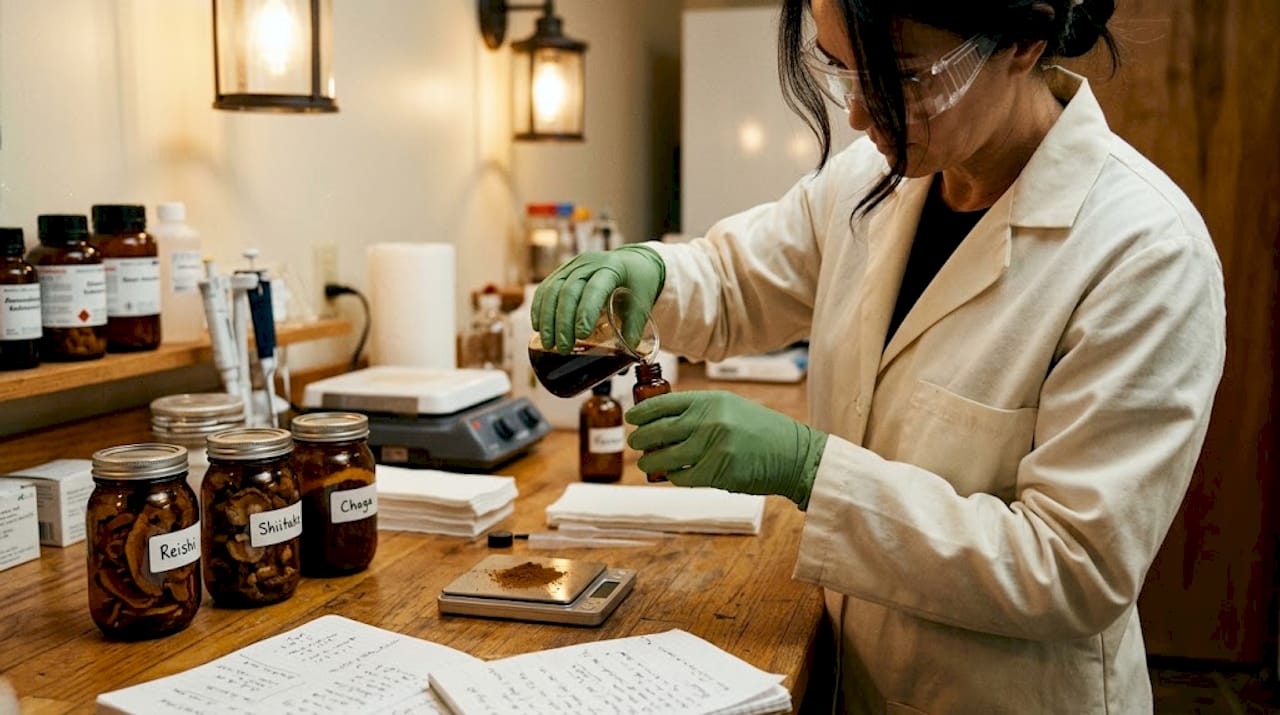
Beta-glucans are water-soluble polysaccharides. They work primarily by activating immune receptors in the gut-associated lymphoid tissue, which trains immune cells to respond more effectively. Because they are water-soluble, hot water extraction increases their bioavailability significantly compared to consuming raw dried powder.
However, not all mushrooms have only water-soluble compounds. Reishi and Chaga contain fat-soluble triterpenes in addition to beta-glucans. These triterpenes are linked to cortisol regulation, sleep quality, and anti-inflammatory activity. To extract both compound classes, manufacturers must use dual extraction: hot water for beta-glucans, followed by an alcohol extract for triterpenes. A single-method extract of Reishi will always be incomplete.
The table below shows how extraction method and source material interact to determine product potency:
| Product type | Beta-glucan range | Starch content | Extraction method | Potency for immune support |
|---|---|---|---|---|
| Fruiting body hot water extract | 25-40% | Minimal | Hot water | High |
| Fruiting body dual extract | 25-40% beta-glucans + triterpenes | Minimal | Hot water + alcohol | High (broad spectrum) |
| Mycelium-on-grain powder | 1-5% | 40-60% | None or minimal | Low |
| Raw dried fruiting body powder | 10-20% | Minimal | None | Moderate |
The milligram number on the label cannot tell you how potent a product is on its own. 1000mg can be diluted grain or a concentrated extract with a completely different active compound profile. Extraction ratios such as “10:1” indicate that 10 grams of starting material were concentrated into 1 gram of extract, which is meaningful only when applied to fruiting body material.
Pro Tip: For Reishi and Chaga specifically, look for “dual extract” or “full-spectrum extract” on the label. Single extracts of these mushrooms skip the triterpene fraction entirely, which removes a meaningful part of their documented benefits.
Reading labels and navigating the regulatory gap
The supplement industry in the United States operates under the Dietary Supplement Health and Education Act of 1994, which places the burden of safety verification on the manufacturer rather than the FDA. No mandatory federal limits for heavy metal contamination in supplements currently exist. This means a product can be sold without any independent verification of what it contains.
This regulatory gap makes third-party certification the most practical tool for consumers. Here is what to look for and what to avoid:
Signs of a trustworthy label:
- Fruiting body explicitly listed as the ingredient source
- Beta-glucan percentage disclosed on the Supplement Facts panel
- Third-party certification from NSF International, USP, or Informed Sport
- Certificate of analysis (CoA) publicly available, showing beta-glucan %, batch number, and lab name
- Certified organic designation from the USDA
Red flags that signal low quality:
- No mention of fruiting body vs mycelium on the label
- Only “mycelium” listed, especially on grain substrate
- No beta-glucan content disclosed
- Large milligram claims with no extraction ratio or source transparency
- No third-party testing documentation
A label listing “1500mg Reishi Mushroom” says nothing about whether that material came from the fruiting body, mycelium, or grain-grown mycelium. It says nothing about extraction, active compound content, or purity. The same label could represent a high-quality product or one that is 50% oat starch. Understanding mushroom supplement certification criteria is the most direct way to cut through this ambiguity.
How dosage and sourcing affect real-world results
The gap between what clinical research uses and what most commercial supplements provide is striking. Clinical trials examining immune effects of Turkey Tail, for example, typically use 2-4 grams per day of fruiting body powder or extract. Many commercial capsule products provide 500mg to 800mg, sourced from mycelium-on-grain material.
| Mushroom | Clinical trial dose | Typical supplement dose | Source in trials | Source in many products |
|---|---|---|---|---|
| Turkey Tail | 2-4g/day | 500-800mg | Fruiting body extract | Mycelium-on-grain |
| Lion’s Mane | 1-3g/day | 500-1000mg | Fruiting body powder | Mycelium-on-grain |
| Reishi | 1.5-3g/day | 400-600mg | Fruiting body dual extract | Dried mycelium |
| Chaga | 1-2g/day | 500mg | Fruiting body hot water extract | Mycelium powder |
This does not mean every commercial supplement is useless. It does mean that the dose and source together determine whether a product can realistically produce the outcomes described in research. Many consumers feel no benefit not because mushrooms do not work, but because they are taking underdosed, grain-heavy products that bear little resemblance to what was studied.
Aligning your supplement dose with research benchmarks is one of the clearest pure mushroom source advantages. A mushroom extract dosage guide can help calibrate expectations based on the specific species and health goal.
How to choose mushroom sources that actually deliver
Applying the science above to a real purchasing decision takes a few clear steps. Here is a straightforward process for evaluating any mushroom supplement:
- Confirm the source. The label must say “fruiting body.” If it says “mycelium” or is vague, look elsewhere unless the brand explains its substrate-free cultivation process.
- Check the beta-glucan content. A quality fruiting body extract should disclose beta-glucan percentage. Aim for products showing at least 20-30% beta-glucans.
- Identify the extraction method. Look for hot water extract, dual extract, or 10:1 extract. Unextracted dried powder has lower bioavailability.
- Verify third-party testing. Find the certificate of analysis on the brand’s website or request it directly. It should name the lab and show the test results for the specific batch.
- Check for certified organic status. Mushrooms are bioaccumulators, meaning they absorb heavy metals and pesticides from their growing environment readily. Certified organic sourcing and third-party contaminant testing protect against this.
- Match the dose to research. Compare the milligram amount to clinical trial doses for that species. If the product is significantly underdosed and uses mycelium, the effective dose is even lower than it appears.
- Commit to consistent use. Benefits from pure mushroom supplements typically require 8-12 weeks of use before measurable effects appear. Short-term trials are unlikely to show much.
My perspective on transparency in this market
In my experience tracking the mushroom supplement space, the single biggest problem is not bad actors intentionally defrauding consumers. It is the normalization of opacity. Brands routinely omit extraction method, beta-glucan content, and source material because they are not required to disclose it. Many consumers never think to ask.
What I have found is that price alone does not reliably predict quality. Some expensive products use mycelium-on-grain. Some modestly priced options offer full fruiting body dual extracts with disclosed beta-glucan content. The differentiator is always transparency: brands that publish their CoAs, name their labs, and specify their extraction ratios are the ones worth trusting.
The frustrating reality is that most supplement marketing focuses on mushroom species names, which creates the impression that simply including Reishi or Lion’s Mane is enough. It is not. The species name without sourcing details is like buying “fish oil” without knowing the species, catch method, or EPA/DHA content. You need the full picture to make a useful judgment.
My honest take: the quality end of this market is growing. More brands are disclosing beta-glucan percentages and sourcing specifics, driven partly by consumer pressure and partly by the benefits of pure mushrooms becoming better understood in mainstream wellness circles. The key is knowing what to demand from a label before you spend money.
— Recontour,
Longevitybotanicals pure mushroom supplements
Longevitybotanicals sources its mushroom products from fruiting body material with verified beta-glucan content, certified organic status, and third-party testing documentation. Every product in the range specifies extraction method and source, so consumers are not guessing about what they are getting.
The organic mushroom capsule supplements collection includes Reishi, Lion’s Mane, Turkey Tail, Chaga, and Cordyceps in dual-extracted or hot water-extracted forms, dosed in alignment with clinical research benchmarks. For those who prefer powders, the mushroom powder supplements line offers flexible dosing with the same sourcing standards.
Longevitybotanicals also publishes certificates of analysis for its products, making third-party verification accessible to any consumer who wants to confirm what they are purchasing.
FAQ
What makes fruiting body extracts better than mycelium products?
Fruiting body extracts contain 25-40% beta-glucans while mycelium-on-grain products typically contain only 1-5%, with 40-60% of the weight being inert grain starch, making fruiting body extracts significantly more potent for immune support.
How do I know if a mushroom supplement uses pure mushroom sources?
Look for “fruiting body” explicitly on the label, a disclosed beta-glucan percentage, an extraction method listed, and a publicly available certificate of analysis from an independent lab.
Why does extraction method matter for mushroom supplements?
Hot water extraction is required to make beta-glucans bioavailable, and mushrooms like Reishi and Chaga require dual extraction to also capture fat-soluble triterpenes. Raw dried powder delivers lower concentrations of active compounds.
How long does it take to see benefits from mushroom supplements?
Clinical research indicates that consistent use over 8-12 weeks is typically needed before measurable benefits appear. Starting with a product that uses underdosed mycelium-on-grain material extends this timeline further or prevents results entirely.
Are there heavy metal risks with mushroom supplements?
Mushrooms naturally absorb contaminants from their growing substrate. Because no mandatory federal heavy metal limits exist for dietary supplements in the U.S., choosing products with certified organic sourcing and third-party contaminant testing is the most reliable protection.
Recommended
Related Posts

Why Water-Soluble Mushroom Compounds Drive Real Results

What Is Mushroom Sustainability? Benefits and Practices

The Role of Organic Farming in Mushrooms Explained

What Is a Fruiting Body? Mushroom Science Explained

Mushroom Allergenicity Explained: Symptoms and Safe Use

Top 5 naturesrise.com Mushroom Supplement Alternatives 2026

Top 6 Hemplucid.com Alternatives for 2026


