

Plant-based wellness with mushrooms: 5 key benefits
TL;DR:
- Medicinal mushrooms contain unique bioactive compounds that enhance immunity and brain health.
- Benefits are task-specific, with Reishi supporting immunity and Lion’s Mane aiding cognitive function.
- Quality, standardization, and personalization are crucial for effective mushroom-based wellness.
Plant-based wellness is often reduced to leafy greens, berries, and root vegetables. But fungi, particularly medicinal mushrooms, represent one of the most bioactive and underused categories in natural health. Reishi, Lion’s Mane, Turkey Tail, Chaga, and Cordyceps each carry compounds that no fruit or vegetable can replicate. The evidence for immune modulation, cognitive support, and antioxidant protection is growing fast. This article breaks down what the science actually says, where the real benefits are, and what to watch out for before adding mushroom supplements to your routine.
Table of Contents
- What is plant-based wellness? Beyond fruits and vegetables
- Immune support from mushroom supplements: Mechanisms and evidence
- Cognitive enhancement: Lion’s Mane and the next frontier
- Holistic health benefits: Antioxidants, inflammation, and chronic disease
- The reality: What the mushroom wellness hype gets wrong
- Next steps: Premium plant-based mushroom supplements for your wellness
- Frequently asked questions
Key Takeaways
| Point | Details |
|---|---|
| Mushrooms expand plant wellness | Medicinal fungi provide unique benefits beyond fruits and vegetables. |
| Evidence-based immune support | Clinical studies show mushrooms modulate immune cells and reduce side effects. |
| Cognition boost is task-linked | Lion’s Mane improves memory and focus in specific populations and tasks. |
| Holistic health requires personalization | Optimal mushroom benefits depend on proper dosing, form, and individual needs. |
| Whole foods may outperform extracts | Experts recommend prioritizing whole mushroom sources for broad health effects. |
What is plant-based wellness? Beyond fruits and vegetables
Plant-based wellness refers to health practices and dietary choices centered on foods and supplements derived from living organisms outside the animal kingdom. Most people picture salads, smoothies, and herbal teas. Fungi, however, occupy their own biological kingdom entirely separate from plants, and that distinction matters for your health.
Medicinal mushrooms produce bioactive compounds that plants simply do not. These include beta-glucans (complex sugars that interact with immune cells), ergosterol (a precursor to vitamin D), and a wide range of polyphenols. Polyphenols from edible fungi exhibit antioxidant, anti-inflammatory, and anticancer effects, supporting chronic disease prevention in ways that go well beyond standard plant nutrition.
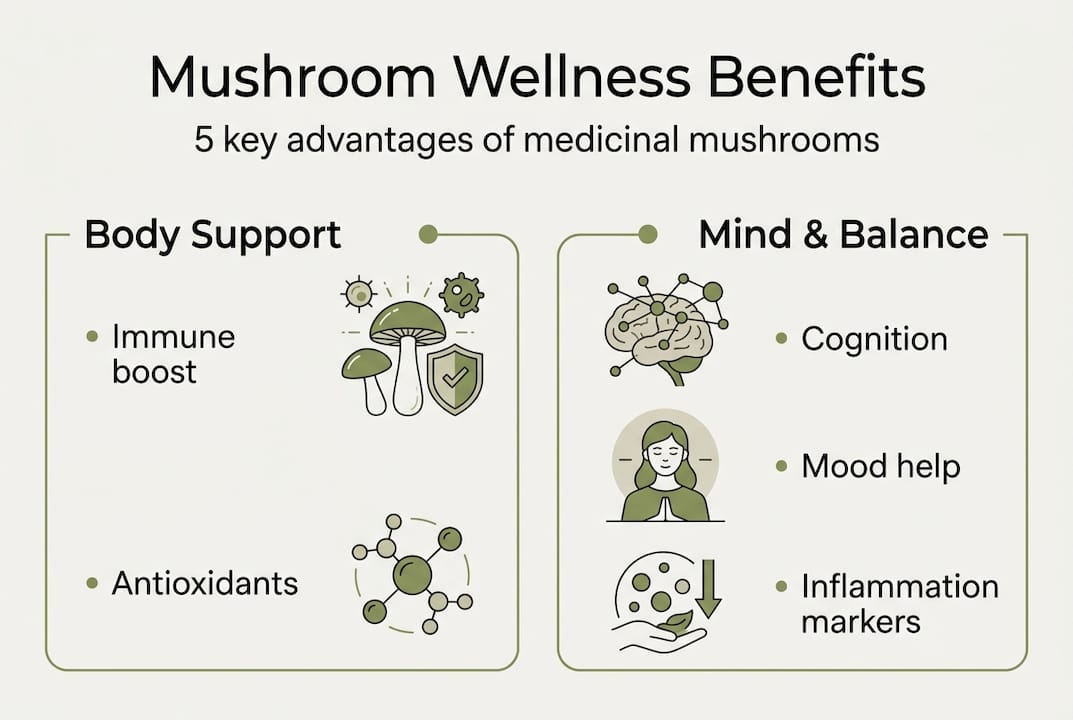
This matters because most plant-based wellness frameworks were built around macronutrients and basic micronutrients. Mushrooms add a third layer: functional bioactives that directly interact with physiological systems like the immune network and the nervous system.
Key bioactive categories found in medicinal mushrooms:
- Beta-glucans: Modulate immune cell activity, particularly macrophages and natural killer cells
- Polysaccharides: Broad immune and gut microbiome support
- Triterpenoids: Anti-inflammatory and liver-protective properties, especially in Reishi
- Hericenones and erinacines: Found only in Lion’s Mane, linked to nerve growth factor production
- Melanins and phenolic acids: Antioxidant protection against oxidative stress
Fungi are not plants. They are their own kingdom, and their health compounds reflect that. Treating mushroom supplements as a simple add-on to a fruit-and-vegetable routine misses what makes them genuinely distinct.
Understanding the difference between mushroom types also helps you choose more precisely. Comparing lion’s mane vs reishi reveals that each species targets different systems, so your wellness goal should guide your selection.
Immune support from mushroom supplements: Mechanisms and evidence
Mushroom supplements have some of the strongest evidence in the immune support category. The key mechanism involves beta-glucans binding to receptors on immune cells, triggering a cascade that activates the body’s defense systems without overstimulating them.
Medicinal mushrooms like Reishi provide immune support through beta-glucans and polysaccharides that modulate immune cells such as macrophages, T cells, and NK cells, along with signaling pathways like NF-kB and the NLRP3 inflammasome. These are not vague wellness claims. These are specific, measurable biological interactions.

Polypore mushroom mycelia reduced COVID-19 vaccine side effects and preserved antibody responses in a randomized trial, which is a notable finding for anyone interested in immune resilience rather than just general wellness. Ganoderma lucidum benefits include enhanced antioxidant status and immune function, with results supported across multiple clinical studies.
Comparison: Immune support profiles of key medicinal mushrooms
| Mushroom | Primary immune mechanism | Key compounds | Evidence level |
|---|---|---|---|
| Reishi | Macrophage and NK cell activation | Triterpenoids, beta-glucans | Multiple clinical studies |
| Turkey Tail | T cell and gut immune support | PSK, PSP polysaccharides | Strong clinical record |
| Chaga | Antioxidant and anti-inflammatory | Melanins, betulinic acid | Preclinical, some human data |
| Cordyceps | Immune modulation, energy | Cordycepin, polysaccharides | Growing clinical evidence |
Pro Tip: If you’re choosing a mushroom supplement specifically for immune support, look for products that specify beta-glucan content on the label. This is a more reliable quality indicator than simply listing mushroom weight.
For a curated overview of the top options, the guide on immune boosting mushrooms covers the evidence across species in plain language.
Key immune benefits supported by current research:
- Activation of macrophages, T cells, and natural killer cells
- Reduction in inflammatory signaling without immune suppression
- Preserved antibody responses during immune challenges
- Antioxidant protection that reduces immune cell damage
Cognitive enhancement: Lion’s Mane and the next frontier
Lion’s Mane (Hericium erinaceus) is the most studied mushroom for brain health. Its unique compounds, hericenones and erinacines, are the only naturally occurring small molecules known to cross the blood-brain barrier and stimulate nerve growth factor (NGF) production.
Lion’s Mane mushroom shows potential for cognitive enhancement via these NGF-promoting compounds, with clinical evidence of improved cognitive scores in mild cognitive impairment patients. The research is most consistent in populations already experiencing cognitive decline, where NGF support appears to slow deterioration and improve functional scores.
For healthy adults, the picture is more nuanced. Acute Lion’s Mane extract at 3g improved pegboard test performance (a measure of fine motor coordination), but showed no overall cognitive or mood benefits in healthy adults. This is an important distinction: the benefits appear to be task-specific and population-specific.
Lion’s Mane cognitive research summary
| Population | Outcome measured | Result |
|---|---|---|
| Mild cognitive impairment | Cognitive scores | Significant improvement |
| Healthy adults (acute) | Motor coordination | Improved |
| Healthy adults (acute) | Mood and overall cognition | No significant change |
| Older adults (chronic use) | Memory recall | Positive trends reported |
How to approach Lion’s Mane supplementation for cognitive goals:
- Identify your target: Are you focused on long-term neuroprotection or short-term focus?
- Check the extract type: Dual-extraction products capture both water-soluble and fat-soluble compounds
- Prioritize consistent daily use over high single doses
- Combine with lifestyle factors: sleep, exercise, and low-sugar diet amplify NGF-related benefits
- Track your baseline: use simple memory or focus tasks to measure personal response over 8 to 12 weeks
Pro Tip: Lion’s Mane works best as a long-term addition, not a one-time boost. Consistent use over several weeks is where the cognitive research shows the clearest results.
For deeper reading, the articles on lion’s mane for sharp brain and lion’s mane brain support cover the mechanisms in detail. A broader overview of top cognitive boost mushrooms is also available for comparison.
Holistic health benefits: Antioxidants, inflammation, and chronic disease
Beyond immunity and cognition, mushrooms contribute to overall health through their antioxidant and anti-inflammatory activity. This is where polyphenols take center stage.
Polyphenols from edible fungi exhibit antioxidant, anti-inflammatory, and anticancer effects that support chronic disease prevention. These effects are not isolated. Mushroom compounds work through what researchers call network pharmacology, meaning multiple compounds act on multiple biological targets at once, producing effects that are greater than any single compound alone.
Holistic health supported by neuroprotective and anti-inflammatory effects shows that plant-based wellness via mushrooms fits immune and cognitive needs, but requires personalized dosing to be effective. One dose does not work for every person or every health goal.
Key considerations for holistic mushroom wellness:
- Bioavailability: Not all mushroom compounds are easily absorbed. Extraction method matters significantly
- Standardization: Product quality varies widely. Look for verified beta-glucan or polyphenol content
- Personalization: Age, gut health, and existing conditions all affect how mushroom compounds work in your body
- Whole-food sources: Eating culinary mushrooms like shiitake and maitake alongside supplements provides a broader range of compounds
Whole-food mushrooms and concentrated extracts are not interchangeable. Each offers a different compound profile. Using both together may provide broader coverage than relying on extracts alone.
For those focused on neuroprotection specifically, the article on lion’s mane neuroprotection covers the NGF pathway and its role in long-term brain health in practical detail.
The reality: What the mushroom wellness hype gets wrong
Mushroom supplements have real, documented benefits. But the wellness industry tends to present them as universal solutions, and that framing does users a disservice.
The first issue is specificity. Benefits are task-specific and domain-specific. Reishi supports immunity. Lion’s Mane supports neurological function. Cordyceps may improve endurance. No single mushroom does everything, and expecting otherwise leads to disappointment and wasted spending.
The second issue is clinical translation. Challenges: poor bioavailability and standardization issues mean that preclinical promise has not fully translated into long-term human trials. Most studies are short-term, use varying doses, and lack standardized extracts. The results are promising but not definitive.
The third issue is extract versus whole food. Expert nuance: benefits task/domain-specific points out that no approved health claims exist for most mushroom extracts, and whole-food sources should be prioritized where possible. Extracts are concentrated but narrow. Whole mushrooms are broader but less potent.
Knowing about lion’s mane side effects is also part of informed supplementation. Most are mild, but they are real and worth understanding before starting.
The takeaway: mushroom supplements are a valuable tool in plant-based wellness, not a replacement for a complete health strategy.
Next steps: Premium plant-based mushroom supplements for your wellness
For those ready to move from research to action, Longevity Botanicals offers a focused range of mushroom supplements built around quality and transparency. Products are available in multiple formats to match different routines and preferences. Mushroom capsule supplements provide a convenient daily option for immune and cognitive support, with clear dosing and standardized extracts. Mushroom powder supplements offer flexibility for those who prefer to blend into drinks or food. Both formats cover key species including Reishi, Lion’s Mane, Turkey Tail, Chaga, and Cordyceps.
Frequently asked questions
How do medicinal mushrooms differ from other plant-based supplements?
Medicinal mushrooms like Reishi contain beta-glucans and polysaccharides that directly modulate immune cells, a mechanism not found in standard plant-based supplements. This makes them functionally distinct, not just nutritionally different.
Can plant-based mushroom supplements help with chronic disease prevention?
Polyphenols from edible fungi show antioxidant, anti-inflammatory, and anticancer properties in research, supporting a role in chronic disease prevention. Results are most consistent when combined with a whole-food diet.
Is Lion’s Mane scientifically proven to improve cognitive function?
Lion’s Mane mushroom has clinical evidence for improved cognitive scores in mild cognitive impairment patients, though effects in healthy adults are more limited and task-specific.
Are there risks or side effects from plant-based mushroom supplements?
Most mushroom supplements are well tolerated, but mild side effects can occur. Expert nuance: benefits task/domain-specific advises prioritizing whole-food sources when possible and consulting a healthcare provider before starting any new supplement.
How do I choose the right mushroom supplement for my wellness goals?
Medicinal mushrooms provide immune and cognitive support that varies by species, so matching the mushroom to your specific goal, Reishi for immunity and Lion’s Mane for cognition, is the most practical starting point.
Recommended
- 7 Ways Mushrooms Boost Wellness Naturally for You – LongevityBotanicals
- Unlock wellness benefits with mushroom supplements – LongevityBotanicals
- 6 Key Mushroom Nutrition Benefits for Better Wellness – LongevityBotanicals
- Mushroom powders checklist: guide for natural wellness – LongevityBotanicals
- Why Choose Plant-Based Supplements: Wellness Impact – Vitaminone.dk
Related Posts

Why Water-Soluble Mushroom Compounds Drive Real Results

What Is Mushroom Sustainability? Benefits and Practices

The Role of Organic Farming in Mushrooms Explained

What Is a Fruiting Body? Mushroom Science Explained

Mushroom Allergenicity Explained: Symptoms and Safe Use

Top 5 naturesrise.com Mushroom Supplement Alternatives 2026

Top 6 Hemplucid.com Alternatives for 2026


