

Why mushrooms support better sleep: benefits and science
TL;DR:
- Medicinal mushrooms like Reishi and Lion’s Mane support sleep by regulating stress and nervous system pathways.
- Reishi is best for stress-related sleep issues, while Lion’s Mane aids mood-related sleep disruptions.
- Consistent use over weeks and choosing quality extracts enhances safety and effectiveness.
Medicinal mushrooms have moved from ancient herbal traditions into modern supplement aisles, and with that shift comes a fair amount of confusion. Can a fungus really help you sleep? The skepticism is understandable, but the science is catching up. Reishi and Lion’s Mane, two of the most studied functional mushrooms, show real promise for improving sleep quality through biological pathways that have nothing to do with sedation. This article breaks down what the research actually says, compares the top options, and gives you practical guidance on how to use them wisely.
Table of Contents
- The science behind mushrooms for sleep support
- Reishi vs. Lion’s Mane: Comparing sleep-enhancing effects
- What the clinical trials say: Evidence and limitations
- Key considerations: Safety, use, and what most people miss
- A fresh perspective: What most guides miss about mushrooms for sleep
- Discover quality mushroom supplements for sleep support
- Frequently asked questions
Key Takeaways
| Point | Details |
|---|---|
| Adaptogenic action | Medicinal mushrooms help regulate stress and support sleep naturally rather than sedating you. |
| Reishi vs. Lion’s Mane | Reishi is best for stress-related sleep issues, while Lion’s Mane targets anxiety-driven sleep problems. |
| Clinical evidence overview | Most benefits show up in stressed populations and require several weeks of consistent use. |
| Safe use and limitations | Mushrooms are low-risk but not substitutes for tested therapies, and interactions are possible. |
The science behind mushrooms for sleep support
Medicinal mushrooms work differently from sleep medications. They do not knock you out. Instead, they work upstream, addressing the biological conditions that make restful sleep harder to achieve. Understanding this distinction is key to setting realistic expectations.
The two primary bioactive compounds responsible for sleep-related benefits are triterpenes and beta-glucans. Triterpenes are fat-soluble compounds found in high concentrations in Reishi. They are small enough to cross the blood-brain barrier, where they can directly influence neurological activity. Beta-glucans, on the other hand, work more broadly on immune regulation and stress response, which indirectly supports sleep quality.
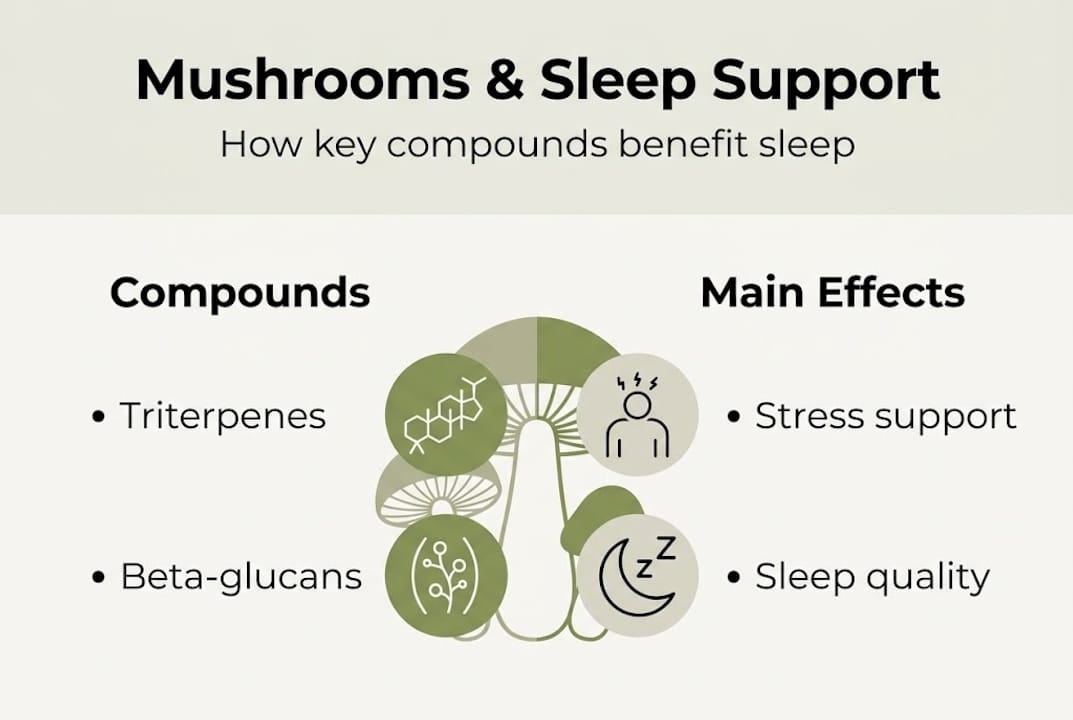
Reishi’s biological effects on sleep involve several overlapping mechanisms: HPA axis modulation, cortisol reduction, GABAergic activity, and interaction with melatonin pathways. The HPA axis (hypothalamic-pituitary-adrenal axis) is the body’s central stress-response system. When it stays activated in the evening, cortisol stays elevated and sleep onset becomes difficult. Reishi helps regulate this system, creating better conditions for natural sleep.
Here is a summary of the main sleep mechanisms linked to medicinal mushrooms:
- Cortisol reduction via HPA axis modulation
- GABAergic activity that calms nervous system arousal
- Melatonin pathway support for natural sleep-wake cycles
- Triterpene activity crossing the blood-brain barrier
- Adaptogenic effects that reduce the physiological impact of stress
Adaptogens are not sedatives. They help the body respond to stress more efficiently over time, which is why consistent use matters more than a single dose. You can explore more about Reishi sleep science to see how these pathways translate into real-world outcomes.
Pro Tip: For best results, take Reishi 60 to 90 minutes before bed. Most studies use doses between 1,000 mg and 1,500 mg of extract daily. Consistency over weeks matters more than any single dose. Learn more about timing Reishi for sleep to get the most from your supplement routine.
Reishi vs. Lion’s Mane: Comparing sleep-enhancing effects
Both Reishi and Lion’s Mane appear in the research on sleep, but they work through different pathways and suit different situations. Knowing which one fits your needs can make a real difference.
Reishi is the more direct option for sleep. Its triterpenes and cortisol-lowering effects make it particularly useful for people whose sleep problems are rooted in stress or an overactive mind at night. Small randomized controlled trials (RCTs) show improved sleep quality and reduced insomnia symptoms in people using Reishi, with improved sleep quality noted across multiple studies.

Lion’s Mane takes a different route. It promotes the production of NGF (nerve growth factor) and BDNF (brain-derived neurotrophic factor), two proteins that support nervous system health and emotional regulation. Research shows that Lion’s Mane supports NGF and BDNF production, which improves sleep in people dealing with mood disorders or anxiety-related sleep disruption. Its effects on PSQI (Pittsburgh Sleep Quality Index) scores are particularly notable in this group.
Here is a direct comparison:
| Feature | Reishi | Lion’s Mane |
|---|---|---|
| Primary mechanism | Cortisol reduction, GABAergic activity | NGF/BDNF production, nervous system support |
| Best for | Stress-related insomnia | Anxiety-related sleep disruption |
| Clinical evidence | Small RCTs, improved sleep quality | Improved PSQI scores in mood disorder groups |
| Onset of effects | 2 to 4 weeks consistent use | 4 to 8 weeks consistent use |
| Format options | Capsules, powder, extract | Capsules, powder, extract |
Reishi is the stronger choice when stress and elevated cortisol are the root cause of poor sleep. Lion’s Mane is more appropriate when anxiety or low mood is driving the problem. In many cases, a blend of both addresses overlapping issues more effectively.
Key use cases for each mushroom:
- Reishi: Difficulty falling asleep due to racing thoughts or stress
- Lion’s Mane: Waking during the night linked to anxiety or low mood
- Both combined: General sleep quality improvement in stressed, anxious individuals
Browse the full range of sleep-boosting mushrooms or explore options focused on the calming effects of mushrooms if anxiety is the primary concern.
What the clinical trials say: Evidence and limitations
The research on mushrooms for sleep is promising but still developing. Here is what the actual data shows, and where the gaps remain.
A notable study found that mushroom blends improved PSQI scores and reduced cortisol stress markers in young adults over 25 days. That is a relatively short window, and the results were meaningful enough to support further investigation. A separate review published in Frontiers in Nutrition confirmed that benefits are most evident in stressed or fatigued populations, reinforcing the adaptogen model rather than a sedative one.
Key clinical findings and what they mean in practice:
- Reishi improved sleep quality scores in breast cancer survivors dealing with fatigue and disrupted sleep.
- Lion’s Mane reduced anxiety and depression scores, with corresponding improvements in sleep in adults with mild mood disorders.
- Mushroom blends outperformed single-mushroom supplements in some trials, suggesting synergistic effects.
- Benefits were not observed in healthy, non-stressed populations to the same degree.
- No studies have demonstrated that mushrooms replace proven sleep therapies like cognitive behavioral therapy for insomnia (CBT-I).
| Study population | Mushroom used | Key result | Duration |
|---|---|---|---|
| Young adults (stressed) | Mushroom blend | Improved PSQI, reduced cortisol | 25 days |
| Breast cancer survivors | Reishi | Reduced fatigue, improved sleep | 4 weeks |
| Adults with mood disorders | Lion’s Mane | Reduced anxiety, better PSQI | 4 weeks |
| Healthy adults (low stress) | Reishi | Minimal sleep improvement | 8 weeks |
The limitations are real. Sample sizes in most trials are small, often under 100 participants. Most studies lack long-term follow-up. And the populations that benefit most are those already dealing with stress, fatigue, or mood issues. For people seeking mushrooms for relaxation, the evidence is more supportive than for general insomnia treatment.
Key considerations: Safety, use, and what most people miss
Even with encouraging evidence, using mushroom supplements for sleep requires informed choices. There are a few things most product pages do not tell you.
First, mushrooms are not a replacement for evidence-based insomnia treatments. CBT-I remains the most effective long-term intervention for chronic insomnia. Mushrooms can support better sleep conditions, but they work best alongside good sleep hygiene, not instead of it.
Second, product quality varies significantly. Extracts made from the fruiting body of the mushroom contain higher concentrations of active compounds like triterpenes and beta-glucans compared to mycelium-based products. Mycelium products often contain significant amounts of grain substrate, which dilutes the active content. Always check the label for fruiting body sourcing and extract ratios.
Third, there are real safety considerations. Mushroom safety guidelines note that no approved health claims exist for mushroom supplements in treating insomnia, and regulatory guidelines do not recommend them as a primary insomnia therapy due to limited large-scale efficacy data. Additionally, interactions with medications involving blood pressure or clotting are possible with Reishi. Anyone on anticoagulants or blood pressure medications should consult a healthcare provider first.
Key safety and usage points:
- Choose fruiting body extracts over mycelium products
- Start with a lower dose and increase gradually
- Avoid use during pregnancy or breastfeeding without medical guidance
- Consult a doctor if you take blood thinners or blood pressure medications
- Do not use mushrooms as a substitute for prescribed sleep treatments
Pro Tip: Read the safe use of mushroom supplements guide before starting any new mushroom routine. Also check the guide for safe mushroom powders if you prefer powder formats over capsules.
A fresh perspective: What most guides miss about mushrooms for sleep
Most articles on mushrooms for sleep focus on compounds and studies. That is useful, but it skips the bigger picture.
The honest reality is that mushrooms work best when the rest of your sleep environment is already reasonable. If chronic stress, poor sleep hygiene, or an underlying health condition is the core problem, a mushroom supplement will not fix it alone. The human evidence remains limited to small studies, and no regulatory body has approved mushroom supplements as insomnia treatments.
What mushrooms do well is support the body’s own regulatory systems over time. They are tools in a broader wellness approach, not standalone solutions. The people who see the most benefit tend to be those already working on stress management, consistent sleep schedules, and overall lifestyle factors.
The hype around mushroom supplements often outpaces the science. That does not mean the science is weak. It means realistic expectations matter. Read about the broader wellness benefits perspective to see how mushrooms fit into a complete health routine rather than a quick fix.
Discover quality mushroom supplements for sleep support
For those ready to add mushroom extracts to a sleep wellness routine, product quality is the starting point. Longevity Botanicals offers a curated range of mushroom capsule supplements made from fruiting body extracts, covering both single-mushroom and blend formats. For sleep-specific support, the Reishi mushroom supplements collection includes standardized extracts with clear dosing information. Whether starting with Reishi alone or exploring a multi-mushroom blend, the focus is on verified quality and transparent sourcing. Explore the full range to find the right format and mushroom for your specific sleep goals.
Frequently asked questions
Can I use mushrooms like Reishi and Lion’s Mane for insomnia?
Small studies suggest these mushrooms may improve sleep quality, especially in stressed individuals, but they are not approved for insomnia treatment by any regulatory body. They work best as a supportive tool alongside other sleep strategies.
How long do mushrooms take to affect sleep?
Most studies show meaningful improvements after 4 to 8 weeks of consistent use, with sleep quality improvements building gradually rather than appearing overnight. Single doses are unlikely to produce noticeable effects.
Are there any side effects or risks?
Mushrooms are generally well tolerated, but Reishi can interact with blood thinners and blood pressure medications, so checking with a healthcare provider before starting is advisable.
Can I combine Reishi and Lion’s Mane for better sleep?
Yes, mushroom blends improved PSQI scores and reduced cortisol in young adults, suggesting that combining both mushrooms may offer broader benefits than using either one alone.
Recommended
- Best Mushrooms for Improved Sleep & Insomnia – LongevityBotanicals
- How Reishi Can Improve Your Sleep, According to Science – LongevityBotanicals
- Mushrooms for brain health: 15% cognitive boost proven – LongevityBotanicals
- Brain health support: Evidence, mushrooms, and strategies – LongevityBotanicals
Related Posts

Why Water-Soluble Mushroom Compounds Drive Real Results

What Is Mushroom Sustainability? Benefits and Practices

The Role of Organic Farming in Mushrooms Explained

What Is a Fruiting Body? Mushroom Science Explained

Mushroom Allergenicity Explained: Symptoms and Safe Use

Top 5 naturesrise.com Mushroom Supplement Alternatives 2026

Top 6 Hemplucid.com Alternatives for 2026


