

Define supplement quality: science-backed guide for mushrooms
TL;DR:
- Supplement quality standards vary, with cGMP being the baseline for safety and consistency.
- Third-party certifications like USP and NSF provide additional assurance of ingredient and contaminant verification.
- Laboratory testing for beta-glucans and heavy metals is crucial, especially in mushroom supplements prone to contamination.
Supplement labels make bold claims, but the standards behind those claims vary widely. Many consumers assume all products on store shelves meet the same safety and quality thresholds, yet the reality is far more fragmented. Mushroom-based supplements face particular scrutiny because they absorb compounds from their growing environment, making contamination a real concern. Supplement benefits and risks are only meaningful when the product itself meets verifiable quality criteria. This guide breaks down the regulatory framework, third-party certifications, lab testing methods, and real-world benchmarks that define supplement quality, so you can make informed decisions.
Table of Contents
- What defines supplement quality? Regulatory foundations
- Third-party certifications: USP, NSF, and what they verify
- Testing methods: How labs verify supplement quality
- Risks and edge cases in supplement quality: Mushrooms as a case study
- Quality benchmarking: Real-world standards and empirical checks
- Why quality benchmarking should empower, not overwhelm, buyers
- Explore high-quality mushroom supplements for wellness
- Frequently asked questions
Key Takeaways
| Point | Details |
|---|---|
| cGMP is a baseline | FDA cGMP sets minimum safety and quality standards for supplements but is not comprehensive. |
| Third-party certifications add trust | USP and NSF verify product quality independently, offering greater assurance but not guaranteeing effectiveness. |
| Testing verifies true quality | Lab methods like HPLC and ICP-MS confirm ingredient identity and purity in mushroom supplements. |
| Benchmarks help choose wisely | Look for beta-glucan levels and low heavy metal content as reliable signs of quality in mushroom extracts. |
| Mushrooms need extra scrutiny | Risks from substrate contamination and adulteration mean buyers must demand clear lab testing and transparent sourcing. |
What defines supplement quality? Regulatory foundations
Quality in dietary supplements is not a vague concept. It has a formal definition rooted in federal regulation. Dietary supplement quality is primarily defined by FDA’s current Good Manufacturing Practice (cGMP) regulations under 21 CFR Part 111. These rules set minimum standards that manufacturers must follow to ensure every product batch meets defined criteria.
The five core cGMP pillars are:
- Identity: The ingredient must be what the label says it is
- Purity: No unwanted substances above acceptable thresholds
- Strength: Active compounds at the stated potency
- Composition: Correct proportions of all ingredients
- Contaminants: Heavy metals, microbes, and adulterants within legal limits
One critical point: there is no pre-market FDA approval for dietary supplements. Manufacturers are responsible for compliance before a product hits the shelf. The FDA inspects facilities and can issue warning letters or recalls after the fact, but it does not review each product before sale.
Regular testing and documentation are mandatory under cGMP. Manufacturers must keep batch records, test raw materials, and verify finished products. This creates a paper trail that regulators can audit.
| cGMP Requirement | What It Covers | Who Verifies |
|---|---|---|
| Identity testing | Ingredient authenticity | Manufacturer + FDA audit |
| Potency testing | Active compound levels | Manufacturer |
| Contaminant limits | Heavy metals, microbes | Manufacturer + third party |
| Batch records | Full production documentation | FDA on inspection |
cGMP is the baseline, not a guarantee. Meeting cGMP means a manufacturer followed the right processes. It does not confirm that every product is effective or free from all risks.
For mushroom supplements specifically, baseline cGMP compliance matters, but it leaves gaps. Substrate sourcing, extraction methods, and species verification require additional scrutiny beyond what cGMP alone demands.
Third-party certifications: USP, NSF, and what they verify
While cGMP covers the basics, third-party verification takes quality assurance to the next level. Two programs stand out: USP Verified and NSF/ANSI 173.
The USP Verified program verifies ingredients, contaminants, dissolution, and audits manufacturing facilities. Products earning the USP Verified mark have been tested against published standards and passed an independent facility audit. NSF/ANSI 173 certification requires GMP compliance, detailed ingredient and contaminant testing, and annual audits of manufacturing sites.
| Criteria | USP Verified | NSF/ANSI 173 |
|---|---|---|
| Ingredient identity | Yes | Yes |
| Potency verification | Yes | Yes |
| Contaminant testing | Yes | Yes |
| Facility audit | Yes | Yes (annual) |
| Banned substance screen | No (standard) | Yes (Certified for Sport) |
| Label accuracy check | Yes | Yes |
Both programs add meaningful assurance, but neither guarantees that a supplement will produce the health outcomes described on the label. Certification confirms what is in the product and that it was made correctly. Efficacy is a separate question answered by clinical research.
For choosing mushroom supplements, these certifications are a strong signal of transparency. Brands that pursue third-party verification are demonstrating accountability that goes beyond the legal minimum.
To check certifications on a mushroom supplement label:
- Look for the USP Verified or NSF mark on the front or back panel
- Note the certification number printed near the mark
- Visit the certifying body’s official website
- Search the product or manufacturer in their public database
- Confirm the certification is current, not expired
Pro Tip: Look for both cGMP compliance and an independent certification seal. A product with only one of these has fewer verification layers than one with both.
Brands that display supplement standards openly, including certificates of analysis, give buyers the clearest picture of what they are purchasing.
Testing methods: How labs verify supplement quality
Even with certifications, actual lab testing is where quality is scientifically proven. Certifications set the framework; lab results fill in the data.
Key testing methodologies include HPLC and GC-MS for identity and potency, and ICP-MS for heavy metals. Each method targets a specific quality dimension.
Common testing methods and what each reveals:
- HPLC (High-Performance Liquid Chromatography): Identifies and quantifies active compounds like beta-glucans and polysaccharides in mushroom extracts
- GC-MS (Gas Chromatography-Mass Spectrometry): Detects volatile compounds, solvents, and adulterants that HPLC may miss
- ICP-MS (Inductively Coupled Plasma Mass Spectrometry): Measures trace heavy metals including arsenic, lead, cadmium, and mercury at very low concentrations
- Microbial enumeration: Counts bacteria, yeast, and mold to confirm the product is safe for consumption
- Orthogonal testing: Uses two or more independent methods on the same sample to cross-verify results, particularly valuable for complex botanicals
Mushroom supplements require extra testing layers compared to simpler supplements. Because mushrooms bioaccumulate compounds from their substrate, a product grown in contaminated soil can carry heavy metals even when the extraction process is otherwise clean. Species misidentification is another documented risk, where one mushroom species is substituted for another with different bioactive profiles.

Turkey tail powder and similar mushroom extracts benefit from HPLC verification of beta-glucan content, the primary marker of immune-supporting activity. Mushroom powders without documented beta-glucan data offer no reliable way to compare potency across products.
Pro Tip: Quality mushroom extracts typically contain 25-40% beta-glucans. Heavy metals should fall below FDA and Prop 65 limits. Ask for a certificate of analysis before purchasing if this data is not published on the product page.
Risks and edge cases in supplement quality: Mushrooms as a case study
Understanding testing is essential, but the real world brings unique risks, especially for mushroom supplements. Several failure modes appear repeatedly in regulatory citations and independent audits.
Mushrooms pose special risks because of how they grow. Unlike synthesized compounds, mushrooms are biological organisms that interact with their environment. Substrate quality, growing conditions, and post-harvest processing all influence the final product’s safety profile.
No pre-market FDA approval exists for supplements, and common failures include inadequate specifications and insufficient testing. For mushrooms, contamination from polluted substrates and adulteration with fillers like grain starch are documented concerns.
Top supplement quality failures include:
- Adulteration: Adding undeclared ingredients or substituting cheaper materials
- Substrate contamination: Heavy metals or pesticides absorbed from growing media
- Potency variability: Inconsistent beta-glucan levels across batches
- Species misidentification: Wrong mushroom species used in production
- Microbial overgrowth: Poor drying or storage conditions leading to mold or bacteria
- Inadequate documentation: Missing batch records that make tracing failures impossible
The role of antioxidants in supplements is relevant here too. Mushrooms like Chaga and Reishi contain high antioxidant loads, but those compounds degrade if storage and processing are not controlled. A product that tested well at manufacture may not reflect what reaches the consumer.
No single certification covers all risks. Buyer vigilance, including reviewing certificates of analysis and understanding what benchmarks mean, remains essential for mushroom supplements.
Reviewing supplement safety tips alongside certification data gives a more complete picture of product reliability.
Quality benchmarking: Real-world standards and empirical checks
To apply quality definitions, benchmarks are needed for real-world products. Benchmarks translate regulatory language into numbers you can actually compare.
For mushroom extracts, two primary benchmarks matter most: beta-glucan content and heavy metal levels. Beta-glucans in the 25-40% range indicate a concentrated, active extract. Heavy metals must fall below FDA limits and California Prop 65 thresholds, which are among the strictest in the US.
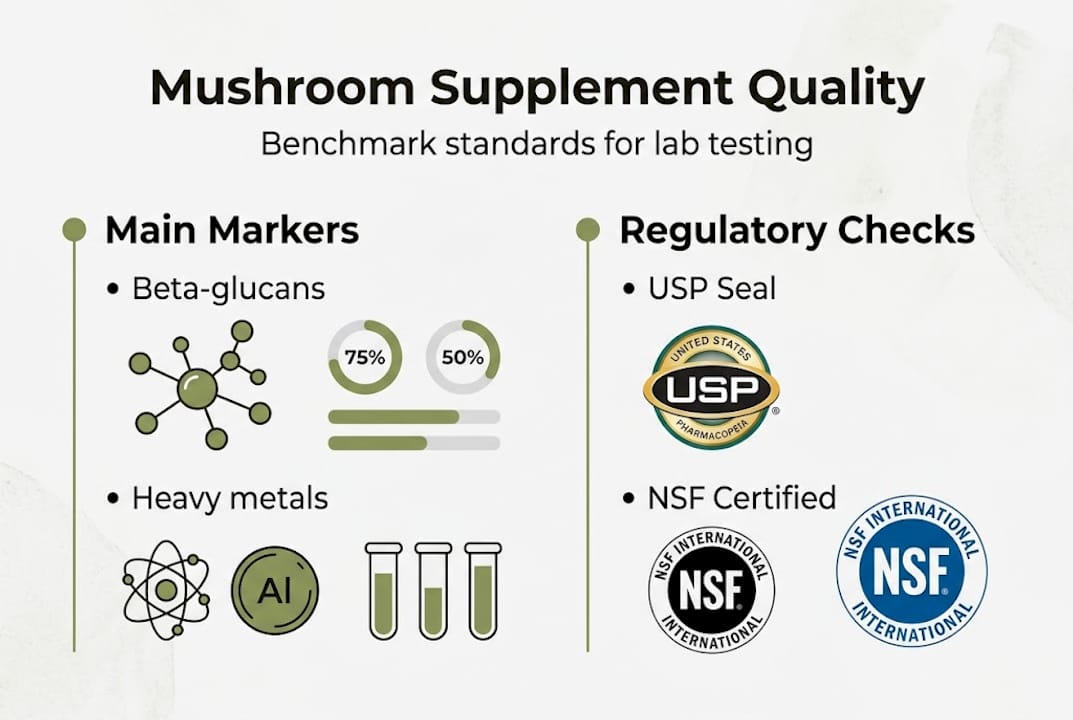
NIST DSQAP provides interlaboratory studies for accuracy in measuring nutrients, markers, and toxics in supplements including botanicals. This program helps labs calibrate their methods against a common standard, reducing variability in results across different testing facilities.
For standardizing mushrooms, consistent benchmarks across the industry remain a work in progress, but established thresholds provide a practical starting point.
How to use benchmarks for practical supplement comparisons:
- Request or download the certificate of analysis for any product
- Check beta-glucan percentage against the 25-40% benchmark
- Verify heavy metal results against FDA and Prop 65 limits
- Confirm the testing lab is accredited (ISO 17025 is the standard)
- Compare batch numbers on the COA to the product you are buying
| Quality Marker | Target Range | Regulatory Limit |
|---|---|---|
| Beta-glucans | 25-40% | No federal minimum set |
| Lead | Below 0.5 mcg/day | Prop 65 limit |
| Arsenic | Below 10 mcg/day | FDA guidance |
| Mercury | Below 0.3 mcg/day | FDA guidance |
| Microbial count | Within USP limits | cGMP requirement |
For those exploring mushroom extract usage, these benchmarks provide a practical filter for comparing products. Staying current with mushroom quality trends also helps as industry standards continue to evolve.
Why quality benchmarking should empower, not overwhelm, buyers
Quality certifications and benchmarks exist to create transparency, not to create confusion. The practical value of understanding cGMP, USP, NSF, and beta-glucan percentages is that it shifts the power dynamic toward the buyer.
Chasing certification badges without understanding what they verify is a common mistake. A USP mark confirms manufacturing quality. It does not tell you whether the beta-glucan content is high enough to be meaningful. Both pieces of information matter, and neither replaces the other.
Educated skepticism is more useful than blind trust in any single label claim. Buyers who know what empirical markers to look for, and where to find published lab data, are better positioned than those who rely on marketing copy alone.
Supplement wellness benefits are only accessible when the product delivering them meets verifiable quality standards. Benchmarks are the bridge between a label claim and a reliable product.
Pro Tip: Look beyond the label for empirical markers. A published certificate of analysis with batch-specific data is worth more than any marketing claim on the front panel.
Explore high-quality mushroom supplements for wellness
For those ready to apply these quality standards to real products, Longevity Botanicals offers mushroom extracts with transparent ingredient sourcing and documented quality data. Product pages include detailed information on extract ratios and formulation specifics.
Browse organic mushroom capsules for convenient daily formats, or explore mushrooms for brain health including Lion’s Mane and Reishi options. The full product catalog covers powders, capsules, and blends across the most researched functional mushroom species. Quality benchmarks, ingredient transparency, and clear product data support informed purchasing decisions at every step.
Frequently asked questions
What is cGMP and why does it matter for supplement quality?
cGMP stands for current Good Manufacturing Practice and sets baseline safety and quality standards enforced under 21 CFR Part 111 for dietary supplements. It requires manufacturers to test, document, and verify every batch before sale.
How can I tell if a supplement is USP or NSF certified?
Check for USP or NSF marks on the label and verify certification numbers on their official websites. Both the USP Verified program and NSF/ANSI 173 allow online verification of current certifications.
Do certifications guarantee a supplement’s efficacy?
No certification guarantees efficacy, only quality as defined by ingredients and safety standards. Certifications confirm what is in the product and how it was made, not whether it will produce specific health outcomes.
What benchmarks should I look for in mushroom supplements?
Look for beta-glucans in the 25-40% range and heavy metals below FDA and Prop 65 limits, with clear lab testing documentation. A batch-specific certificate of analysis from an ISO 17025 accredited lab is the strongest evidence.
Why are mushrooms more prone to contamination than other supplements?
Mushrooms absorb contaminants from their substrate during growth, making substrate purity and post-harvest testing especially critical. This bioaccumulation risk is higher than for most synthesized or plant-extracted supplements.
Recommended
- Mushroom supplement dos and don’ts: safe guide for wellness – LongevityBotanicals
- How to Choose Mushroom Supplements for Best Results – LongevityBotanicals
- Dietary supplements explained: benefits, risks, and mushroom science – LongevityBotanicals
- Mushroom powders checklist: guide for natural wellness – LongevityBotanicals
Related Posts

Why Water-Soluble Mushroom Compounds Drive Real Results

What Is Mushroom Sustainability? Benefits and Practices

The Role of Organic Farming in Mushrooms Explained

What Is a Fruiting Body? Mushroom Science Explained

Mushroom Allergenicity Explained: Symptoms and Safe Use

Top 5 naturesrise.com Mushroom Supplement Alternatives 2026

Top 6 Hemplucid.com Alternatives for 2026


