

How to read mushroom supplement labels effectively
TL;DR:
- Many mushroom supplement labels lack critical details like beta-glucan content and extraction methods due to limited legal requirements. Consumers should look for transparent labels showing specific beta-glucan percentages, third-party testing, and clear extraction practices to ensure quality. Understanding terms like fruiting body versus mycelium and verifying independent testing help in choosing effective, safe mushroom supplements.
Mushroom supplement labels look straightforward until you start asking harder questions. Most consumers assume a label guarantees what’s inside, but the reality is that many critical details like beta-glucan content, extraction method, and third-party testing results are not required by law and rarely appear. Learning to read a label carefully is one of the most practical steps you can take toward making safe, effective choices with your supplement spending.
Table of Contents
- What information is legally required on mushroom supplement labels?
- Going beyond the basics: What important details are often missing?
- Decoding mushroom ingredient terminology: Fruiting body vs mycelium, and more
- How to verify quality: Testing methods, extraction, and red flags
- Why smart supplement shoppers look for transparency over hype
- Explore high-quality, transparent mushroom supplements
- Frequently asked questions
Key Takeaways
| Point | Details |
|---|---|
| Know required label info | Every legal mushroom supplement label must include species names, part used, and Supplement Facts, but many key quality details are voluntary. |
| Demand third-party testing | Seek out products that clearly mention independent beta-glucan tests and openly display quality metrics. |
| Prioritize fruiting body extracts | Labels specifying fruiting body rather than mycelium-on-grain usually guarantee higher beta-glucan potency and less filler. |
| Watch for proprietary blends | Avoid proprietary blends when you want full ingredient and potency transparency. |
| Insist on clear terminology | Latin names, extraction methods, and exact beta-glucan percentages on the label help you pick the right supplement for your health. |
What information is legally required on mushroom supplement labels?
Every mushroom supplement sold in the United States must meet specific labeling rules set by the FDA under the Dietary Supplement Health and Education Act (DSHEA). These rules set the floor, not the ceiling, for what you see on a bottle.
The most important required element is the Supplement Facts panel. According to regulatory requirements, mushroom supplement labels must include a Supplement Facts panel listing serving size, amounts of dietary ingredients by weight, a full ingredient list with both common and Latin names of mushrooms, the part used such as fruiting body or mycelium, and manufacturer details along with the FDA disclaimer. This panel is the single most standardized section on any supplement label.
Here is a breakdown of exactly what the law requires:
- Supplement Facts panel with serving size and ingredient weights
- Common and Latin names for each mushroom species (e.g., Reishi, Ganoderma lucidum)
- Part of mushroom used (fruiting body, mycelium, or spores)
- Full other ingredients list including fillers, binders, and capsule material
- Manufacturer or distributor name and address
- FDA disclaimer stating the product is not intended to diagnose, treat, cure, or prevent disease
- Net quantity of contents
- Directions for use
Structure/function claims are also regulated. A label can say “supports immune health” or “promotes cognitive function,” but these claims require a disclaimer stating the FDA has not evaluated the claim. Disease claims, like “treats diabetes,” are strictly prohibited without drug approval.
| Label element | Required by law? | Notes |
|---|---|---|
| Supplement Facts panel | Yes | Serving size, weight per ingredient |
| Common and Latin mushroom name | Yes | Both names required |
| Part used (fruiting body, etc.) | Yes | Must be listed |
| Manufacturer details | Yes | Name and address |
| FDA disclaimer | Yes | Standard language |
| Beta-glucan percentage | No | Voluntary only |
| Extraction method | No | Voluntary only |
| Third-party testing | No | Voluntary only |
“Structure/function claims like ‘supports immune health’ are allowed on labels, but brands must include a disclaimer. Claims about treating or curing diseases are prohibited without FDA drug approval.”
One major legal gap worth noting: proprietary blends. A brand can list a blend of multiple mushrooms under one total weight, hiding how much of each individual ingredient is actually present. This is fully legal and widely used. For tips on navigating these situations safely, reviewing supplement safety tips can help you set better buying standards from the start.
Going beyond the basics: What important details are often missing?
Legal compliance sets the baseline, but it leaves many important quality signals completely off the table. Savvy supplement shoppers know to look for details that brands volunteer, not just what regulations require.
The FDA does not require disclosure of beta-glucan content, extraction method, extraction ratio, or third-party testing on labels under DSHEA. These are entirely voluntary. This creates a wide gap between a technically compliant label and a genuinely transparent one.
Here is a numbered checklist of what a high-quality mushroom supplement label should ideally include:
- Beta-glucan percentage, tested using a validated method (not just total polysaccharides)
- Extraction method stated clearly, such as hot water extraction or dual extraction
- Extraction ratio, for example 10:1 or 8:1, indicating how concentrated the extract is
- Fruiting body listed as the primary mushroom part, not just generic “mushroom”
- Latin species name for each mushroom included
- Third-party testing reference or COA (certificate of analysis) availability
- No proprietary blends hiding individual ingredient amounts
- Country of origin for raw materials
Proprietary blends must show total weight but are not required to reveal individual ingredient amounts. This reduces the transparency consumers need to evaluate a product fairly. When every mushroom in a blend could be present in trace amounts, there is no way to confirm effective dosing from the label alone.
Pro Tip: If a brand does not publish COAs on their website or does not respond when you request one, treat that as a significant red flag for product quality.
| Transparency feature | Required by law? | What to look for |
|---|---|---|
| Beta-glucan % | No | Look for 20%+ for quality fruiting body extract |
| Extraction method stated | No | Hot water, dual extraction, or alcohol |
| COA / third-party testing | No | NSF, Eurofins, or independent labs |
| Individual blend amounts | No | Avoid products with only total blend weight |
| Extraction ratio | No | 8:1 or higher for concentrated extract |
Making evidence-based choices when buying supplements means going beyond the legal minimum. A label that only meets regulatory requirements is telling you the legal minimum, not the quality maximum.
For consumers who want to know more about what testing and certification actually signal, reviewing certification and testing standards provides useful context. And understanding how quality is defined at a scientific level is covered well in this science-backed quality guide.
Decoding mushroom ingredient terminology: Fruiting body vs mycelium, and more
Once you know what should appear on a label, the next challenge is understanding what the terms actually mean. This is where many consumers get misled, even when they are reading carefully.
The two most commonly debated terms are fruiting body and mycelium. The fruiting body is the above-ground, mature mushroom. Mycelium is the root-like network that grows below ground or through a growth substrate. These two parts are not equivalent in potency.

Quality fruiting body extracts typically contain 25 to 40% beta-glucans, while mycelium-on-grain products often contain only 1 to 5%. Polysaccharide claims on labels can also be misleading because they include starch, not just the beneficial beta-glucans consumers are looking for.
Key terminology to know when reading a mushroom supplement label:
- Fruiting body extract: Preferred for most health applications. Higher beta-glucan density. No grain filler.
- Mycelium-on-grain (MOG): Root part grown on rice or oats. May list “myceliated rice” in other ingredients. Lower potency benchmark.
- Beta-glucans: The specific polysaccharide linked to immune and health benefits. Look for explicit beta-glucan percentage, not just total polysaccharides.
- Polysaccharides: A broad category that includes both beneficial beta-glucans and non-beneficial starches. High polysaccharide numbers do not always mean high quality.
- Dual extraction: A process using both water and alcohol to capture a full spectrum of bioactive compounds, including water-soluble beta-glucans and alcohol-soluble triterpenes.
- 10:1 extract: Means 10 kg of raw mushroom was used to make 1 kg of extract. Higher ratios often indicate more concentrated product.
“Fruiting body is preferred for higher beta-glucan content by most experts, though some argue mycelium contains unique compounds. Empirical tests consistently show fruiting body is superior in potency benchmarks.”
Understanding the difference between fruiting body and mycelium is foundational to reading any mushroom label correctly. A full breakdown of fruiting body vs mycelium helps clarify why this distinction matters for product effectiveness. For consumers who want to understand where beta-glucan sources come from and how they vary, that resource is worth bookmarking.
Pro Tip: If a label says “myceliated grain” or “myceliated oats” in the other ingredients section, the product contains significant grain filler. This directly reduces the effective mushroom content per serving.
How to verify quality: Testing methods, extraction, and red flags
Understanding label language is only part of the picture. Knowing how to cross-reference quality claims against scientific testing standards gives you the ability to evaluate products with confidence.
The gold standard for mushroom supplement quality verification is third-party beta-glucan testing using a validated method. Beta-glucan testing should use the Megazyme K-YBGL or AOAC method to accurately distinguish fungal beta-glucans from alpha-glucans and starch. These tests are specific enough to confirm whether the beta-glucan number on a label actually reflects mushroom content or just starch from grain filler.
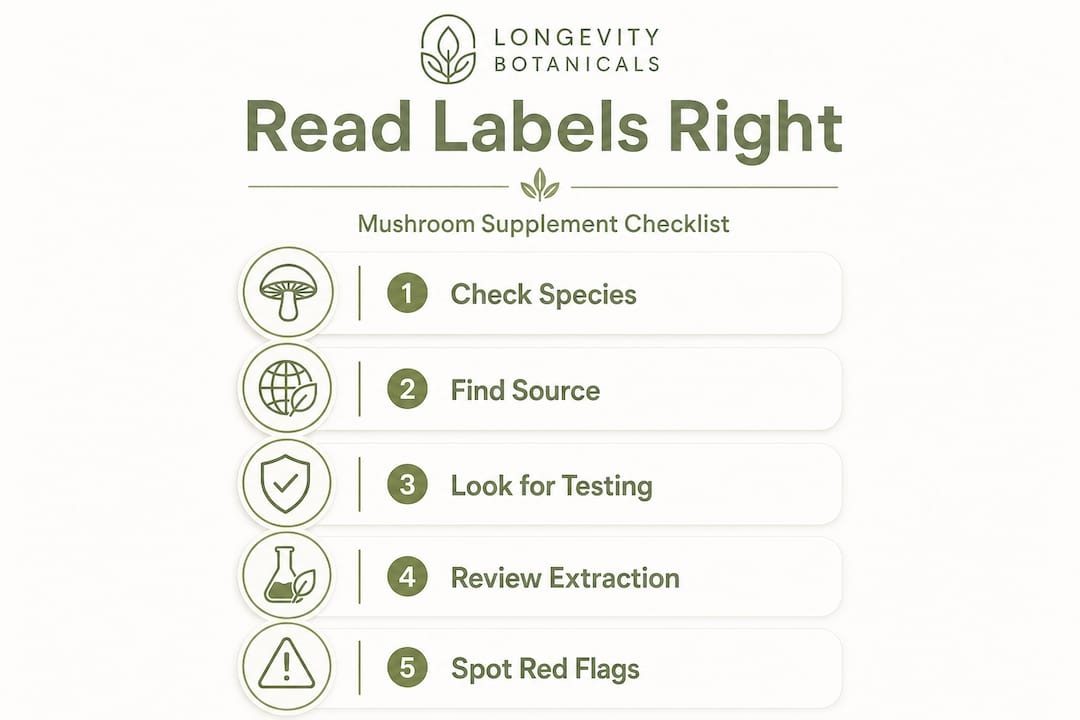
Steps to verify mushroom supplement quality before buying:
- Check for stated beta-glucan %: Look for this on the label or the product page. Anything above 20% from a fruiting body extract is a reliable quality marker.
- Look for extraction method disclosure: Hot water extraction is standard for polysaccharides. Dual extraction (water and alcohol) is ideal for mushrooms like Reishi and Chaga that contain triterpenes.
- Search for a published COA: Reputable brands post certificates of analysis from third-party labs on their websites. Lot numbers on the bottle should match the COA.
- Avoid polysaccharide-only claims: High polysaccharide percentages without a corresponding beta-glucan percentage often indicate starch content from grain-based mycelium products.
- Flag proprietary blends: These prevent you from confirming effective dosing for each mushroom species in the formula.
| Quality signal | What to look for | Red flag |
|---|---|---|
| Beta-glucan % | 20% or higher (fruiting body) | Not listed at all |
| Extraction method | Hot water or dual extraction stated | No mention of extraction |
| Third-party testing | Lab name, COA available | No testing reference |
| Polysaccharide vs beta-glucan | Beta-glucan specifically noted | Only “polysaccharides” listed |
| Proprietary blend | All ingredients listed with amounts | Total weight only |
Pro Tip: Search the brand name plus “COA” or “certificate of analysis” online. Transparent brands make these documents publicly accessible. If none appear, that tells you something important.
Understanding how standardized extract methods affect potency and purity helps explain why the extraction process matters as much as the raw ingredient itself.
Why smart supplement shoppers look for transparency over hype
Most of the confusion around mushroom supplements does not come from a lack of regulation alone. It comes from the gap between what brands are allowed to say and what consumers assume that language means. When a label says “1,000 mg mushroom blend,” most people interpret that as 1,000 mg of functional, bioactive mushroom content. In reality, a significant portion of that weight could be starch, myceliated grain, or low-potency powder.
The brands that consistently perform well in independent testing are not the ones with the loudest health claims. They are the ones showing why third-party certification matters by listing specific beta-glucan percentages, naming their testing labs, and disclosing extraction methods. Transparency on a label is not just a nice-to-have. It is the most reliable proxy for actual product quality.
The mindset shift worth making is this: stop evaluating supplements based on how confident the marketing sounds. Start evaluating based on what the brand is willing to disclose. A product that openly states “40% beta-glucans, hot water extracted, third-party verified” is giving you verifiable, checkable data. A product that says “premium mushroom blend for total wellness” is giving you nothing you can verify.
Real wellness results come from consistent use of verified, potent formulas at effective doses. That only happens when the label gives you enough information to confirm quality before purchase. Demand that standard from every mushroom supplement you consider.
Explore high-quality, transparent mushroom supplements
If you want supplements that make label transparency a priority, here’s where your search gets easier. Longevity Botanicals offers organic mushroom extracts formulated with fruiting body material, clear beta-glucan disclosure, and extraction method information. Each product is designed to meet the standards this article outlines, from Latin species naming to third-party quality markers. For those looking to address multiple health goals in one formula, the range of mushroom blends covers immune support, cognitive function, and stress relief with fully disclosed ingredient lists. Browse by benefit or mushroom type to find the right fit.
Frequently asked questions
What does ‘mycelium-on-grain’ mean on a mushroom label?
It refers to products made from the root-like part of mushrooms grown on grain substrate, which often results in lower beta-glucan potency and potential starch filler. A label listing “myceliated rice” in the other ingredients section is a reliable indicator of a mycelium-on-grain product.
How do I know if a mushroom supplement is third-party tested?
Look for a batch number on the bottle and check whether the brand publishes COAs on their website. FDA does not require third-party testing disclosure under DSHEA, so absence of this information is a signal to ask the brand directly or move on.
Are beta-glucan percentages always listed on mushroom supplement labels?
No. Listing beta-glucan content is voluntary and not required by law, which is why many brands skip it and use total polysaccharide figures instead.
Is it safe to buy and use proprietary blends in mushroom supplements?
Proprietary blends must list only their total weight, not the individual ingredient amounts, which makes it impossible to verify whether each mushroom is present at an effective dose. Choosing products with fully disclosed individual ingredient weights is a safer approach for transparency.
What is the difference between fruiting body and powder on labels?
Fruiting body refers to the mature mushroom structure used for higher potency extracts, while “mushroom powder” could be made from any part of the fungus. Extracts outperform whole powders for bioavailability, and dual extraction captures both water-soluble beta-glucans and alcohol-soluble triterpenes for a fuller range of bioactive compounds.
Recommended
- Standardized Mushroom Extract: Potency, Purity, Explained – LongevityBotanicals
- How to choose medicinal mushrooms for optimal wellness – LongevityBotanicals
- Mushroom supplement dos and don’ts: safe guide for wellness – LongevityBotanicals
- How to Choose Mushroom Supplements for Best Results – LongevityBotanicals
Related Posts

What Is a Fruiting Body? Mushroom Science Explained

Mushroom Allergenicity Explained: Symptoms and Safe Use

What is an anti-inflammatory mushroom? Benefits and uses

Standardized Mushroom Extract: Potency, Purity, Explained

Mushroom supplement dos and don'ts: safe guide for wellness

Top 6 Best Mushroom Supplements 2026

Mushroom extract dosage guide for immune and brain support


