

How to take reishi for immunity: safe & effective steps
TL;DR:
- Reishi mushroom acts as an immune modulator, balancing overactive and underactive immune responses.
- High-quality products should be dual-extracted, from organic fruiting bodies, with verified beta-glucan content.
- For safety and effectiveness, start with low doses, take consistently, and allow weeks to months for results.
Reishi mushroom has built a strong reputation as a natural immune support tool, and for good reason. You keep hearing about it, but the details get confusing fast: which form works, how much to take, and whether it’s actually safe. Raw reishi powder is less effective than extract forms and may cause digestive discomfort, so the method matters. This guide walks through how reishi works, how to choose a quality product, how to take it correctly, and who should be careful. No guesswork, just clear steps.
Table of Contents
- Understanding reishi and immunity
- Choosing the right reishi product for immune support
- How to take reishi for immunity: step-by-step
- Safety, side effects, and who should avoid reishi
- What most reishi guides miss: A balanced immune approach
- Explore quality reishi supplements for immune support
- Frequently asked questions
Key Takeaways
| Point | Details |
|---|---|
| Quality matters most | Choose organic, dual-extracted, third-party tested reishi for real immune support. |
| Safe usage guidelines | Extracts are generally safe for up to one year; avoid raw powder and consult your doctor if in doubt. |
| Immune modulation benefit | Reishi helps balance immune responses rather than simply boosting them. |
| Step-by-step approach | Follow specific dosing, timing, and safety steps for maximum efficacy. |
Understanding reishi and immunity
Now that you know why reishi mushroom attracts so much attention for immune support, let’s clarify how it actually works.
Reishi (Ganoderma lucidum) is not a simple immune booster. It works more as an immune modulator, meaning it helps normalize immune responses rather than just pushing them higher. This distinction matters. An overactive immune system can cause inflammation and autoimmune issues. An underactive one leaves you vulnerable to illness. Reishi appears to help bring balance to both states.
The key active compounds are beta-glucans and polysaccharides, which interact with immune cells like macrophages and natural killer cells. Triterpenes, another compound group found in reishi, contribute to its anti-inflammatory properties. These compounds work together rather than in isolation.
Here is what the research actually supports:
- Reishi may help reduce fatigue in people with certain chronic conditions
- It shows adjunct benefits for immune function when used alongside conventional care
- Reishi modulates immune response, balancing overactive and weak states, though evidence for broad claims remains limited
- Some studies show improved natural killer cell activity
- Anti-inflammatory effects are documented in laboratory and some clinical settings
“Reishi is best understood as an immune regulator, not a cure-all. The evidence supports its use as a supportive tool, not a primary treatment.”
Many products on the market overstate what reishi can do. Claims like “eliminates infections” or “cures autoimmune disease” are not backed by solid clinical evidence. What is supported is its role as a reishi mushroom immune support supplement that works best as part of a broader wellness approach.
Reishi is also not the only mushroom with immune relevance. Turkey Tail, Chaga, and Cordyceps each have their own profiles. If you want a broader view, the top immune boosting mushrooms guide covers how they compare and where reishi fits.
The bottom line: reishi supports immunity in a measured, gradual way. It is not a fast-acting stimulant. Realistic expectations lead to better outcomes.
Choosing the right reishi product for immune support
Once you understand how reishi supports immunity, the next crucial step is selecting the right product.
Not all reishi supplements are created equal. The form, source, and testing standards vary widely, and those differences directly affect how well the product works.
Fruiting body vs. mycelium-on-grain
This is one of the most important distinctions. The fruiting body is the actual mushroom cap and stem. Mycelium-on-grain products are grown on a grain substrate, and the final product often contains significant amounts of starch with lower active compound content. For immune support, fruiting body extracts consistently outperform mycelium-on-grain options.
Dual extraction
Reishi contains both water-soluble compounds (polysaccharides, beta-glucans) and alcohol-soluble compounds (triterpenes). A dual-extracted product uses both water and alcohol extraction to capture the full range of active compounds. Single-extraction products miss part of the picture.
| Feature | What to look for | What to avoid |
|---|---|---|
| Source | Organic fruiting body | Mycelium-on-grain |
| Extraction | Dual-extracted | Single or unextracted |
| Testing | Third-party verified | No testing disclosed |
| Beta-glucan content | Over 20% | Unlisted or very low |
| Additives | None or minimal | Fillers, artificial ingredients |
Key quality markers to check on any label:
- Beta-glucan content listed (ideally over 20%)
- Polysaccharide content disclosed
- Third-party testing certificate available
- Organic certification from a recognized body
- Clear extraction ratio or method stated
Pro Tip: If a product lists “polysaccharides” but not “beta-glucans” separately, ask the manufacturer for a breakdown. Starch is technically a polysaccharide too, and some brands inflate their numbers by including grain starch in the count.
For a reliable option, red reishi powder from organic fruiting body is a practical starting point. If you prefer capsules or liquid extracts, the full range of reishi supplements covers multiple formats. For a broader comparison of best immune mushrooms, the category breakdown helps narrow down the right fit.

Avoid raw reishi powder for immune purposes. It has low bioavailability and is harder on digestion. Look for organic fruiting body, dual-extracted, third-party tested products with over 20% beta-glucans as the baseline standard.
How to take reishi for immunity: step-by-step
Armed with a quality reishi product, here’s exactly how to take it for optimal immune support.
Step 1: Choose your format
Capsules offer convenience and pre-measured doses. Powders allow flexible dosing and can be mixed into food or drinks. Liquid extracts are fast to absorb and easy to add to beverages. All three work well when the product quality is high.
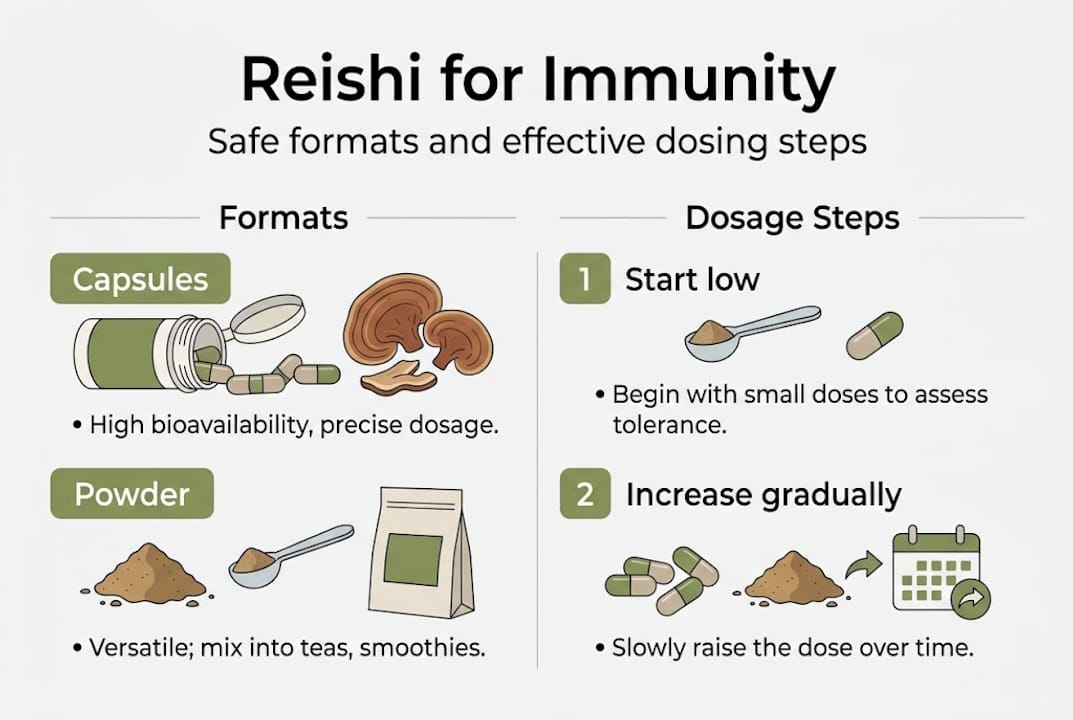
Step 2: Start with a lower dose
Begin at the lower end of the typical range and increase gradually based on tolerance. Most people do well somewhere in the 500 mg to 3000 mg daily range for extract forms.
Step 3: Pick a consistent time
Consistency matters more than perfect timing. Morning works well for many people since it fits into an existing routine. Evening is also fine. Some split the dose between morning and evening for steady levels throughout the day.
Step 4: Mix or take as directed
For using reishi powder, stir into warm water, tea, coffee, or a smoothie. It blends easily into most liquids. Capsules can be taken with a full glass of water, with or without food.
| Format | Typical daily dose | Best taken with |
|---|---|---|
| Capsules | 500 mg to 2000 mg | Water, with or without food |
| Extract powder | 1 g to 3 g | Warm liquid or smoothie |
| Liquid extract | Per label (varies) | Water or juice |
Step 5: Be patient and track your response
Reishi is not fast-acting. The reishi effects timeline typically spans weeks to months. Track energy levels, sleep quality, and how often you get sick over time rather than looking for overnight results.
Pro Tip: Keep a simple log for the first 30 days. Note your dose, timing, and any changes you notice. This makes it easier to adjust and helps you identify what is actually working.
Reishi extracts are generally safe for up to one year of continuous use. Avoid raw powder due to low bioavailability and possible digestive upset. For a full overview of how mushrooms support immunity step by step, the mushroom immune support guide covers the broader picture. Check the best time for reishi if you want more detail on timing strategies.
Safety, side effects, and who should avoid reishi
Even the best supplement requires careful attention to safety. Here’s what you need to know before getting started.
Reishi has a solid safety record when used as a quality extract at standard doses. Most side effects are mild and tend to occur with raw powder, very high doses, or extended use without breaks.
Common mild side effects:
- Digestive discomfort, especially with raw powder
- Dry mouth or throat
- Dizziness in some individuals
- Loose stools at higher doses
- Mild skin rash in rare cases
These effects are not universal. Many people take reishi daily with no issues at all. They are more likely when someone starts with a high dose or uses a low-quality product.
“Start low, go slow. Mild side effects are usually a signal to reduce the dose, not stop entirely.”
Who should avoid reishi or consult a doctor first:
- Pregnant or breastfeeding individuals
- People with bleeding disorders
- Those scheduled for surgery within two weeks
- Anyone taking blood-thinning medications like warfarin
- People on immunosuppressant drugs
- Those with known mushroom allergies
Reishi is generally safe at standard doses, but safety concerns apply directly to the groups listed above. Liver toxicity is rare but has been reported in cases involving very high doses or prolonged use of certain concentrated forms. This is not common with standard extract products, but it reinforces the value of sticking to recommended doses.
For guidance on how to use reishi powder safely day to day, the reishi powder usage resource covers practical steps and precautions. When in doubt, a conversation with a healthcare provider before starting is always the right move.
What most reishi guides miss: A balanced immune approach
Having covered safety and method, it’s time for a fresh look at how to approach reishi and immunity wisely.
Most guides focus on what reishi can do for you. Fewer ask whether more immune stimulation is always a good thing. It is not. Reishi modulates immune response rather than simply boosting it, and that distinction is actually its strongest feature, not a limitation.
The idea that a stronger immune response is always better is a common misconception. Autoimmune conditions, chronic inflammation, and certain allergic responses are all examples of the immune system being too active. Modulating that activity, bringing it toward balance, is often more useful than pushing it higher.
Reishi fits best into a routine that already includes good sleep, reasonable nutrition, and manageable stress. It is not a substitute for those foundations. Treating it as a shortcut leads to disappointment. Treating it as a consistent, low-intervention support tool tends to produce better results over time.
Personalization also matters. Some people respond well to 500 mg daily. Others find 2000 mg more effective. Starting low and adjusting based on your own response is more practical than following a one-size-fits-all dose. The immune support with mushrooms guide offers a broader framework for building a personalized approach.
Knowing what reishi cannot do is just as important as knowing what it can.
Explore quality reishi supplements for immune support
With all the steps to take reishi for immunity clearly laid out, finding trusted products makes the experience safe and effective. Longevity Botanicals carries a curated range of organic, dual-extracted reishi options with third-party testing standards. Whether you prefer the convenience of mushroom capsule supplements or the flexibility of organic mushroom powders, the formats are available to match your routine. For a focused selection built around immunity specifically, the immune function extracts collection brings together the most relevant products in one place. Quality sourcing, clear labeling, and consistent potency are the baseline for everything offered.
Frequently asked questions
What is the ideal dose of reishi for immune support?
Typical extract doses range from 500 mg to 3000 mg daily, but always follow manufacturer guidelines and consult your doctor. Raw powder is not recommended due to low bioavailability.
Can I mix reishi powder with food or drinks?
Yes, dual-extracted reishi powders blend well into smoothies, teas, or warm water and are effective in those forms. Stick to high-quality extract powder rather than raw ground mushroom.
Are there any groups who should avoid reishi?
Pregnant or breastfeeding individuals, those with bleeding disorders or certain medications should avoid reishi or consult a physician before use.
How long does it take for reishi to affect immunity?
Noticeable effects may take weeks to months since reishi supports gradual immune modulation, not rapid stimulation. Consistent daily use over time produces the most reliable results.
Recommended
- Top immune boosting mushrooms for natural health support – LongevityBotanicals
- Step-by-step immune support with mushrooms: your guide – LongevityBotanicals
- How to use reishi powder for immune support in 2026 – LongevityBotanicals
- What is Reishi Mushroom? 35% Immune Cell Boost Guide – LongevityBotanicals
Related Posts

Why Water-Soluble Mushroom Compounds Drive Real Results

What Is Mushroom Sustainability? Benefits and Practices

The Role of Organic Farming in Mushrooms Explained

What Is a Fruiting Body? Mushroom Science Explained

Mushroom Allergenicity Explained: Symptoms and Safe Use

Top 5 naturesrise.com Mushroom Supplement Alternatives 2026

Top 6 Hemplucid.com Alternatives for 2026


