

Why use herbal extracts? Unlocking mushroom benefits
Most people assume that eating a mushroom delivers all its health benefits. In reality, the most powerful compounds in mushrooms are locked inside tough cell walls made of chitin, a fiber the human body cannot break down. Raw or powdered mushrooms leave much of that value unabsorbed. Extraction makes these compounds more bioavailable than raw or powdered forms, which is why herbal extracts have become the preferred format for immune support, cognitive enhancement, and whole-body wellness. This article breaks down the science, the specific health benefits, and what to look for when choosing a quality mushroom extract.
Table of Contents
- The science behind herbal extracts
- Immune support: How mushroom extracts power your body’s defenses
- Cognitive enhancement: The Lion’s Mane advantage
- Beyond immunity and cognition: The wellness spectrum
- A closer look: What most people miss when choosing herbal extracts
- Explore quality mushroom supplements for your wellness journey
- Frequently asked questions
Key Takeaways
| Point | Details |
|---|---|
| Extracts unlock bioactive compounds | Herbal extraction releases potent compounds that are otherwise locked in whole mushrooms. |
| Immune and cognitive support | Research shows mushroom extracts power immune function and enhance brain health. |
| Standardization matters | Choosing standardized extracts ensures you get the right levels of bioactive ingredients for real benefits. |
| Broader wellness gains | Mushroom extracts offer antioxidant, adaptogenic, and mood-supporting effects for overall wellness. |
| Fruiting body is best | Fruiting body extracts deliver higher beta-glucans and greater efficacy than mycelium-on-grain supplements. |
The science behind herbal extracts
Extraction is not just a processing step. It is the method that determines how much of a mushroom’s active compounds actually reach your bloodstream. The three main methods are hot water extraction, alcohol extraction, and dual extraction, which combines both.
Hot water extraction pulls out water-soluble compounds like beta-D-glucans, the polysaccharides responsible for immune activation. Alcohol extraction targets fat-soluble compounds like triterpenoids and sterols, which are found in high concentrations in Reishi. Dual extraction captures both compound classes, making it the most complete method for full-spectrum benefits.
Why does this matter so much? Because bioactive compounds like beta-D-glucans, hericenones, and triterpenoids are locked inside chitin cell walls that human digestion cannot penetrate. Without extraction, most of these compounds pass through the body unused. Understanding the difference between extracts versus powders helps clarify why format matters as much as the mushroom species itself.
Another critical distinction is fruiting body extracts versus mycelium-on-grain products. Fruiting bodies are the actual mushroom caps and stems. Mycelium-on-grain products contain the root-like fungal network grown on a grain substrate, which means a significant portion of the product is starch, not mushroom.
| Product type | Beta-glucan content | Active compounds | Grain filler |
|---|---|---|---|
| Fruiting body extract | High (>20%) | Full spectrum | None |
| Dual extract | High | Full spectrum | None |
| Mycelium-on-grain | Low to variable | Limited | Yes |
| Raw mushroom powder | Low | Mostly locked | None |
Key bioactive compounds unlocked through proper extraction:
- Beta-D-glucans: Immune-activating polysaccharides
- Triterpenoids: Anti-inflammatory, found in Reishi
- Hericenones and erinacines: Nerve growth factor stimulants in Lion’s Mane
- Ergosterol: Precursor to vitamin D2
- Polyphenols: Antioxidant compounds
Pro Tip: Always check the supplement label for standardized beta-glucan content. A quality mushroom extract should list at least 20% beta-glucans. If no percentage is listed, the product may not meet clinical thresholds for effectiveness.
Immune support: How mushroom extracts power your body’s defenses
Understanding extraction science sets the stage for examining the specific ways these extracts power your immune system. The mechanism is direct and well-documented.
Beta-D-glucans bind to immune receptors, including Dectin-1, TLR2/4, and CR3, which sit on the surface of macrophages, dendritic cells, and natural killer cells. When beta-glucans dock onto these receptors, they trigger a cascade of immune signaling. The body releases cytokines, proteins that coordinate both the innate immune response (fast, non-specific) and the adaptive immune response (slower, targeted).
Reishi extract has some of the strongest immune-modulating evidence. Its triterpenoids inhibit the NF-kB pathway, a key regulator of inflammation. Studies show Reishi can achieve 60 to 80% NF-kB inhibition, which explains its use in both immune activation and inflammation control. Notably, low doses inhibit inflammation while higher doses activate beneficial immune pathways, a dose-dependent effect that makes standardized extracts important for predictable results.
How mushroom extracts activate immunity, step by step:
- Beta-glucans are absorbed through the gut wall after extraction removes the chitin barrier.
- They bind to pattern recognition receptors on immune cells.
- Immune cells release cytokines, activating macrophages and natural killer cells.
- Adaptive immunity receives signals to produce targeted antibodies.
- Inflammation is regulated, not just suppressed, supporting long-term immune balance.
Key finding: Reishi immune research shows that standardized Reishi extracts can modulate immune response at both the innate and adaptive levels, with effects on tumor necrosis factor and interleukin pathways.
For those interested in how immune health connects to cognition, research on mushrooms for brain health shows overlapping mechanisms, particularly around neuroinflammation.
| Mushroom | Key immune compound | Primary receptor target | Effect |
|---|---|---|---|
| Reishi | Triterpenoids, beta-glucans | TLR4, NF-kB | Inflammation control |
| Turkey Tail | PSK, PSP polysaccharides | Dectin-1, TLR2 | Innate immune boost |
| Chaga | Betulinic acid, beta-glucans | CR3 | Antioxidant, immune support |
| Cordyceps | Cordycepin | Adenosine receptors | Immune modulation, energy |
Cognitive enhancement: The Lion’s Mane advantage
With immune-supporting evidence covered, it is time to explore the standout cognitive benefits of mushroom extracts, especially Lion’s Mane. No other functional mushroom has a comparable body of evidence for brain health.
Lion’s Mane (Hericium erinaceus) contains two unique compound classes: hericenones, found in the fruiting body, and erinacines, found in the mycelium. Both stimulate the production of nerve growth factor (NGF), a protein that supports the survival, growth, and maintenance of neurons. NGF production naturally declines with age, which is linked to memory loss and slower cognitive processing.

Lion’s Mane boosts NGF through hericenones and erinacines, with clinical improvement documented in people with mild cognitive impairment. Separately, pilot studies show improved attention and processing speed in healthy adults after consistent supplementation.
Cognitive benefits supported by current research:
- Memory recall: Improved in older adults with mild cognitive impairment
- Processing speed: Faster response times in pilot studies
- Neuroprotection: Reduced neuronal damage markers in animal models
- Mood stability: Reduced anxiety scores in small human trials
- Focus and attention: Reported improvements in healthy adult cohorts
For a deeper look at how this applies to aging, the article on Lion’s Mane for aging brain covers the clinical picture in detail. The NGF pathway mechanisms behind these effects are also well-documented.
Pro Tip: Look for Lion’s Mane products that use both fruiting body and mycelium. Hericenones come from the fruiting body and erinacines from the mycelium, so a dual-source extract covers both NGF-stimulating pathways. Lion’s Mane capsules that specify both sources offer the most complete cognitive support.
Animal studies using Lion’s Mane research models show regeneration of myelin, the protective sheath around nerve fibers, which has implications for conditions beyond age-related cognitive decline.
Beyond immunity and cognition: The wellness spectrum
While immune and cognitive support are major draws, mushroom extracts also deliver a full spectrum of wellness benefits worth unpacking. The evidence here spans antioxidant activity, anti-inflammatory effects, adaptogenic support, and measurable improvements in mood, sleep, and physical endurance.
Mushroom extracts provide antioxidant, anti-inflammatory, anti-cancer, and adaptogenic effects as measured in both clinical and animal studies. Antioxidant activity reduces oxidative stress, a driver of cellular aging and chronic disease. Anti-inflammatory effects work through multiple pathways, including NF-kB inhibition and cytokine regulation.
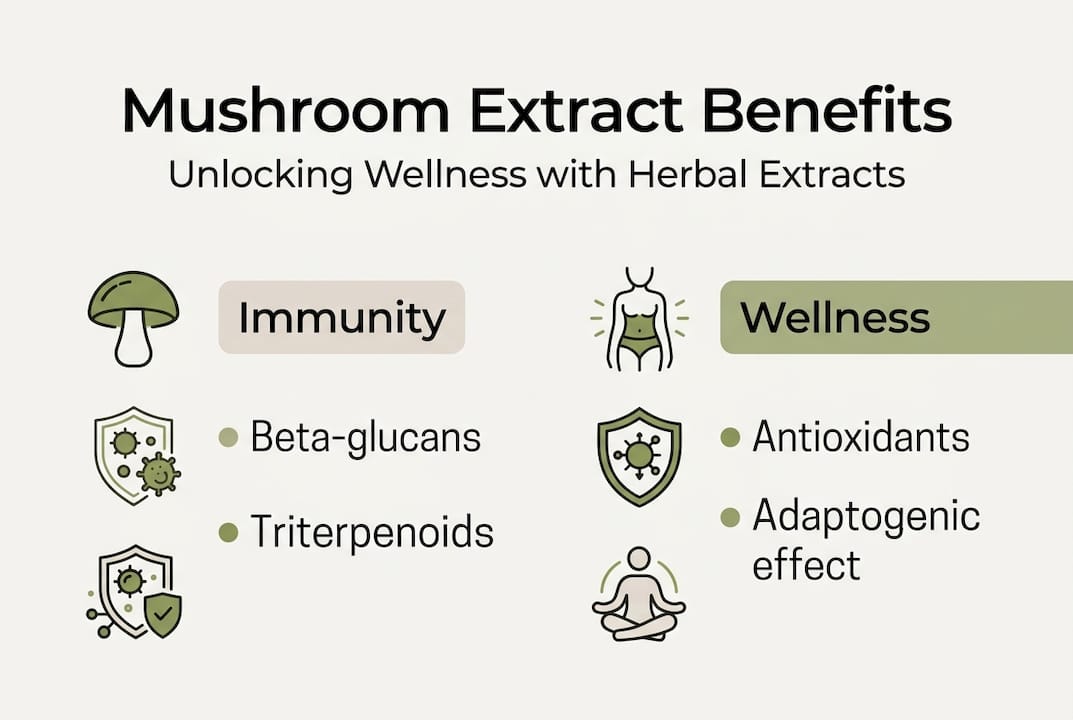
Adaptogenic effects are particularly relevant for stress and stamina. Cordyceps, for example, increases ATP production and oxygen utilization, which translates to improved endurance in athletes. Reishi’s calming triterpenoids support sleep quality and reduce cortisol-related stress responses.
Clinical findings on wellness outcomes:
- Sleep quality: Reishi extract improved sleep latency and duration in RCTs
- Stress reduction: Reduced cortisol markers in adaptogen studies
- Endurance: Cordyceps increased VO2 max in trained athletes
- Mood: Lion’s Mane reduced depression and anxiety scores in small trials
- Blood sugar regulation: Chaga and Reishi showed glucose-modulating effects
From the data: Real-world RCTs on mood, sleep, and endurance show consistent but modest effects, with larger trials needed to confirm optimal dosing.
| Mushroom | Wellness benefit | Evidence level |
|---|---|---|
| Reishi | Sleep, stress, immune balance | Human RCTs |
| Cordyceps | Endurance, energy, oxygen use | Human and animal |
| Lion’s Mane | Mood, cognitive function | Small human trials |
| Chaga | Antioxidant, blood sugar | Mostly preclinical |
For those who prefer a versatile daily format, mushroom powders offer a flexible way to incorporate multiple species. More wellness benefits research continues to expand the evidence base across these categories.
A closer look: What most people miss when choosing herbal extracts
Most buying guides focus on which mushroom to take. The more important question is how the extract was made and what the label actually tells you.
Fruiting body extracts consistently outperform mycelium-on-grain products in beta-glucan concentration. Yet many popular supplements use mycelium-on-grain because it is cheaper to produce. The label often does not make this clear. Beta-glucan content varies dramatically across products, and without a listed percentage, there is no way to verify potency.
Dual extraction is another overlooked factor. A hot-water-only extract misses fat-soluble triterpenoids. An alcohol-only extract misses water-soluble beta-glucans. Only dual extraction captures both. This matters most for Reishi, where the triterpenoid content drives much of the immune and sleep benefit.
Safety is generally not a concern with quality extracts, but mild gastrointestinal effects and the need for larger RCTs are noted in the literature. Rapid effects should not be expected. Most clinical benefits appear after four to eight weeks of consistent use.
For those researching specific cognitive applications, the article on Lion’s Mane brain health covers standardization and dosing in practical terms.
Pro Tip: Look for labels that state the extraction method, the part of the mushroom used (fruiting body vs. mycelium), and a documented beta-glucan percentage. Transparency on these three points is the clearest signal of a quality product.
Explore quality mushroom supplements for your wellness journey
With actionable insights in hand, the next logical step is finding trustworthy, science-backed mushroom extracts to support your health goals. Longevity Botanicals offers a range of standardized, full-spectrum mushroom supplements aligned with the evidence covered here.
For targeted support, browse mushroom capsule supplements covering individual species like Lion’s Mane, Reishi, and Cordyceps. For broader wellness coverage, mushroom blend extracts combine multiple species into one daily formula. The full range of mushroom extracts includes options by benefit, format, and mushroom type, making it straightforward to match a product to specific health goals.
Frequently asked questions
What makes mushroom-based herbal extracts more effective than powders?
Mushroom extracts concentrate bioactive compounds and improve their bioavailability, making them more potent than powders or whole mushrooms. Powders retain the chitin barrier that blocks absorption of key compounds.
How do mushroom extracts support the immune system?
Beta-D-glucans bind to immune receptors, activating macrophages, natural killer cells, and cytokine signaling pathways that enhance both innate and adaptive immunity.
Are there clinical studies confirming cognitive benefits of Lion’s Mane?
Yes. Small clinical trials show Lion’s Mane improves memory and cognitive function, with pilot studies also noting better attention and processing speed in healthy adults.
What are the safety concerns with mushroom extracts?
Mushroom extracts are generally safe. Rare mild gastrointestinal effects are the most commonly reported side effects, and these are typically dose-dependent and temporary.
Should I choose fruiting body extracts or mycelium-on-grain supplements?
Fruiting body extracts contain higher beta-glucan concentrations and deliver more documented wellness benefits than mycelium-on-grain products, which often contain significant amounts of grain starch.
Recommended
- Comprehensive Guide to Mushroom Extract Usage for Wellness – LongevityBotanicals
- How to blend mushroom extracts for immune and brain health – LongevityBotanicals
- Mushroom extract dosage guide for immune and brain support – LongevityBotanicals
- Mushroom Extract Explained: Key Benefits and Uses – LongevityBotanicals
- MUSHROOM COFFEE (MORNING MINDSET) (20 SERVINGS) – ElevateSupplements
Related Posts

Why Water-Soluble Mushroom Compounds Drive Real Results

What Is Mushroom Sustainability? Benefits and Practices

The Role of Organic Farming in Mushrooms Explained

What Is a Fruiting Body? Mushroom Science Explained

Mushroom Allergenicity Explained: Symptoms and Safe Use

Top 5 naturesrise.com Mushroom Supplement Alternatives 2026

Top 6 Hemplucid.com Alternatives for 2026


