


TL;DR:
- Choosing high-quality adaptogenic mushrooms requires understanding their source, extraction methods, and bioactive compounds to ensure efficacy. Matching specific species like Reishi, Lion’s Mane, Cordyceps, Turkey Tail, and Chaga to your wellness goals maximizes benefits, while starting with low doses and monitoring responses is essential. Prioritizing lab-tested fruiting body extracts with transparent labeling enhances safety and effectiveness, especially when integrating supplements into a broader health routine.
Adaptogenic mushrooms have moved firmly into mainstream wellness, but walking into a supplement aisle or browsing an online store still feels like navigating a maze. Reishi, Lion’s Mane, Chaga, Turkey Tail, Cordyceps — each species carries a different profile of benefits, and most products don’t make it easy to tell the difference between a high-potency extract and a low-grade powder loaded with starch. This guide cuts through the noise with evidence-backed steps, clear comparisons, and practical checkpoints so you can choose the right mushroom for your specific wellness goals with confidence.
Table of Contents
- Clarify your wellness goals and match mushroom types
- Check extract quality: fruiting body vs mycelium
- Understand bioactive compounds and extraction methods
- Stay safe: dosing, interactions, and quality assurance
- Track your results and adjust
- The uncomfortable truth about choosing adaptogenic mushrooms
- Find lab-tested, high-quality adaptogenic mushrooms
- Frequently asked questions
Key Takeaways
| Point | Details |
|---|---|
| Match goal to mushroom | Pick your mushroom based on whether you want more focus, resilience to stress, energy, or immune support. |
| Prioritize fruiting body | Choose fruiting body extracts for higher concentrations of actives like beta-glucans versus mycelium products. |
| Look for third-party testing | Select supplements that show lab-verified levels of key compounds and dual extraction methods. |
| Start low and monitor | Begin with a low dose and assess your response over several weeks before increasing or combining types. |
| Combine with healthy habits | Adaptogenic mushrooms are most effective when paired with good sleep, nutrition, and stress management. |
Clarify your wellness goals and match mushroom types
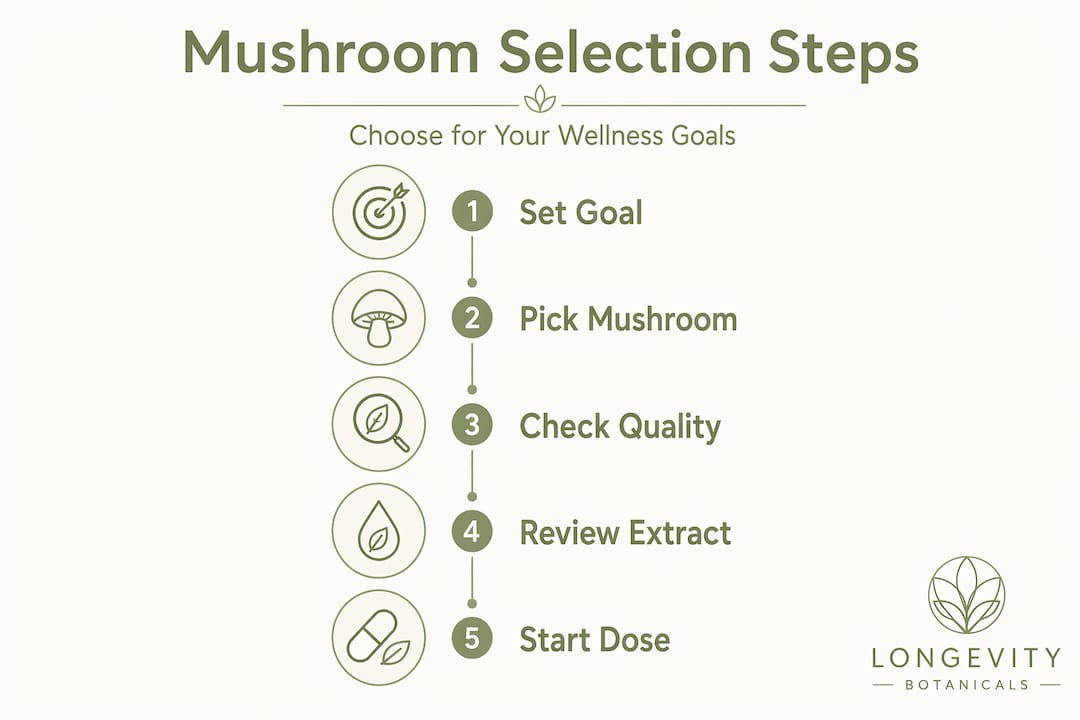
The first step is straightforward: know what you want. Adaptogenic mushrooms work through different biological pathways, so picking the wrong one for your goal means slower results and wasted money. The top adaptogenic mushrooms each have a primary strength, and matching that strength to your priority is the foundation of a smart selection.
Common wellness goals and their best-matched species:
- Stress relief and sleep quality: Reishi (Ganoderma lucidum) modulates the HPA (hypothalamic-pituitary-adrenal) axis, which controls the body’s stress response.
- Cognitive function and memory: Lion’s Mane (Hericium erinaceus) stimulates NGF (nerve growth factor), a protein that supports neuron growth and repair.
- Energy and athletic endurance: Cordyceps (Cordyceps militaris) supports ATP (adenosine triphosphate) production, the primary energy currency in cells.
- Immune support: Turkey Tail (Trametes versicolor) and Chaga (Inonotus obliquus) are rich in beta-glucans, complex polysaccharides that activate immune cells.
The table below maps goals to species, so selection becomes a direct match rather than guesswork:
| Wellness goal | Best mushroom | Primary mechanism |
|---|---|---|
| Stress and anxiety relief | Reishi | HPA axis modulation |
| Cognitive sharpness | Lion’s Mane | NGF stimulation |
| Physical energy and stamina | Cordyceps | ATP synthesis support |
| Immune system activation | Turkey Tail, Chaga | Beta-glucan activity |
| Overall immune and gut health | Turkey Tail | PSK/PSP polysaccharides |
As adaptogenic mushrooms research consistently notes, matching mushrooms to goals (Lion’s Mane for cognition and NGF, Reishi for stress and HPA modulation, Cordyceps for energy and ATP, Turkey Tail and Chaga for immune beta-glucans) and starting low at 500mg per species while monitoring for 2 to 4 weeks is the recommended baseline approach. This is especially useful when cross-referencing your wellness biomarkers and health goals before starting any supplement routine.
For stress-specific goals, detailed guidance on mushrooms for stress relief provides species-level comparisons and dosing context.
Pro Tip: Start with one mushroom species at the lowest effective dose (around 500mg daily). Track your response over 2 to 4 weeks before adding another species or increasing dosage.
Check extract quality: fruiting body vs mycelium
With your target mushroom in mind, next ensure you’re selecting a formulation with the highest efficacy. This is where most shoppers lose ground without realizing it — two products with identical labels can deliver very different results depending on which part of the mushroom they use.
Fruiting body refers to the cap and stem structure that grows above ground. This is the traditional medicinal part of the mushroom, concentrated with beta-glucans, triterpenes, and other bioactive compounds.

Mycelium-on-grain is the root-like network of fungal threads grown on a substrate, usually rice or oats. It’s cheaper to produce, but it often contains significant amounts of starch from the grain that it’s grown on. The starch dilutes the actual mushroom content.
| Factor | Fruiting body extract | Mycelium-on-grain |
|---|---|---|
| Beta-glucan content | High (often 20-40%) | Low (often under 10%) |
| Starch content | Minimal | High (from grain substrate) |
| Active compound density | Concentrated | Diluted |
| Label indicator | “Fruiting body,” dual-extracted | “Mycelium,” “full-spectrum” |
| Cost to produce | Higher | Lower |
Third-party lab data confirms the difference. Labs testing functional mushrooms consistently show that fruiting body extracts outperform mycelium-on-grain for bioactive compound concentration, particularly the beta-glucans essential for immune modulation. This makes source material one of the most critical factors in product selection. You can find an in-depth breakdown of the fruiting body vs mycelium debate, including label-reading guidance, on the Longevity Botanicals blog.
Understanding advanced lab testing for mushrooms is also helpful when evaluating brand transparency and deciding which companies back their claims with actual analytical data.
Pro Tip: Look for products that list beta-glucan content greater than 25% on the label, or that show a certificate of analysis (COA) from a third-party lab confirming actives.
Understand bioactive compounds and extraction methods
Having covered source material, zoom in on the real actives and how they’re extracted — your next layer of smart selection. Even high-quality fruiting body material can underperform if the extraction method doesn’t pull out the full range of bioactive compounds.
Each mushroom contains distinct actives with specific wellness functions:
| Mushroom | Key actives | Wellness impact |
|---|---|---|
| Reishi | Triterpenes, beta-glucans | Stress modulation, immune regulation |
| Lion’s Mane | Hericenones, erinacines | NGF support, cognitive function |
| Cordyceps | Cordycepin, adenosine | Energy production, oxygen utilization |
| Turkey Tail | PSK, PSP, beta-glucans | Immune activation, gut health |
| Chaga | Betulinic acid, melanin | Antioxidant activity, immune support |
Extraction method determines how much of these compounds actually end up in your supplement. The two main methods are water extraction (which pulls out polysaccharides including beta-glucans) and alcohol extraction (which pulls out fat-soluble compounds like triterpenes). A dual extraction process uses both methods, which means you get the full bioactive range.
According to mushroom bioactive research, for Reishi you should confirm triterpenes at 2% or above alongside beta-glucans for adaptogenic and stress-relief effects. For Lion’s Mane, look for hericenones and erinacines for NGF support and cognition. For Cordyceps, cordycepin at 1% or above supports energy and cognition. Dual extraction (water plus alcohol) is the method that captures both polysaccharides and terpenoids effectively.
What to check on supplement labels before buying:
- Extraction type listed: Look for “dual-extracted,” “water and ethanol extracted,” or both extraction methods named explicitly.
- Beta-glucan percentage: Should appear as a specific number (for example, “30% beta-glucans”), not just as “polysaccharides.”
- Species-specific actives: Reishi products should list triterpene percentage. Cordyceps products should specify cordycepin content.
- Substrate disclosure: If mycelium is used, the label should disclose the grain substrate so you know what else you’re consuming.
- Standardized extract designation: Terms like “10:1 extract” suggest concentration, but always verify with actual compound percentages.
Learn more about how Lion’s Mane supports cognition and the specific compounds behind those results. For energy-focused users, the research on Cordyceps and energy explains the ATP mechanism in practical terms. See also the benefits of dual extraction for a technical comparison of extraction yield data.
Stay safe: dosing, interactions, and quality assurance
Once you know what to look for, it’s crucial to consider how to use adaptogenic mushrooms safely and effectively. Most people tolerate these supplements well, but there are specific groups who should approach them with caution or avoid them entirely.
Common side effects include mild gastrointestinal upset (nausea, bloating, loose stools), particularly when starting at higher doses. Allergic reactions are rare but possible, especially for people with known mushroom sensitivities.
Safety warning: Avoid adaptogenic mushroom supplements during pregnancy, if you have a diagnosed bleeding disorder, in the two weeks before surgery, or if you currently take immunosuppressant medications. Beta-glucans actively modulate immune activity, which can interfere with immunosuppressive drug therapy. If you have an autoimmune condition, consult a healthcare provider before starting any mushroom supplement.
Safety data on adaptogenic beverages confirms that these supplements are generally well-tolerated short-term, with rare GI upset and allergies noted. No significant ALT liver enzyme elevations have been recorded in clinical trials, but monitoring liver function is advisable if using powdered Reishi for longer than one month. Review potential risks of mushroom supplements for a broader look at safety monitoring approaches.
Additional guidance on Cordyceps supplement safety covers drug interaction considerations relevant to athletes and those managing chronic conditions.
Red flags to watch for on product labels:
- No beta-glucan percentage listed (listed only as “polysaccharides” is a red flag)
- No extraction method disclosed
- No country of origin for mushrooms
- No third-party testing certification or COA available
- Long filler ingredient list (maltodextrin, rice flour used as bulking agents)
- Proprietary blends without individual dose transparency
Pro Tip: If you experience any unusual symptoms after starting a mushroom supplement, stop use immediately. Also stop use at least two weeks before any scheduled surgery to avoid potential effects on bleeding and immune function.
Track your results and adjust
With safety covered, close the loop by ensuring you’re measuring progress and adapting your routine as needed. The most common mistake people make is expecting dramatic changes within a few days, then quitting before any meaningful adaptation has taken place.
Realistic timelines for different goals:
- Stress and mood improvement: 2 to 4 weeks of daily use. Reishi’s HPA modulation takes time to influence cortisol patterns.
- Sleep quality changes: Often noticed within 2 to 3 weeks. Reishi and Lion’s Mane both show sleep-related benefits in early trials.
- Cognitive clarity and focus: Lion’s Mane trials typically show measurable cognitive changes around the 4-week mark.
- Energy and endurance: Cordyceps effects on oxygen utilization may become noticeable after 3 to 4 weeks of consistent use.
- Immune response: Turkey Tail and Chaga effects on immune markers build over 4 to 8 weeks of use.
A randomized controlled trial with 78 participants showed that a mushroom blend significantly reduced DASS-21 stress and anxiety scores, PSQI sleep scores, and salivary cortisol levels (p less than 0.05) compared to placebo over just 25 days. Lion’s Mane also shows modest but consistent cognitive benefits across multiple small trials.
Track these specific outcomes to measure your progress accurately:
- Energy levels: Rate your daily energy on a simple 1 to 10 scale each morning and afternoon.
- Stress and mood: Use a weekly average score based on how you felt across the week.
- Sleep quality: Track time to fall asleep, number of wake-ups, and how rested you feel each morning.
- Focus and cognition: Note your ability to sustain attention on demanding tasks at work or during study.
- Immune events: Track frequency of colds, infections, or seasonal illnesses over a 3 to 6 month period.
If you’re not noticing any change after 6 to 8 weeks, consider increasing the dose within safe limits, switching to a higher-quality extract, or adding a complementary species. Review Lion’s Mane cognitive results for benchmarks on what realistic cognitive improvements look like in trial settings.
The uncomfortable truth about choosing adaptogenic mushrooms
Here’s what most articles won’t say directly: the supplement industry around functional mushrooms is outpacing the clinical research. Many brands market their products with language implying strong, fast, guaranteed effects. The actual science tells a more measured story.
Clinical data on adaptogenic mushrooms shows that benefits are promising but modest. Stress and sleep improvements through HPA modulation are real, cognitive support through NGF is real, but most trials are small, short-term, and conducted with specific standardized extracts that may not match what’s in a given retail product.
Combining adaptogenic mushrooms with quality sleep, consistent movement, and a whole-food diet produces meaningfully better outcomes than taking any supplement in isolation. The mushroom is a tool, not a fix.
The comprehensive mushroom benefits picture is genuinely positive, but the most effective users treat these supplements as part of a larger system. Someone sleeping six hours a night, eating a high-sugar diet, and under chronic stress will see far less benefit from Reishi than someone who’s already doing the basics well and uses it to fine-tune their stress resilience.
The real advantage of understanding actives, extraction methods, and source quality is that it filters out low-grade products. It puts you in the 20% of supplement buyers who are actually getting what the label claims. That gap between marketed results and actual results often comes down entirely to product quality, not the mushroom itself.
Find lab-tested, high-quality adaptogenic mushrooms
Ready to take the guesswork out of choosing? Longevity Botanicals offers a curated range of mushroom supplements tested for beta-glucan levels, specific bioactive compounds, and purity, with transparent sourcing and third-party verified extracts. Browse organic mushroom capsule supplements for convenient daily use, or explore organic mushroom powders for flexible dosing in smoothies, coffee, or functional drinks. For users focused on immunity, the mushroom extracts for immune support collection includes Turkey Tail, Chaga, and immune-targeted blends, all with clearly labeled actives.
Frequently asked questions
How much adaptogenic mushroom should a beginner take?
Start with 500mg per mushroom species daily and monitor your response for 2 to 4 weeks before adjusting dose or adding additional species.
What’s the difference between fruiting body and mycelium supplements?
Fruiting body extracts contain higher concentrations of active compounds like beta-glucans, while mycelium-on-grain products often include significant starch content from the grain substrate, which dilutes potency.
Are adaptogenic mushrooms safe for everyone?
Most people tolerate them well short-term, but avoid during pregnancy, before surgery, or when taking immunosuppressant medications due to beta-glucan immune modulation effects.
Can I mix different adaptogenic mushrooms?
Yes, blends are widely used and a mushroom blend RCT showed significant stress, sleep, and cortisol improvements over 25 days. Introduce one species at a time to confirm individual tolerance first.
How long until I notice results?
Most users report changes in mood, energy, or sleep within 2 to 4 weeks of consistent daily use, with immune and cognitive benefits typically requiring 4 to 8 weeks.
Recommended
- Top adaptogenic mushrooms for stress, immunity, and focus – LongevityBotanicals
- How to Choose Mushroom Supplements for Best Results – LongevityBotanicals
- How to add mushrooms to your wellness routine for maximum benefit – LongevityBotanicals
- Functional mushrooms guide: maximize immune and brain benefits – LongevityBotanicals


