

Mushroom bioavailability: How to get real wellness results
TL;DR:
- Mushroom bioavailability focuses on how gut fermentation and microbial activity, rather than bloodstream absorption, drive health benefits. The effectiveness of supplements depends heavily on processing methods and individual gut health, not just milligram content. Understanding these factors helps consumers make informed choices for optimized wellness results.
Many people assume a higher milligram count on a mushroom supplement label means stronger results. That assumption leads to real confusion at checkout and, more importantly, at the cellular level. Bioavailability, meaning how much of a mushroom’s beneficial compounds your body can actually access and use, is the factor most supplement marketing glosses over. This guide explains the science behind mushroom bioavailability, what actually happens to those compounds inside your body, and how to use that knowledge to make smarter purchasing decisions.
Table of Contents
- What is mushroom bioavailability and why does it matter?
- How do mushroom β-glucans work in the body?
- Why processing and preparation influence bioavailability
- Real-world factors that impact how much you benefit
- The truth about bioavailability: A fresh look for wellness seekers
- Ready to optimize your mushroom wellness journey?
- Frequently asked questions
Key Takeaways
| Point | Details |
|---|---|
| Bioavailability defined | A supplement’s benefits depend on what your body can actually use, not just what the label claims. |
| Gut health connection | Many mushroom compounds work indirectly by fueling gut microbiota and producing metabolites for wellness. |
| Preparation matters | How a mushroom supplement is processed greatly affects its actual impact on your health. |
| Buyer beware | Effective mushroom supplements require more than a high dose—quality of extraction and formulation are crucial. |
What is mushroom bioavailability and why does it matter?
Bioavailability is a pharmacology term that describes the fraction of any substance that reaches its site of action in an active form. In drug science, that typically means blood plasma levels. For mushroom supplements, the picture is fundamentally different and far more interesting.
The most studied active compounds in medicinal mushrooms are β-glucans (beta-glucans), a class of polysaccharides found in the cell walls of fungi. Unlike a vitamin C molecule that gets absorbed through the small intestine and circulates in your blood, β-glucans are large, complex carbohydrates. They don’t behave like small molecules.
Key insight: Mushroom “bioavailability” depends on which mushroom constituents you mean. For many mushroom supplements, the key compounds — especially β-glucans — are not absorbed like small molecules, but instead act largely through digestion, bioaccessibility, and then fermentation by gut microbiota.
This distinction matters enormously. When a supplement brand claims superior “absorption,” it may be applying a drug-style bioavailability framework to compounds that don’t follow those rules. The wellness benefits of mushrooms are real, but the pathway to those benefits runs through your digestive system, not necessarily your bloodstream.
Common misconceptions to drop now:
- Higher extract concentration always equals stronger effects
- Blood-level absorption is the only valid measure of a supplement working
- All β-glucan sources function identically regardless of species or processing
- More milligrams per capsule automatically means more benefit
Understanding these points is step one. Step two is following what β-glucans actually do once they arrive in your gut.
How do mushroom β-glucans work in the body?
With a clear definition in hand, let’s follow what actually happens when you take a mushroom supplement.
Most β-glucans pass through the small intestine largely intact. They are not digested by human enzymes the way proteins or simple carbohydrates are. Instead, they function as prebiotics, feeding the bacteria that live in your colon. That process is called fermentation, and its outputs are far more significant than many people expect.
Mushroom polysaccharides are poorly absorbed in the upper digestive tract. They reach the colon largely intact and are fermented by the gut microbiota, producing short-chain fatty acids (SCFAs) that mediate downstream effects throughout the body.
What are short-chain fatty acids? SCFAs are small compounds, primarily acetate, propionate, and butyrate, produced when colonic bacteria break down fiber-like polysaccharides. Butyrate, in particular, is the primary energy source for colonocytes (cells lining the colon) and plays a well-documented role in reducing gut inflammation, maintaining the intestinal barrier, and modulating immune activity.
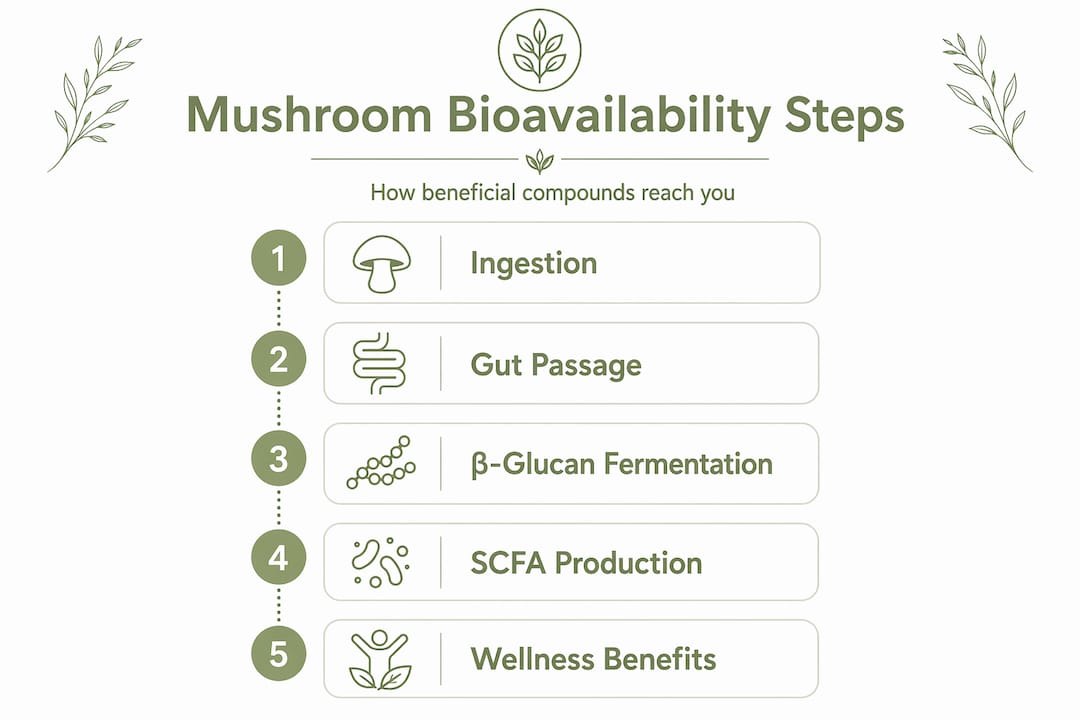
Here’s a simplified look at the β-glucan journey:
| Stage | Location | What happens |
|---|---|---|
| Ingestion | Mouth / stomach | Minimal digestion; structure largely preserved |
| Transit | Small intestine | Some bioaccessibility; limited absorption |
| Fermentation | Colon | Gut bacteria break down β-glucans into SCFAs |
| SCFA signaling | Colon and systemic | Butyrate, propionate, acetate exert local and systemic effects |
| Immune modulation | Gut-associated lymphoid tissue | β-glucan fragments interact with immune receptors |
The numbered process looks like this:
- You consume a mushroom supplement (capsule, powder, or extract)
- β-glucans survive the acidic stomach environment largely intact
- They arrive at the colon where microbial fermentation begins
- Bacterial metabolism produces SCFAs as byproducts
- SCFAs act on gut lining cells, reduce inflammation, and support immune balance
- Some β-glucan fragments interact directly with immune cells in gut-associated lymphoid tissue
Pro Tip: Taking your mushroom supplement consistently, not just occasionally, matters more for gut-mediated effects because building a favorable microbiome environment takes time. Daily use creates a cumulative prebiotic effect that sporadic doses simply can’t replicate.
Exploring the broader context of mushroom nutrition science helps connect these gut-level mechanisms to the broader wellness benefits that researchers continue to study.
Why processing and preparation influence bioavailability
There’s more to the story. How your mushroom product is made can radically shift its benefits.
Not all mushroom supplements start from the same place or end up the same way. Whole dried mushroom powder, hot water extracts, alcohol extracts (tinctures), and dual extracts (using both water and alcohol) each deliver a different profile of compounds. And each profile interacts with your gut differently.

Extraction and processing choices can shift the relevant bioavailability pathway by changing solubility, structural features, and what portion of the mushroom matrix gets delivered. A hot water extract, for example, is designed to release water-soluble β-glucans in a form more accessible to gut bacteria. An alcohol extract pulls out different compounds, including certain triterpenes found in Reishi, which are largely absent in water-only extracts.
Whole fruiting body vs. mycelium: what’s the difference?
| Feature | Fruiting body | Mycelium on grain |
|---|---|---|
| β-glucan content | Generally higher | Often lower; contains grain starch |
| Standardization | Easier to verify | Variable; grain contamination possible |
| Bioactive profile | Full spectrum of mushroom compounds | May lack some fruiting body compounds |
| Common use | Premium extracts and powders | Lower-cost products |
The mushroom food matrix can matter significantly for biological function in the gut. Experimental data show that different preparation forms can have different effects on intestinal barrier integrity and immune signaling in cell-based studies. This means the structural context of the β-glucan, not just its presence, influences what your gut does with it.
What to watch for on labels:
- Stated β-glucan percentage (not just polysaccharide content, which can include starch)
- Whether the product uses fruiting bodies, mycelium, or both
- Extraction method noted (hot water, ethanol, dual extract)
- Third-party testing or certificates of analysis
Pro Tip: Polysaccharide content and β-glucan content are not the same thing. Some products inflate polysaccharide numbers by including grain starch from mycelium substrates. Look specifically for β-glucan percentages from verified testing.
Comparing options in detail is easier when you understand the differences between mushroom extract vs. powder formats and can evaluate how mushroom extraction methods affect compound delivery. Products made to standardized extract specifications offer the most consistent bioactive profiles.
Real-world factors that impact how much you benefit
Now let’s bring these complexities into focus by highlighting practical, everyday factors and choices that affect your results.
The gap between the compound in a capsule and the effect on your body can widen or narrow based on several factors within your control. Cooking method, supplement format, individual gut health, and even how much water you drink can influence the practical bioavailability you experience.
How cooking changes the picture
When whole mushrooms are cooked, particularly boiled, changes in nutrient bioavailability can go both ways. Cooking and digestive simulation can change nutrient and antinutrient effects, sometimes improving overall mineral bioavailability by reducing compounds that block absorption. However, some water-soluble nutrients do leach into cooking water. For supplement users, this nuance is less relevant since processing happens at the manufacturing stage, but it illustrates why raw powder and processed extract aren’t equivalent.
Here’s a practical breakdown of factors affecting individual benefit:
- Gut microbiome diversity: A richer, more diverse microbiome ferments β-glucans more efficiently. People with depleted gut bacteria from antibiotic use or poor diet may see reduced benefits initially.
- Digestive health: Conditions affecting gut lining integrity or transit time can change how much fermentation actually occurs before compounds exit the body.
- Supplement format: Capsules protect compounds from gastric acid better than loose powder mixed into hot beverages, which may degrade heat-sensitive components.
- Dose and consistency: Single large doses are less effective than consistent daily servings for prebiotic-type benefits. Gut bacteria need sustained feeding to produce meaningful SCFA output.
- Food timing: Taking mushroom supplements with food, particularly fiber-rich meals, may support fermentation by providing additional substrate for gut bacteria.
Low bioavailability is a recognized challenge in translational mushroom research, and for at least some mushroom constituents, the extent and meaning of bioavailability varies significantly by compound. This reality is driving innovation in supplement formulation, including nanoencapsulation and liposomal delivery for specific mushroom compounds with genuinely low absorption rates.
Buyer checklist for real-world results:
- Choose products with documented extraction methods
- Prioritize fruiting body extracts with verified β-glucan content
- Look for third-party testing that confirms actual compound concentrations
- Take supplements consistently, not intermittently
- Consider your own gut health as a variable, not just the product label
Pro Tip: If you’re new to mushroom supplements and your diet has been low in fiber, start with a lower dose. A sudden introduction of prebiotic compounds can cause temporary digestive discomfort while your gut microbiome adjusts.
For a broader guide to navigating these decisions, the resources on choosing mushroom supplements and understanding mushroom supplement best practices offer structured, evidence-aligned guidance.
The truth about bioavailability: A fresh look for wellness seekers
With the facts on the table, let’s cut through the noise and myths that surround bioavailability.
Mushroom bioavailability is genuinely unlike the bioavailability of vitamins, minerals, or pharmaceutical compounds. Yet supplement marketing frequently borrows the language of drug pharmacokinetics to make products sound more potent or scientifically validated. Terms like “maximum absorption” or “bioavailable form” can be technically accurate for some compounds while being completely irrelevant for others.
Here’s the uncomfortable truth: bioavailability can be misused in supplement marketing. When the compound in question is a large polysaccharide like a β-glucan, blood-level absorption, what pharmacologists call plasma Cmax, may not be the right metric at all. The more relevant endpoints are colon fermentation activity, SCFA output, and downstream immune signaling. None of those are measured on a standard supplement label.
This means an informed consumer needs a slightly different mental model than the one that works for, say, evaluating a magnesium supplement. With magnesium, you can reasonably ask “what form is best absorbed?” With mushroom β-glucans, the better question is “what extraction method best prepares this compound for gut fermentation and immune interaction?”
The brands that acknowledge this complexity, that explain their processing transparently and cite specific β-glucan content rather than vague polysaccharide percentages, are the ones worth trusting. Transparency about what the product actually contains and how it was made is more valuable than broad wellness claims.
It’s also worth noting that individual variation is real. Two people taking the same high-quality Reishi extract will not have identical results because their gut microbiomes, immune baselines, and health histories differ. This isn’t a flaw in the supplement; it’s biology. Understanding the full picture of supplement benefits and scientific context helps set realistic, grounded expectations.
Ready to optimize your mushroom wellness journey?
For those who want to take the next step with confidence, here’s how to put this knowledge into action.
Longevity Botanicals offers a range of mushroom supplements built around transparency in sourcing, extraction, and compound verification. Whether the goal is immune support, cognitive clarity, stress resilience, or general wellness, product selection starts with understanding what’s actually in the supplement and how it was made.
Browse organic mushroom capsule supplements for standardized, daily-use formats that prioritize consistent β-glucan delivery. For targeted combinations, the mushroom blend collection pairs species with complementary bioactive profiles. Those who prefer the most concentrated forms can explore mushroom extract options that specify extraction method and verified compound content. Each product category reflects the science covered in this guide, connecting processing quality to real-world wellness outcomes.
Frequently asked questions
Do all mushroom supplements have the same bioavailability?
No. Bioavailability varies widely based on mushroom type, extraction process, and formulation specifics. β-glucan efficacy depends strongly on structural differences, solubility, molecular weight, and mushroom species, so two products with the same labeled β-glucan content can behave very differently in the body.
Is absorption into the blood required for mushrooms to be effective?
No. Some of the most important bioactive compounds work through gut fermentation and immune signaling rather than direct bloodstream absorption. Mushroom polysaccharides reach the colon largely intact and are fermented by gut microbiota, producing short-chain fatty acids that mediate downstream health effects.
Can cooking mushrooms increase their bioavailability?
Cooking, especially boiling, can sometimes improve mineral bioavailability by reducing antinutrients, though some water-soluble nutrients may leach into the cooking water. Cooking and digestive simulation can change nutrient and antinutrient effects in both directions, depending on the specific compound and preparation method.
Why do some experts call for more research into mushroom supplement bioavailability?
Current products show varied effectiveness, and low bioavailability remains a documented challenge for specific compounds. Researchers explicitly call for better characterization, standardization, and more clinical evidence before drawing firm conclusions about health effects for specific mushroom bioactives.
Recommended
- Mushroom extraction explained: unlock wellness from nature – LongevityBotanicals
- How to Use Mushroom Supplements for Natural Wellness – LongevityBotanicals
- Mushroom wellness checklist: Make informed choices – LongevityBotanicals
- Master the Mushroom Blending Process for Optimal Wellness – LongevityBotanicals
Related Posts

Why Water-Soluble Mushroom Compounds Drive Real Results

What Is Mushroom Sustainability? Benefits and Practices

The Role of Organic Farming in Mushrooms Explained

What Is a Fruiting Body? Mushroom Science Explained

Mushroom Allergenicity Explained: Symptoms and Safe Use

Top 5 naturesrise.com Mushroom Supplement Alternatives 2026

Top 6 Hemplucid.com Alternatives for 2026


