

What is an anti-inflammatory mushroom? Benefits and uses
TL;DR:
- Specific medicinal mushrooms contain bioactive compounds that regulate inflammation pathways naturally.
- They work through multi-pathway mechanisms like NF-κB inhibition and Nrf2 activation.
- Standardized extracts and consistent use enhance safety and efficacy for immune support.
Mushrooms have long been treated as little more than a flavorful ingredient, but a growing body of research tells a different story. Specific species carry bioactive compounds that work on multiple inflammation pathways at once, offering a level of biological activity that most foods simply do not match. Anti-inflammatory activities via multi-target mechanisms position certain mushrooms as a serious complement to any wellness plan. This article covers which mushrooms qualify, how they work at the biochemical level, their practical limits, and how to add them to a daily routine with confidence.
Table of Contents
- Defining anti-inflammatory mushrooms: What sets them apart
- How anti-inflammatory mushrooms work: Multi-pathway mechanisms
- Nuances and limits: Species choice, bioavailability, and safety
- Practical use: Selecting and integrating anti-inflammatory mushrooms
- The real world of anti-inflammatory mushrooms: Benefits, caution, and next steps
- Explore quality anti-inflammatory mushroom supplements
- Frequently asked questions
Key Takeaways
| Point | Details |
|---|---|
| Potent bioactive compounds | Anti-inflammatory mushrooms contain β-glucans, triterpenoids, and other compounds that target multiple inflammation pathways. |
| Multi-pathway support | These mushrooms act on key immune and antioxidant mechanisms like NF-κB and Nrf2 for broad inflammation balance. |
| Not all mushrooms equal | Functional varieties offer greater benefits than culinary types; product quality and extraction matter greatly. |
| Results require consistency | Daily use over weeks or months is needed for noticeable wellness effects, combined with overall healthy habits. |
| Sourcing and safety | Choose standardized, reputable supplements and consult with a professional for optimal results and safety. |
Defining anti-inflammatory mushrooms: What sets them apart
Not every mushroom on your grocery shelf qualifies as an anti-inflammatory mushroom. The term refers to specific functional and medicinal species that contain concentrated bioactive compounds capable of modulating (meaning regulating up or down) the body’s inflammatory responses. Common culinary mushrooms like white button or portobello do contain some nutrients, but their anti-inflammatory compound concentrations are typically far lower than those found in medicinal varieties.
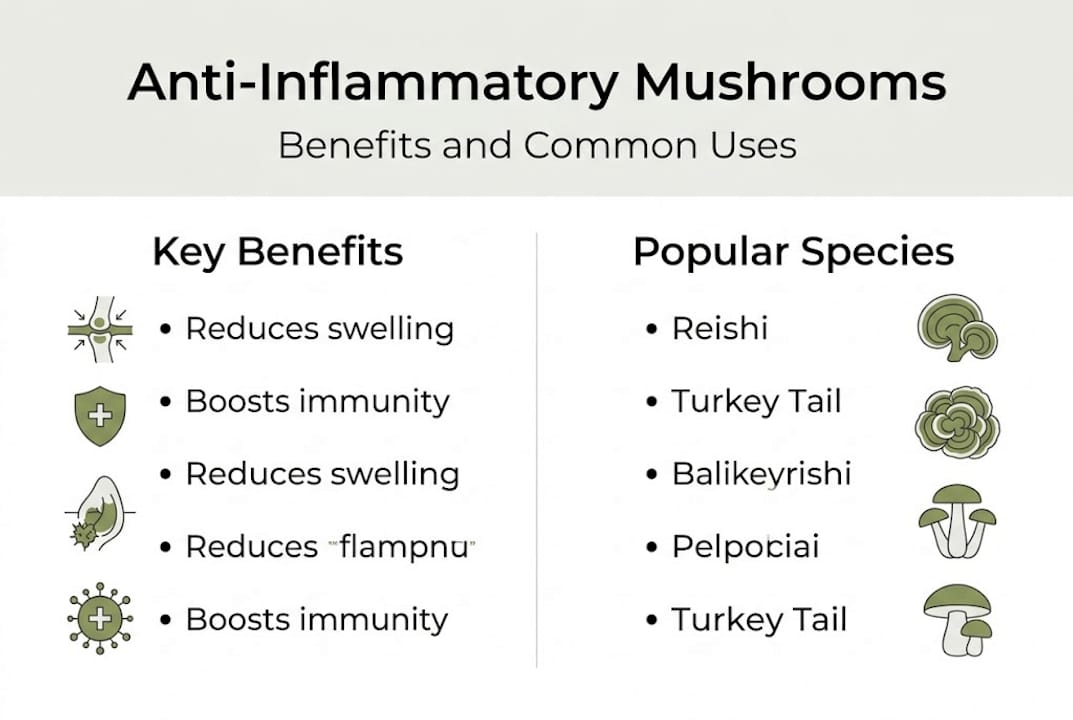
The best mushrooms for inflammation include species such as Reishi (Ganoderma lucidum), Chaga (Inonotus obliquus), Shiitake (Lentinula edodes), Lion’s Mane (Hericium erinaceus), Turkey Tail (Trametes versicolor), and Cordyceps. Each of these has been studied for distinct profiles of bioactive compounds.
Primary bioactive compounds found in anti-inflammatory mushrooms:
- β-glucans: Polysaccharides that interact directly with immune receptors
- Triterpenoids: Found prominently in Reishi, with strong anti-inflammatory signaling properties
- Phenolic compounds: Act as antioxidants and secondary modulators of inflammation
- Peptides: Small proteins with targeted immune activity
As noted in recent research, key bioactive compounds include polysaccharides, triterpenoids, phenolic compounds, and peptides, each contributing through distinct mechanisms.
| Mushroom | Key compound | Primary role |
|---|---|---|
| Reishi | Triterpenoids | NF-κB inhibition, immune regulation |
| Chaga | Polysaccharides, phenolics | Antioxidant, inflammatory marker reduction |
| Lion’s Mane | β-glucans, hericenones | Nerve support, immune modulation |
| Turkey Tail | PSK, PSP polysaccharides | Immune cell activation |
| Cordyceps | Cordycepin, β-glucans | Anti-inflammatory enzyme inhibition |
“Functional mushrooms address inflammation at the source by interacting with immune receptors and gene expression pathways, not just by suppressing symptoms.”
Understanding mushroom immune modulation helps clarify why species selection matters so much when choosing a supplement.
How anti-inflammatory mushrooms work: Multi-pathway mechanisms
Once the right bioactives enter the body, they interact with several distinct inflammation-control systems simultaneously. This multi-pathway activity is one of the most clinically interesting features of medicinal mushrooms.
The four main mechanisms:
- NF-κB pathway inhibition: NF-κB is a protein complex that controls the production of pro-inflammatory cytokines. Triterpenoids from Reishi and β-glucans from multiple species suppress this pathway, reducing downstream inflammatory signaling.
- MAPK cascade modulation: The MAPK (mitogen-activated protein kinase) cascades, specifically ERK, JNK, and p38 branches, are targeted by mushroom bioactives to reduce inflammatory gene expression.
- NLRP3 inflammasome suppression: The NLRP3 inflammasome drives chronic inflammation. Certain polysaccharides directly suppress its activation.
- Nrf2/HO-1 pathway activation: This antioxidant pathway counterbalances oxidative stress, a key driver of sustained inflammation. Mushroom phenolics and β-glucans help activate it.
Research confirms that these mushrooms inhibit the NF-κB pathway, MAPK cascades, and NLRP3 inflammasome while activating the Nrf2/HO-1 antioxidant pathway and modulating immune cells.
| Mechanism | Key compounds involved | Effect |
|---|---|---|
| NF-κB inhibition | Triterpenoids, β-glucans | Fewer pro-inflammatory cytokines |
| MAPK cascade modulation | Polysaccharides, phenolics | Reduced inflammatory gene expression |
| Nrf2/HO-1 activation | Phenolics, β-glucans | Increased antioxidant enzyme output |
| M1/M2 macrophage shift | β-glucans | Promotes anti-inflammatory immune profile |
Beyond these pathways, medicinal mushrooms also modulate specific immune cells. M1 macrophages drive inflammation, while M2 macrophages resolve it. Mushroom bioactives encourage this shift toward M2 activity. Regulatory T-cells (Tregs) and natural killer (NK) cells also respond to β-glucan signaling, helping keep immune responses balanced rather than overactive.

For a broader look at how medicinal mushrooms boost immunity and cognitive health, the interaction between anti-inflammatory action and neural pathways is particularly relevant for long-term wellness.
Pro Tip: Combining Reishi (rich in triterpenoids) with Turkey Tail (rich in PSK polysaccharides) targets both the NF-κB and macrophage polarization pathways at once, offering broader coverage than any single species.
The role of antioxidants in mushrooms adds another layer to this picture, since oxidative stress and inflammation are closely linked.
Nuances and limits: Species choice, bioavailability, and safety
The science is promising, but there are real constraints that matter when choosing a mushroom supplement.
Key limitations to understand:
- Species specificity: Culinary mushrooms have minimal anti-inflammatory compound concentrations. Only targeted medicinal species carry clinically relevant levels.
- Bioavailability challenges: Most bioactives in raw mushroom material have poor bioavailability of under 5%, meaning the body absorbs only a small fraction without proper extraction.
- Extraction method matters: Hot water extraction captures β-glucans well; alcohol extraction is better for triterpenoids. Dual-extraction products cover both.
- Fruiting body vs. mycelium: Fruiting body extracts consistently show higher bioactive concentrations than mycelium-based products, which often contain more filler starch.
- Mostly preclinical evidence: Many studies are conducted in cell cultures or animal models. Human clinical trials are still catching up.
Regarding safety, most functional mushrooms are well-tolerated. Typical effective doses range from 2 to 3g per day of standardized extract. Some users experience mild GI upset or, rarely, allergic reactions, particularly with Reishi. People taking immunosuppressant drugs should consult a healthcare provider before adding medicinal mushrooms, since the immune-modulating activity could interact with medication.
The efficacy and limits of medicinal mushrooms are well-documented, and understanding these nuances helps set realistic expectations.
Synergistic effects between compounds within a single mushroom, and across species in a blend, are real and increasingly supported. But they also make standardized dosing more complex. A product listing “500mg mushroom powder” with no extraction ratio or β-glucan percentage is providing very little useful information.
Pro Tip: Look for supplement labels that list the β-glucan percentage (aim for 20% or higher) and specify fruiting body as the source. These two data points tell you more than the mushroom species name alone.
For practical guidance on boosting immunity and wellness through mushroom use, understanding what immune support actually means helps in evaluating product claims.
Practical use: Selecting and integrating anti-inflammatory mushrooms
With a clear picture of the science and its limits, here is a straightforward approach to adding anti-inflammatory mushrooms to a daily routine.
Step-by-step integration guide:
- Choose a standardized extract. Confirm the product specifies fruiting body source and lists a β-glucan content percentage. Avoid products that only list “proprietary blend” without specifics.
- Start with one species. Beginning with a single well-studied mushroom like Reishi or Turkey Tail makes it easier to monitor how your body responds before adding a blend.
- Set a consistent dose. A typical starting range is 1 to 2g per day, building toward 2 to 3g as tolerated. Daily use for weeks to months is needed to notice meaningful benefits, so consistency matters more than the amount taken on any single day.
- Integrate with meals. Mushroom powders blend well into coffee, smoothies, or soups. Capsules work better for those who prefer a no-taste option.
- Pair with lifestyle habits. Anti-inflammatory diet choices (reducing processed foods, increasing vegetables and omega-3 sources), regular movement, and adequate sleep each amplify the effects of mushroom supplementation.
- Monitor and adjust. Keep a brief log of energy, digestion, and any joint or inflammatory symptoms over the first 4 to 8 weeks to assess what is changing.
Pro Tip: If you are exploring top immune boosting mushrooms for the first time, starting in the fall when immune demands increase gives you a clear seasonal benchmark for measuring benefit.
If you have a known autoimmune condition or take prescription medications, always check with a physician before starting. Mushroom supplements are generally recognized as safe, but they are pharmacologically active, and individual responses vary. Reviewing 7 ways mushrooms boost wellness can also help identify which species aligns best with your specific health priorities.
The real world of anti-inflammatory mushrooms: Benefits, caution, and next steps
The enthusiasm around anti-inflammatory mushrooms is not unfounded. The mechanistic science is solid, the safety profile is favorable for most people, and the compounds involved work through pathways that matter for long-term health. But there is a gap between what laboratory research shows and what a person taking a supplement at home will reliably experience.
Marketing often outpaces clinical evidence. Products make broad claims about “reducing inflammation” without specifying what type, what dose, or over what time frame. Real-world results depend heavily on extract quality, daily consistency, and whether the rest of your lifestyle is supporting or working against your body’s inflammatory balance.
The view at plant-based mushroom wellness is that mushrooms work best as part of a broader strategy, not as a standalone fix. Standardized extracts from reputable sources, combined with consistent lifestyle principles, remain the most evidence-backed approach. More randomized controlled trials (RCTs) are still needed to establish precise human dosing guidelines and long-term safety data. That is not a reason to wait, but it is a reason to choose carefully and stay informed.
Explore quality anti-inflammatory mushroom supplements
For those ready to move from information to action, sourcing matters as much as species selection. Longevity Botanicals offers a curated range of organic mushroom capsule supplements and organic mushroom powder supplements, each formulated from fruiting body extracts with transparent ingredient labeling. Products are available by mushroom type, by benefit, and by format, making it straightforward to find a match for specific wellness goals. Whether starting with a single species or exploring a multi-mushroom blend, the focus on extract standardization ensures you are getting the bioactive content that research actually supports.
Frequently asked questions
What is an anti-inflammatory mushroom?
An anti-inflammatory mushroom is a functional or medicinal species rich in β-glucans and triterpenoids that modulate inflammatory pathways and immune cells to help reduce chronic and acute inflammation.
How do anti-inflammatory mushrooms work?
They inhibit NF-κB and MAPK pathways, activate the Nrf2/HO-1 antioxidant system, and shift macrophage activity toward an anti-inflammatory profile for systemic immune balance.
Are all mushrooms anti-inflammatory?
No. Only specific functional and medicinal varieties carry potent anti-inflammatory bioactives. Species-specific efficacy is well-documented, and most culinary mushrooms have minimal anti-inflammatory activity at typical serving sizes.
What is the safest way to use anti-inflammatory mushrooms?
Choose standardized fruiting body extracts and start with 1 to 2g per day, building to 2 to 3g while monitoring for any digestive sensitivity or allergic response.
How long does it take to see results from anti-inflammatory mushrooms?
Most users need several weeks to months of consistent daily use before noticing measurable benefits, particularly for systemic inflammation markers or immune function changes.
Recommended
- Best Mushrooms for Inflammation - Natural Support – LongevityBotanicals
- Benefits of Agaricus Blazei Murill (Sun Mushroom) – LongevityBotanicals
- Plant-based wellness with mushrooms: 5 key benefits – LongevityBotanicals
- Why Use Mushroom Supplements for Wellness – LongevityBotanicals
- Irish moss explained: benefits and risks for women over 40 – Caribella
Related Posts

What Is a Fruiting Body? Mushroom Science Explained

Mushroom Allergenicity Explained: Symptoms and Safe Use

How to read mushroom supplement labels effectively

Standardized Mushroom Extract: Potency, Purity, Explained

Mushroom supplement dos and don'ts: safe guide for wellness

Top 6 Best Mushroom Supplements 2026

Mushroom extract dosage guide for immune and brain support


